Measurement of Personality
 Call Kai
 Learn
 Practice Test
 Spaced Repetition
 Match
 Flashcards
 Knowt Play
1/20

There's no tags or description
Looks like no tags are added yet.
21 Terms
What types of personality models are there?
Types
Dynamics
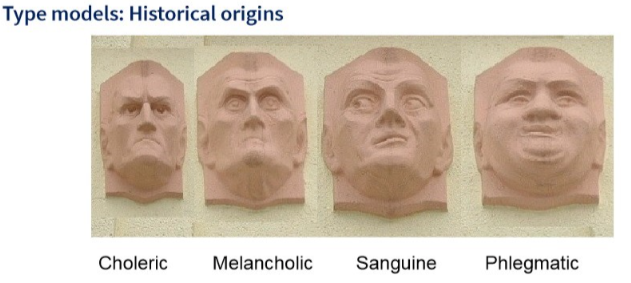
What are personality type models?
People can be organised into discrete, discontinuous categories
Intuitive, easy to grasp, beneficial for non-expert individuals
E.g. MBTI
BUT lacks internal consistency, test-retest reliability + predictive validity (Pittenger, 2005)
Not considered credible in academic psychology BUT widely popular outside of it (particularly in the workplace)
What is a dynamic model of personality?
Traits only have modest correlations with behaviour
0.3 *Mischel, 1968)
Trait psychology has been unfashionable for several decades (70s-90s)
Situationists believe that all behaviour comes from the environment
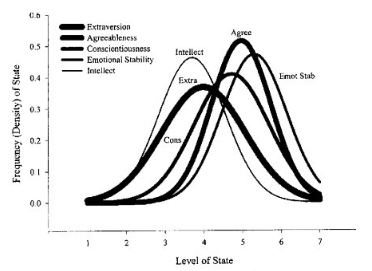
What is the interactionist perspective of the personality?
Personality traits reflect stable patterns of corresponding personality states 9Fleeson, 2001)
Behaviour is the product of trait-environment interactions
Widely accepted in the field now
How do we develop trait models?
Allport + Odbert (1936) - the lexical hypothesis dynasty
4,504 English adjectives describing people → self-report of clusters
Cattell whittled down to 171 (factor analysis to 16)
Tubes + Cristal argued that in the 171, only 5 important
1980 → Goldberg, Digman argued this is the best
Costa + Mcrea (1985) → 5-factor NEO + FF theory to support
Lots of subjectivity in this process
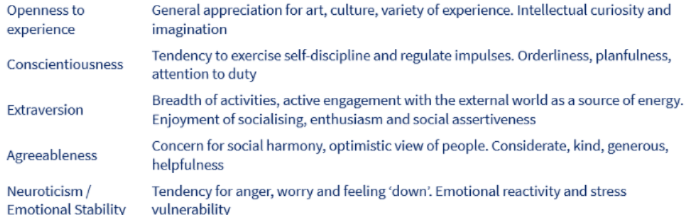
What is included in the 5-factor model?
Has 30 uniqure facets, new models have 70+ (Irwing, 2023)
What is 5-factor theory?
These factors reflect biological/genetic contributions that are relatively fixed + stable after 30
The biological seeds of which are present from birth
These traits exert direct causal influences on affect, behaviour, cognition + desire that maintain stability
Environment produces short-term variance (could be viewed as error)
Model can incorporate all aspects of personality if the hierarchy has enough detail
What are the limitations of 5-factor theory?
FFM factors correlate
Personality keeps changing
Environment contributes to stability
Actual evidence for biological coherence is limited
What traits are missing from the 5-factor model?
Antisocial behaviour
Alienation, aggression, manipulation, cruelty, greed
Other trait measure are better predictors
Social dominance, competitiveness, ambition
Risk-taking, thrill-seeking, assertiveness
Morality, spirituality, religiosity
Psychopathology
Despite the limited factors included in the 5-factor model, what evidence shows that it works?
High neuroticism + low agreeableness predict psychopathology
High conscientiousness, openness to experiences + low neuroticism predict educational achievement + attainment + work work performance
Low agreeableness predicts higher income
High conscientiousness predicts health
Why does the 5-factor model work?
Personality influences our behaviours + life choices
Despite cloudy definitions of broad factors, they’re psychologically relevant
Saturated with social desirability
BUT socially desirable behaviour is socially rewarded
Content overlap between items
E.g. conscientiousness predicts obesity because it contains items related to impulsive eating
What are sets of ABCDs?
Affect
How we feel (e.g. emotions, moods, feelings + preferences)
Behaviour
What we do (e.g. verbal utterances, physical movements)
Cogntiion
What we think (e.g. beliefs, appraisals + memories)
Desire
What we want (e.g. motives, goals + needs(
How do traits relate to ABCDs?
Traits are comprised of sets of related ABCDs
Represent patterns of ABCDs that are:
Consistent over situations
Stable over time
Heritable
How do personality inventories measure personality?
Self or other-reports of the extent to which statements/adjectives apply to respondents
Selected to cluster around traits
Scored as sums or means
Scored on 1-4/5/7 scale
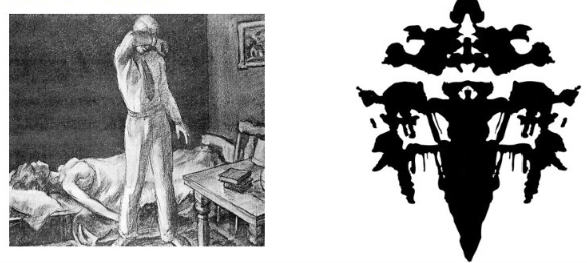
How do projective techniques measure personality?
Free-form reactions to ambiguous stimuli/situations
Reactions/responses interpreted by test administrator → can be scored numerically
What are empirically designed objective tests of personality?
Match groups differing in some crucial way on other factors
Administer tests to both groups
Identify terms that distinguish the subgroups
Used initially for clinical tested (e.g. MMPI)
What are the strengths of questionnaire measures?
Info breadth (we are the best witnesses)
Motivation to report → we’re all interested in ourselves
Causal force → self-perception influences behaviour
Practicality
What are the limitations of questionnaire measures?
Inventory responses aren’t the referenced behaviours
Many items implicitly reflect social desirability
People can easily ‘fake good’
People often lack insight into how others see them
Difficult to write items interpreted only 1 way
Self-other report → even close others rarely see targets in all situations
Can’t know how they actually feel + think
Have their own values/views about behaviour, motivations
Interpretations of projective test responses are highly subjective + speculative
What is self-presentation bias?
Bäckström (2009)
Modified personality items to be more neutral
Make plans + stick to them → avoid departing from a place once I have made one
Particularly important for traits that are less socially desirable (context dependant)
What are some common method variance and effect sizes?
Measuring our predictors + outcomes using the same method (e.g. self-report) inflates correlations among variables + we may overestimate
Typical correlation between personality + outcome measure (0.3)
Solutions: longitudinal data, informant-report, statistical control
How effective are trait measures overall?
Evidence suggests all trait measures are very good (at a population level + by the standards of psychology
High re-test reliability
Self + informant-report correlate
Different measures of the same constructs correlates
BUT type measures are less good + all personality measures are less good than intelligence measures