L5 Physical and Motor Devmt in Infancy
 Call Kai
 Learn
 Practice Test
 Spaced Repetition
 Match
 Flashcards
 Knowt Play
1/42

There's no tags or description
Looks like no tags are added yet.
43 Terms
What is the Apgar Scale used for?
It is a standard measurement system that indicates the level of health in newborns.
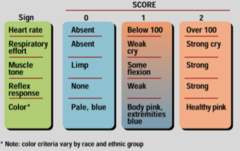
What score on the Apgar Scale indicates that a newborn needs attention?
A score of less than 4.
How many categories are in the Brazelton Neonatal Behavioral Assessment Scale (NBAS)?
27 categories.--> neurological & bh responses to envmt
what does NBAS measure
interactions with others
motor bh
physiological control
response to stress
Definition of reflex
involuntary responses occurring automatically, genet determined, universal + useful for diagnostic
FOR INFANTS: building blocks --> voluntary movements
What are survival reflexes in infants?
such as sucking, swallowing, and rooting.
What are primitive reflexes?
reflexes that are remnants from the past.
- the moro reflex
- babinski reflex
- swimming reflex,
What are the six infant behavioral states?
Regular sleep, irregular sleep, drowsiness, alert inactivity, alert activity, and crying.
ft. of regular sleep (how much and..)
(8-9hpd) Eyes closed, no eye movements, no activity except occasional jerky movements
ft. of irregular sleep (how much and...)
(8-9hpd) eyes closed, REM, activity low, slow mvmts, irreg breathing // 'dreaming'
ft. of drowsiness (how much and..)
(1/2-3hpd) : eyes open, drooled, delayed response to stimuli
ft. of alert inactivity (how much)
2-3hpd
ft. of alert activity (how much and..)
(1-3hpd) : 'interactable', diff threshold levels ==> become irritable, fussing "temperment" "building blocks of personality"
ft. of crying (how ,uch and....)
1-3hpd signal of distress, hunger, pain
How does the amount of sleep change from infancy to later years?
18 hpd to 12 hpd
REM patterns of decrease
REM --> internally stimulated which promotes brain dvmt + compensates lack of stim
decrease of REM--> more external stimulation
What is the significance of crying in infants?
Crying signals distress such as hunger, discomfort, or pain.
Weight at 5m
15lb
weight & lenght at age 1
22lb and 30in
weight at age 2
30lb
when does the increase in height and weight occur?
first year then stabilizes
What are the four principles governing physical growth in infants?
Cephalocaudal direction, proximodistal direction, hierarchical integration, and independence of systems.
cephalocaudal direction?
head-downward
proximodistal direction?
centre-outward
hierarchical integration?
simple skills develop separately and independently; later are integrated into more complex skills
independence of systems?
different body systems grow at different rates
What happens to the proportions of the head as a child grows?
The head proportion decreases from 1/4 at birth to 1/8 by age 25.
ft. of bones during infancy?
Bones are soft and pliable.
ft. of skull during infancy
Fontanelles are soft spots that allow the brain to grow.
when is main brain growth spurt?
period of infancy
different motor skills
Motor skills
gross (large muscles: walking, jumping) and fine (small muscles: writing, grasping) actions,
locomotion is a specific type of gross motor skill == moving the body from one place to another (running, hopping, crawling)
3 kinds of milestones
postural control
locomotion
manual control
Postural control (1st major motor) milestones in infancy?
lift head, keep head upright, maintains upright sitting position, standing position....
Locomotion milestones
(3mo) rolls over, crawls, forward walking, creeping, scooting
manual control milestones
4mo: moves hand to mouth, scooping using thumbs/fingertips, pre-reaching
What are some milestones in fine motor skills for infants?
3mo: they can coordinate limb movements;
11mo: they can grasp objects;
2yo: they can drink from a cup without spilling.
What is the maturational viewpoint?
It suggests that motor skills unfold in a fixed, predictable, genetically-driven sequence, & environment plays minimal role
what is experiential hypothesis
importance of opportunity to practice motor skills
Dennis 60:
maturation is necessary but not sufficient
what do ethnotheories suggest on maturation
parental expectations (linked to cultural beliefs) influence timing of milestones
What is the dynamic goal-directed system in infants?
-It refers to infants actively reorganizing existing motor capabilities into more complex systems.
-each skill is a construction
what main motive of motor development?
get to interesting objects they hope to explore + perceptual development
What implications does motor development have for caregivers?
--> autonomy --> caregivers place limits on exploration --> conflict