Amount of Substance
 Call Kai
 Learn
 Practice Test
 Spaced Repetition
 Match
 Flashcards
 Knowt Play
1/16

There's no tags or description
Looks like no tags are added yet.
17 Terms
Mole
the amount of substance in grams that has the same number of particles as there are atoms in 12 grams of carbon-12.
RAM
Average mass of an element compared to the 1/12 of the mass of one atom of carbon-12
Avogadro's Constant (L)
There are6.022x 1023atoms in 12 grams of carbon-12.
No of particles =
No of particles = moles of substance (in mol) XAvogadro'sconstant
Empirical formula
the simplest ratio of atoms of each element in the compound.
A molecular formula
shows the actual number of atoms of each element present in a molecule of a compound.

Determining the formula of hydrated salts - Heating in a crucible
Determining the formula of hydrated salts
Aim:
Determine the value of \(x\) in a hydrated salt formula, e.g. \(CaSO_4.xH_2O\).
Water of crystallisation is removed as water vapour by heating.
Method:
Weigh an empty, clean, dry crucible and lid.
Add approximately 2 g of hydrated salt and weigh again.
Heat strongly using a Bunsen burner for a couple of minutes.
Allow the crucible to cool.
Reweigh the crucible and contents.
Repeat heating and weighing until a constant mass is reached to ensure the reaction is complete.
Role of the lid:
Prevents loss of solid from the crucible, improving accuracy.
Should be loosely fitted to allow water vapour to escape.
Why use an appropriate amount of hydrated salt?
Large amounts (e.g. 50 g) should not be used because decomposition may be incomplete.
Very small amounts (e.g. 0.100 g) should not be used because the percentage uncertainty in measurements will be too large.
Importance of a dry crucible:
The crucible must be dry before heating.
Any water already present would evaporate during heating, causing an excessive mass loss and an inaccurate result.
Making a standard solution
Method:
Weigh the sample bottle containing the required mass of solid (to 2 d.p.).
Transfer solid to a beaker and reweigh the sample bottle to calculate the mass transferred.
Add 100 cm³ of distilled water and stir with a glass rod to dissolve the solid (heat gently if needed).
Transfer solution into a volumetric flask using a funnel.
Rinse the beaker, funnel and glass rod with distilled water and add washings to the flask to ensure all solute is transferred.
Make up to the calibration mark using a dropping pipette for the final drops.
Ensure the bottom of the meniscus is level with the mark.
Stopper and invert the flask several times to ensure a uniform solution.
Important points:
Use distilled water to avoid contamination.
Transfer all the solid and washings to avoid losing solute.
Read the bottom of the meniscus at eye level.
Inverting ensures the solution is evenly mixed.
Diluting solutions
Method:
Use a volumetric pipette to transfer 25 cm³ of the original solution into a 250 cm³ volumetric flask.
Add distilled water until close to the mark.
Use a dropping pipette to add the final few drops until the bottom of the meniscus reaches the mark.
Stopper and invert the flask several times to ensure a uniform solution.
Important points:
A volumetric pipette is more accurate than a measuring cylinder because it has a smaller uncertainty.
Use a dropping pipette to avoid going over the calibration mark.
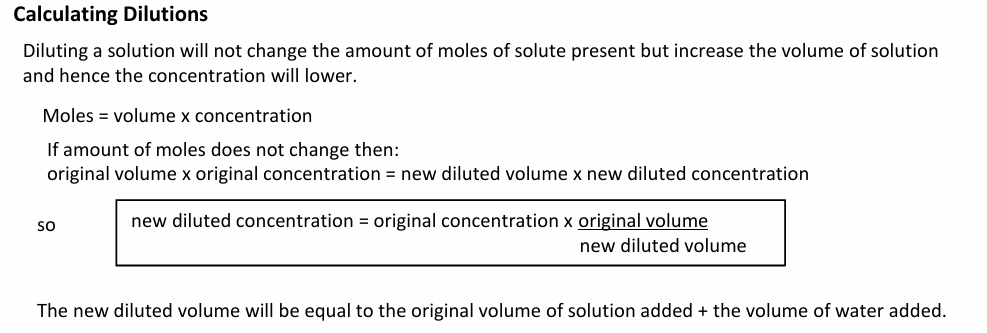
Calculating dilutions
this

Safety and hazards
Irritant- dilute acid and alkalis- wear googles
Corrosive- stronger acids and alkalis wear goggles
Flammable– keep away from naked flames
Toxic– wear gloves- avoid skin contact- wash hands after use
Oxidising- Keep away from flammable / easily oxidised materials
Acid–alkali titration
Method:
Rinse the burette with acid, pipette with alkali and conical flask with distilled water.
Use a pipette to transfer 25 cm³ of alkali into the conical flask. Touch the pipette against the flask's inside surface to ensure the correct volume is transferred.
Ensure the burette jet is filled with acid.
Add a few drops of suitable indicator to the conical flask.
Place the flask on a white tile to make the colour change easier to see.
Add acid from the burette whilst swirling the flask. Add acid dropwise near the end point.
Record the initial and final burette readings to calculate the titre.
Repeat until at least two concordant results are obtained (within 0.1 cm³ of each other).
Indicators:
Phenolphthalein: Pink in alkali → colourless in acid. End point: pink just disappears. (Suitable for NaOH.)
Methyl orange: Yellow in alkali → red in acid. End point: orange. (Suitable for HCl.)
Safety precautions
Acids and alkalis are corrosive (dilute acids may be irritants).
Wear eye protection and gloves.
If a spill occurs, immediately wash the affected area.
Treat unknown substances as potentially toxic and wear gloves.
Calculating average titre
Only calculate the average using concordant titres.
Concordant results are within 0.10 cm³ of each other.
Concordant results indicate good repeatability and a consistent titration technique.
Important titration points
Testing batches
- Test several samples during quality control because the concentration may vary between samples.
Titrating mixtures
Check whether other substances in the mixture have acid–base properties.
If they do not, they will not interfere with the titration.
Neutralising excess acid
Sodium hydrogen carbonate (NaHCO₃) and calcium carbonate (CaCO₃): Neutralise excess acid and are not corrosive. They produce CO₂, which can cause wind.
Magnesium hydroxide: Weakly alkaline and poorly soluble, making it suitable for neutralising excess stomach acid. It does not produce CO₂.
Strong alkalis (e.g. sodium hydroxide) are unsuitable because they are corrosive.
Important titration points
Conical flask: Easier to swirl without spilling than a beaker.
Distilled water: Washes liquid from the flask's sides into the mixture. Does not affect the titre because it does not change the number of moles of acid or alkali.
Indicator: Only add a few drops because indicators are weak acids and excess can affect the result.
Burette jet: Must be filled with acid before starting. Otherwise, acid filling the jet during titration causes an inaccurately high titre.
Uncertainty
Uncertainty
Uncertainty of a reading (one judgement): At least ±0.5 of the smallest scale division.
Uncertainty of a measurement (two judgements): At least ±1 of the smallest scale division.
Calculating percentage uncertainty
% uncertainty=absolute uncertaintymeasured value×100% uncertainty=measured valueabsolute uncertainty×100
- For two or more measurements, add the absolute uncertainties before calculating percentage uncertainty.
Reducing uncertainties in a titration
Replace measuring cylinders with pipettes or burettes, which have lower apparatus uncertainty.
Increase the titre volume to reduce percentage uncertainty. This can be done by:
Increasing the volume or concentration of the solution in the conical flask.
Decreasing the concentration of the solution in the burette.
Reducing uncertainties when measuring mass
Use a balance that measures to more decimal places or use a larger mass to reduce percentage uncertainty.
Weigh the sample bottle before and after transferring the solid, then calculate the difference for a more accurate mass measurement.
Comparing percentage uncertainty and percentage difference
- Percentage difference:
∣actual value−calculated value∣actual value×100actual value∣actual value−calculated value∣×100
If percentage uncertainty is smaller than percentage difference, there is a discrepancy caused by other errors.
If percentage uncertainty is greater than percentage difference, there is no significant discrepancy; the difference can be explained by the sensitivity of the equipment.