Exam 3 and Quiz Study Guide Bio 189
 Call Kai
 Learn
 Practice Test
 Spaced Repetition
 Match
 Flashcards
 Knowt Play
1/67

There's no tags or description
Looks like no tags are added yet.
68 Terms
Fluid Mosaic model
the membrane is considered to be a fluid combination of phospholipids, proteins, and other molecules
Plasma membrane
Membrane barrier surrounding cell
Selectively permeable → allows certain items to pass from one side of the barrier to the next
Selective permeable
Allow certain items to pass from one side of the bilayer to the other.
Parts of a Phospolipid
Complex phosphate group → Hydrophilic
Glycerol backbone → 3 - carbon sugar
Two fatty acid chains → Hydrophobic, C + H chains
Inside and Outside membrane → composed of -P (negatively charged phosphate → hydrophilic)
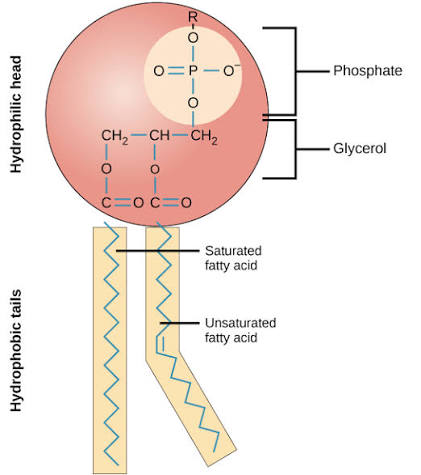
Total Part of a Plasma membrane
Proteins, Cholesterol, Glycoproteins, Glycolipids
What molecules can easily pass through the membrane without help?
Small, neutral (non-polar) molecules Ex: CO2, O2
What molecules struggle to pass through the membrane and need help?
Large, polar molecules Ex: glucose
Requires transport proteins inside the membrane to move to the other side
Embedded
Inside membrane
Attached
Outside membrane
Whats inside the plasma membrane?
Cholesterol (steroid)
phospholipids (they are the bilayer)
integral proteins
Whats outside the plasma membrane
Cytoskeleton filaments
Peripheral proteins
Carbohydrates
Membrane fluidity is regulated by____
Cell membrane fluidity
Type of phospholipid → SAT or UNSATURATED fatty acids
Cholesterol amount → temperature buffer
Regulates fluidity at low and high temps
Membrane is hot
More Saturated fatty acids in phospholipid
Cells want more rigid/viscous membrane (less fluid)
Membrane is cold
More Unsaturated fatty acids in phospholipids
Cell wants more fluidity
Peripheral Proteins
Attached to surface of membrane
Hydrophilic

Intergral Proteins
Inside the bilayer - among fatty acids
(Hydrophobic + Hydrophilic) → Amphipathic

Membrane protein functions
Transport 2. Enzyme Activity 3. Signal Transduction 4. Cell to Cell
Diffusion
Molecules → [HIGH] to → [low]
What effects the rate of Diffusion?
Temperature
Concentration gradient
starting diameter of solute
High temp → Faster Diffusion
Greater the difference from [High] to [Low] → Faster Diffusion
Smaller starting diameter → Faster Diffusion
(Greater concentration gradient)
Molecules are in a constant motion? True or False
True

Bowinian Motion
Molecules → constantly moving and bumping into one another, heading into unique directions
Ex: billiard balls
molecules get evenly spread
Gradient
Difference in concentration across region
Osmosis (Passive)
Movement of water (or solvent) across a selectively permeable membrane
Diffusion of water → [High] to [low]
Water moves towards → MORE SOLUTE
Water likes more stuff
Solute Concentration
[High Solute] on one side → less room for water → Low water concentration
[Low Solute] on one side → more room on low concentration side
3 Types
Isotonic [Equal Solute] = [Equal Solute] on both sides
Hypotonic [More Solute inside] ←[Less Solute]
Hypertonic [Low Solute inside] ← [More Solute]
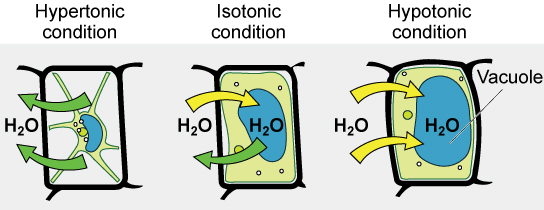
Isotonic
Equal solute concentration on both sides of the plasma membrane
[Inside] = [Outside]
[Solute] = [Solute]
Equal [Solute] → Equal water concentration
Water molecules move in and out at EQUAL RATE. No Net movement of water across membrane
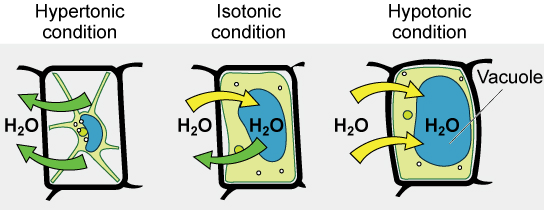
Hypertonic
Higher solute concentration → OUTSIDE cell
Low solute concentration → INSIDE cell
Water concentration HIGHER in side the cell and at a LOWER concentration outside the cell.
Random Molecular motion → Diffusion [High] to [Low]
Water leaves the cell going outside the membrane
Cell → Shrivels and shrinks in size

Hypotonic
Low Solute concentration → OUTSIDE
High Solute concentration → INSIDE
[Low Solute] → water concentration higher
[High solute] → water concentration lower
Low water concentration INSIDE and high water concentration OUTSIDE
Remember Diffusion → [High] to [Low]
Cell → Swell, no cell wall protection leads to burst of cell
What happens to Animal and Plant cells during a Hypertonic, Isotonic, and Hypotonic solution
Isotonic → Equal [solute] going in and out
Animal cell normal
Plant cell → Flaccid
(limp or soft because water is no longer pushing the plasma membrane into the cell wall, no structure) loss of tugor
Hypertonic → Higher [solute] outside | Lower [solute] inside
Animal cell → Shriveled (water leaves the cell, remember diffusion [High] to [Low]
Plant Cell → Plasmolyse (water leaves the cell, no pressure to keep structure up → shrinking, wilting)
Remember: [Low Solute] = High water concentration (Diffusion [High] to [Low]
Hypotonic → Low [solute] outside | higher [solute] inside
[High water] | [Low water] = Water rushes inside the cell leading to burst
Animal Cell → Lysed (to burst)
Plant Cell → Turgid (Swollen , puffed up, normal state)

Solute concentration displaces the water concentration
High Solute → low water concentration
(solute takes up space)
Low Solute → high water concentration
(water takes up space)
Hypo
Animal cell lyses, BURSTS. Plant cell is ok (cell wall prevents burst)
Hyper
Animal cell SHRINKS. Plant cell Plasmolyze (Shrinks because of loss of water)
Osmoregulation
Process of controlling solute concentration and water balance within the cell (organism)
Ex: homeostasis
Passive Cell Transport
[High] → [Low]
DOWN the gradient
NO energy input required for molecules → cross membrane
NO energy needed to cross membrane
Simple Diffusion
Facilitated Diffusion
Ex: diffusion, osmosis
Gradient - difference in concentration across region
Active Cell Transport
[Low] → [High]
UP the gradient
Requires energy (ATP)
Ex: Co transport, Bulk Transport (like endocytosis)

Simple Diffusion
Molecules move down the gradient
DIRECTLY through the membrane
PASS through membrane with NO HELP
Molecules
Small (2 - 3 atoms)
Non-polar (Hydrophobic
Ex: O2, CO2, fatty acids
H2O can pass through the membrane BUT
very slowly
abundant
small

Facilitated Diffusion (helped progress)
Molecules move down gradient via
PROTEIN TRANSPORTERS (not directly by themselves)
Molecules TOO LARGE, they NEED HELP
Molecules
Large
Polar, and/or CHARGED (Hydrophilic)
Ex: Ion’s, Macromolecules, H2O
Channel Protein (Diffusion)
Diffusion → Continuous (CONSTANT) transport of molecules across bilayer (NO STOPPING)
Specific for the molecule (like an ion)
ONLY used for Passive Transport Diffusion
Channel never changes shape
Aquaporus
Channel proteins that move WATER (H2O)
water holes
Specifically made for only water
Carrier Protein (1 molecule at a time)
Discontinuous transport of molecules across bilayer
Spe
Enzymes role in biochemical reactions
Biological catalyst to speed up chemical reactions by lowering activation energy
Active site
Were the hydrolysis occurs, were the enzyme meets with the substrate.
The site on the enzyme were the substrate binds
Substrate (Starch)
(Were all the catalysis occurs) Reactants starting molecules
Substrate = Reactant
Products
Simple Sugars (Gluecose)
Ending molecule of a reaction
Enzyme (Amylase)
“ase” → Enzyme
Enzymes are Catalysts → to increase the rate of chemical reactions to rates that are biologically useful.
Function of this amylase (enzyme)
Break down starch into simple sugars
All the chemical reactions that occur in the cell
Metabolism
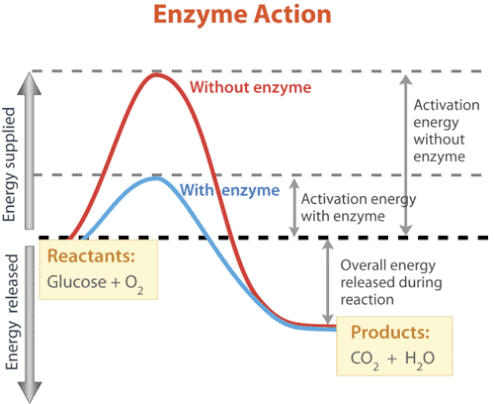
Specific Function of Enzymes
Catalyze (accelerate) reactions → Lowering activation energy needed for the reaction to occur
Speeds up reaction time to make substrates into products
To activate, an enzyme needs to bind to a ____ to form an enzyme - substrate complex
substrate
Activation Energy
Energy needed to transform the substrate into products(s)
Enzyme lowers amount of activation energy needed to transform the substrate into products
LESS ENERGY to make SUBSTRATES → PRODUCTS
Enzyme Function → Catalyze substrate into product diagram
Substrate attaches to Enzyme at the Active Site
Enzyme changes shape → when substrate enters active site (making the fit more snug)
Enzyme Complex
Enzyme + Products leaving active site
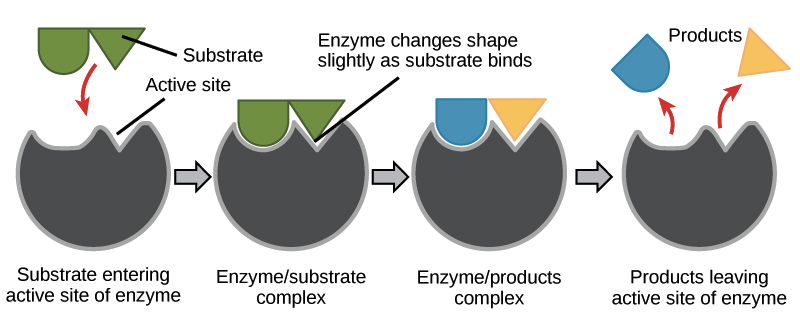
Enzymes choose specific substrates to bind with. One chemical reaction with one type of substrate.
Enzyme (Key) only has 1 lock (substrate) to turn.
True
Factors effecting Enzyme Speed
Most Enzymes are → Proteins (can be altered by…)
PH 1-13
Temperature
Salt Concentration
Result of PH, Temperature, and Salt Concentration on Enzyme
Changes the shape of enzymes active site → preventing substrate binding
three - dimensional shape of enzyme is disrupted.
Factors on Enzyme Activity
Enzyme Concentration:
High enzyme concentration → High enzyme activity
Time:
Enzyme has more time to catalyze reaction → High enzyme activity, High Asorbance
Temperature:
IDEAL / Optimal Temp (37 degrees C) → High enzyme activity
pH:
IDEAL / Otimpal pH (ex: 9pH) → High Enzyme Activity
High Absorbance meaning
Solution Color: Dark Blue
Amount of Starch: A lot
Enzyme Activity: Low
Low Absorbance
Solution Color: Light Blue
Amount of Starch: Not a lot
Enzyme Activity: High
How to tell if something is a enzyme
Ends in “ase”
Ex: Amalyase → Enzyme (ends in “ase”)
How do enzymes catalyze a reaction?
Lower Activation Energy
How do enzymes lower activation energy?
Position/Orient substrate in specific way
Weaken covalent bonds by bonding substrate
Aerobic Cellular Respiration
Metabolism of glucose (C6 H12 O6) Using O2 to generate lots of ATP
Catabolism of gluecose using Oxygen (O2) to generate lots of ATP
Aerobic Cellular Respiration Formula
C6 H12 O12 + 6O2 → 6CO2 + 6H20 + ATP (Energy)
Gluecose is Oxidized
Glycolysis
First Step
Located → Cytoplasm (outside mitocondria)
O2 NOT NEEDED
IN : Gluecose, NAD+
OUT : Pyruvates, NADH, ATP
NAD + → NADH (More e- / energy)
Pyruvate Oxidation (Transition Stage)
Located → Mitocondrial Matrix
Needs O2 (Oxygen)
IN: Pyruvates, NAD +, COA
OUT: Acetyl COA, NADH, CO2
Citric Acid Cycle (Krebs Cycle)
Located → Matrix
Requires O2 (Not directly)
IN: Acetyl COA, NAD+, FAD
OUT: CO2, NADH, FADH2, ATP
Oxidative Phosphorylation (Electron Transport)
Located → Inner mitochonidrial membrane
Requires and uses O2 (oxygen) → final electron acceptor
IN: NADH, FADH2, O2
OUT: NAD+, FAD, H2O, A lots of ATP, Drop
Two Types of Fermentation
Lactic Acid Fermentation and Alcohol Fermentation
Lactic Acid Fermentation