Sexual Reproduction Lecture 4 + 5
 Call Kai
 Learn
 Practice Test
 Spaced Repetition
 Match
 Flashcards
 Knowt Play
1/35

There's no tags or description
Looks like no tags are added yet.
36 Terms
Homology
Being derived from the same primordial tissue. Structures that develop from the same stem cells. Example: penis and clitoris.
Gamete
Haploid cell capable of reproduction by fusing with another haploid gamete. A process called fertilization.
Two Types of haploid cells:
Sperm: gametes (haploid N) produced by testes in a process called spermatogenesis
Ova: gametes (haploid N) produced by the ovaries in a process called oogenesis.

Penis
Internally made up of nerves, blood vessels, and cylinders of erectile tissue and urethra
Primary functions:
serves as conduit for urine to leave the body
Serves as conduit for semen(contains sperm) to leave the body
Organ of sexual pleasure
Three sections:
Glans: Head of the penis
Shaft: body of the penis
Root: base of the penis

Penis: Scrotum
a thick, two-chambered pouch of skin and muscle located behind and below the penis
Pouch of skin that holds the testicles

Internal Anatomy of the Penis: Glans (Head of the Penis)
The glans is made up of:
Corona
Meatus
Frenulum
Foreskin (Prepuce) —> Smegma —> Circumcision

Internal Anatomy of the Penis: Shaft (Body of Penis)
Cylinders of Erectile Tissue —> Internally, the shaft consists of three cylinders of erectile tissue
Cavernous Bodies (Corpora Cavernosa): Two cavernous bodies run dorsally along the upper portion of the penis.
Spongy Body (Corpus Spongiosum): Erectile tissue located on the underside of the penis that surrounds the urethra.

Internal Anatomy of the Penis: Root (Base of penis)
The Root and Associated Muscles —> The root features an extensive network of muscles that help control urination and ejaculation.
Crura:
—> Covered by muscle and attached to the pubic bone.
—>The surrounding muscles assist in controlling urination and ejaculation.
Kegel Exercises:
—> Strengthening these pelvic muscles through Kegel exercises may lead to stronger orgasms and improved ejaculatory control.

Scrotum cont. (scrotum temperature)
scrotum —> the pouch of skin that holds the testicles outside body
Optimal temperature for sperm production and viability is slightly below body temperature = 93°F
Vigorous exercise, sitting in hot tub and use of laptop on lap raises temperature enough to inhibit sperm production, but not boxers vs briefs
Can rise and fall depending on temperature due to tunica dartos in scrotum. Also, can sweat to cause cooling
Scrotum: tunica dartos
The scrotum can rise and fall depending on external temperature due to the tunica dartos muscle layer within the scrotum.
tunica dartos —> smooth muscle and connective tissue, raising and lowering testicles when warm or cold

Scrotum: Cremasteric muscle
ocation: Located within the scrotum and spermatic cord.
Function: Influences the position of the testicles within the scrotum.
Control: Unlike smooth muscle, it can be voluntarily contracted.

External Anatomy: Perineum
Perineum → sensitive area between genitals and anus
massaging area can enhance pleasure & orgasm
Supports urogenital muscles important in defecation(pooping)
(same loc for male and female)

External Anatomy: Pubic hair
Pubic hair —> may act as cushion during sexual contact & traps scents that are attractive
“Manscaping”: shaving or trimming pubic hair is a common ritual
Advantages: can make one feel more sexually attractive. Some people prefer performing oral sex on a partner who has shaved pubic hair
Disadvantages: itching can occur when hair grows back, could cause nicks or abrasions on skin lending to easier transmission of infectious agents.
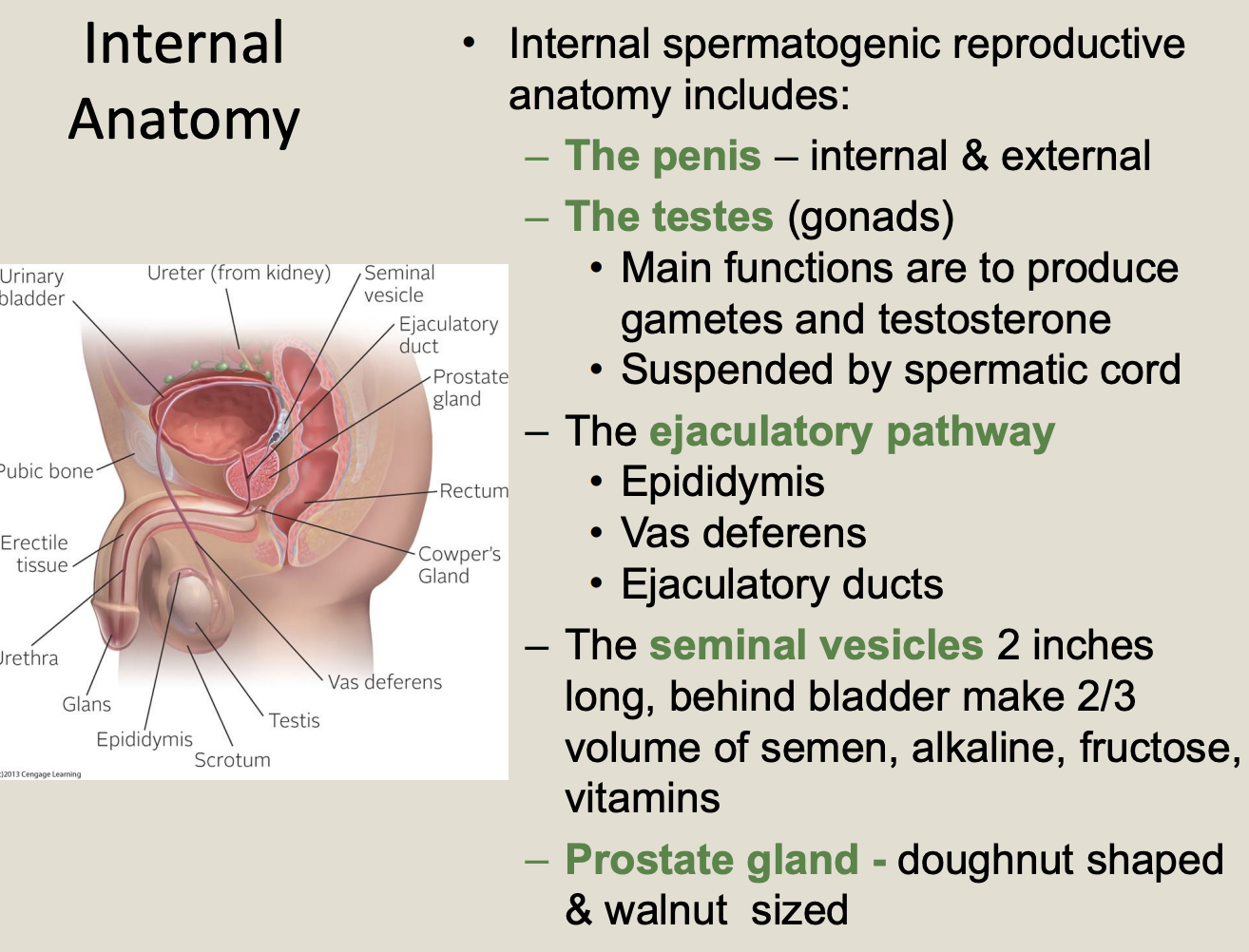
Internal Anatomy: What does it include?
The penis (ALSO external)
The Testes
ejaculatory pathway
seminal vesicles
Prostate gland
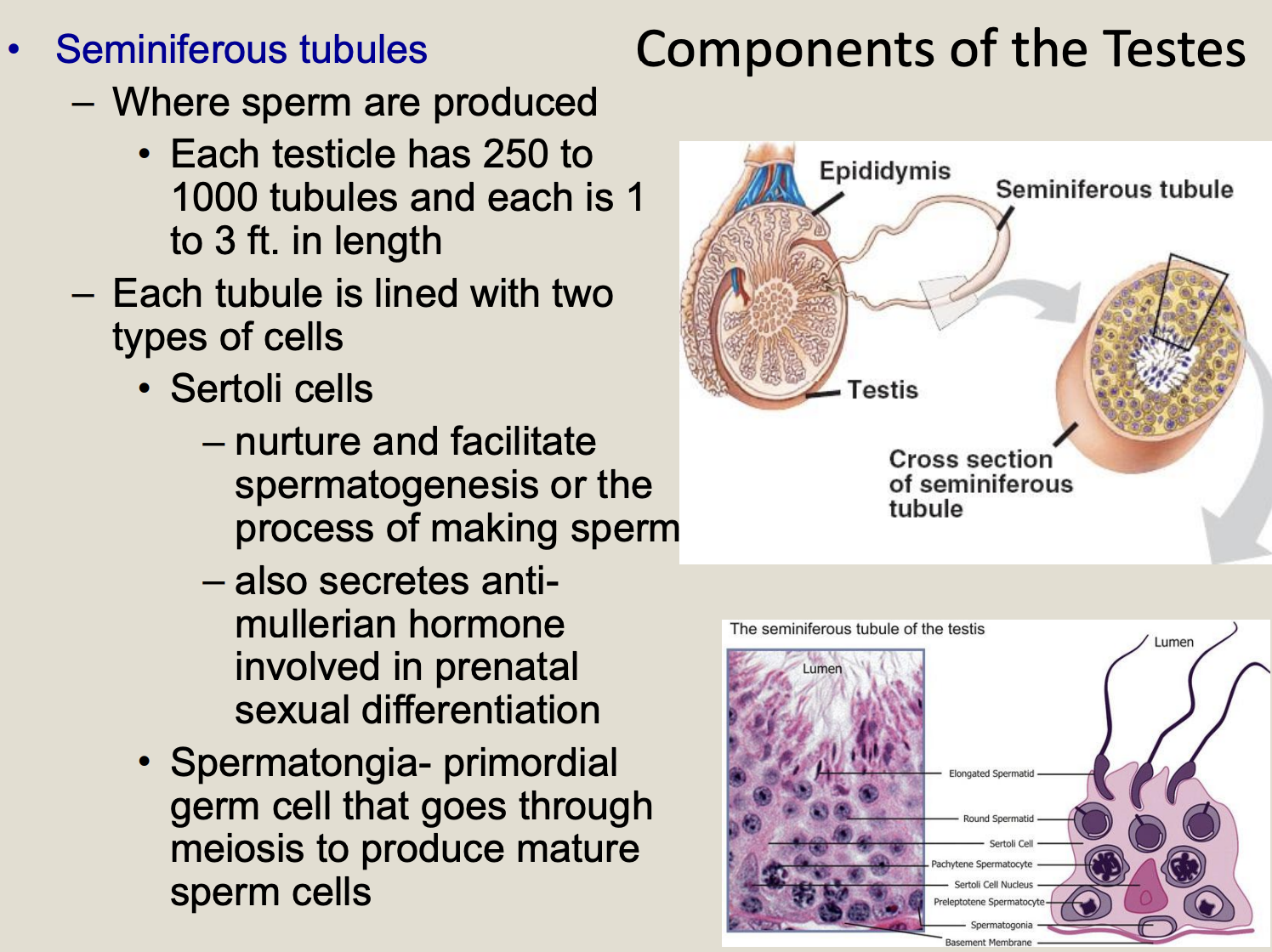
The Testes: Semineforous tubules
Sites where sperm cells are produced
Each tubule is lined with two types of cells
Sertoli cells —> nourish sperm cells
Spermatagonia —> Stem cells; receive testosterone and divide into sperm
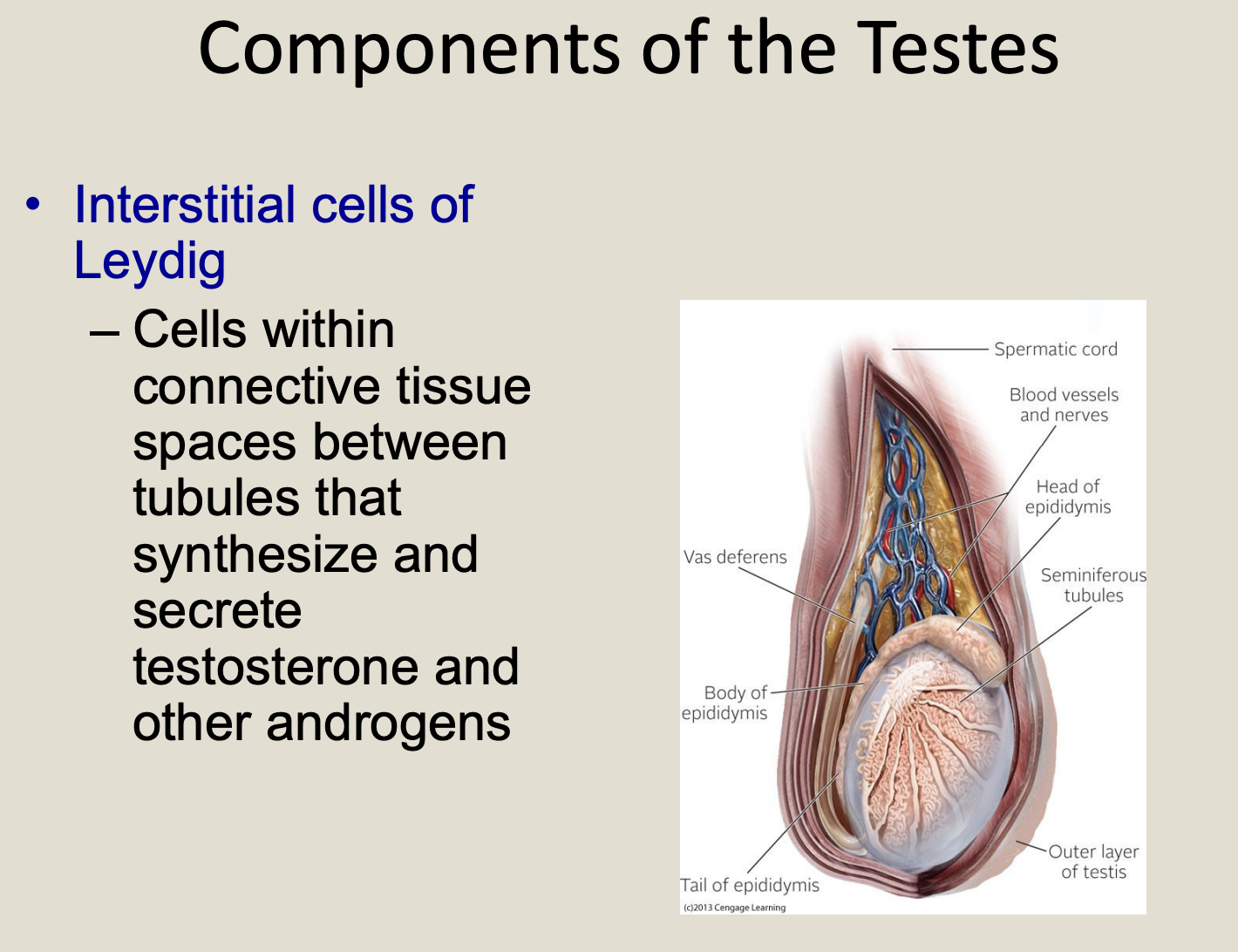
The Testes: Interstitial cells of Leydig
Specialized endocrine cells located in the connective tissue surrounding the seminiferous tubules in the testes.
synthesize and secrete testosterone and other androgens
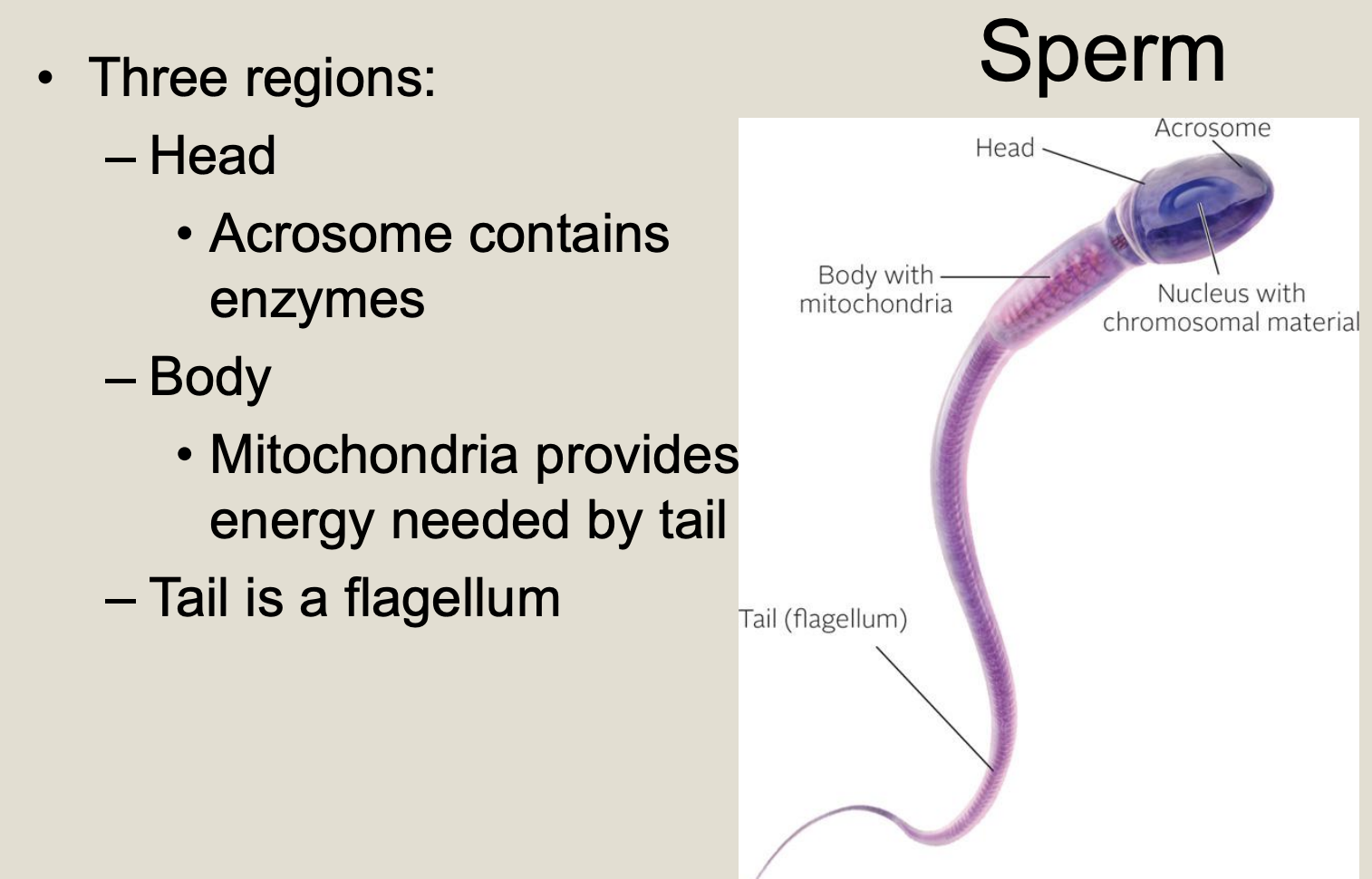
Sperm
3 regions
Head
contains Acrosome which has enzymes
Body
has mitochondria which provides energy for the tail
Tail
Tail has a flagellum
Sperm: chromosomes
Sperm carry chromosomes
Chromsomes —> Components in the nucleus of a cell that contain genes (DNA)
Chromosome count
Somatic cells —> (2n) 46 chromosomes
Gametes —> (n) 23 chromosomes (only carry a single set of chromosomes)
Types of chromosomes
Autosome —> non-sex chromsomes
Sex Chromosome —> Sex chromosomes (carries as X or Y)
—> XY induces the formation of spermatogenic structures
—> XX induces the formation of oogenic structures
Spermatogenesis vs.Oogenesis

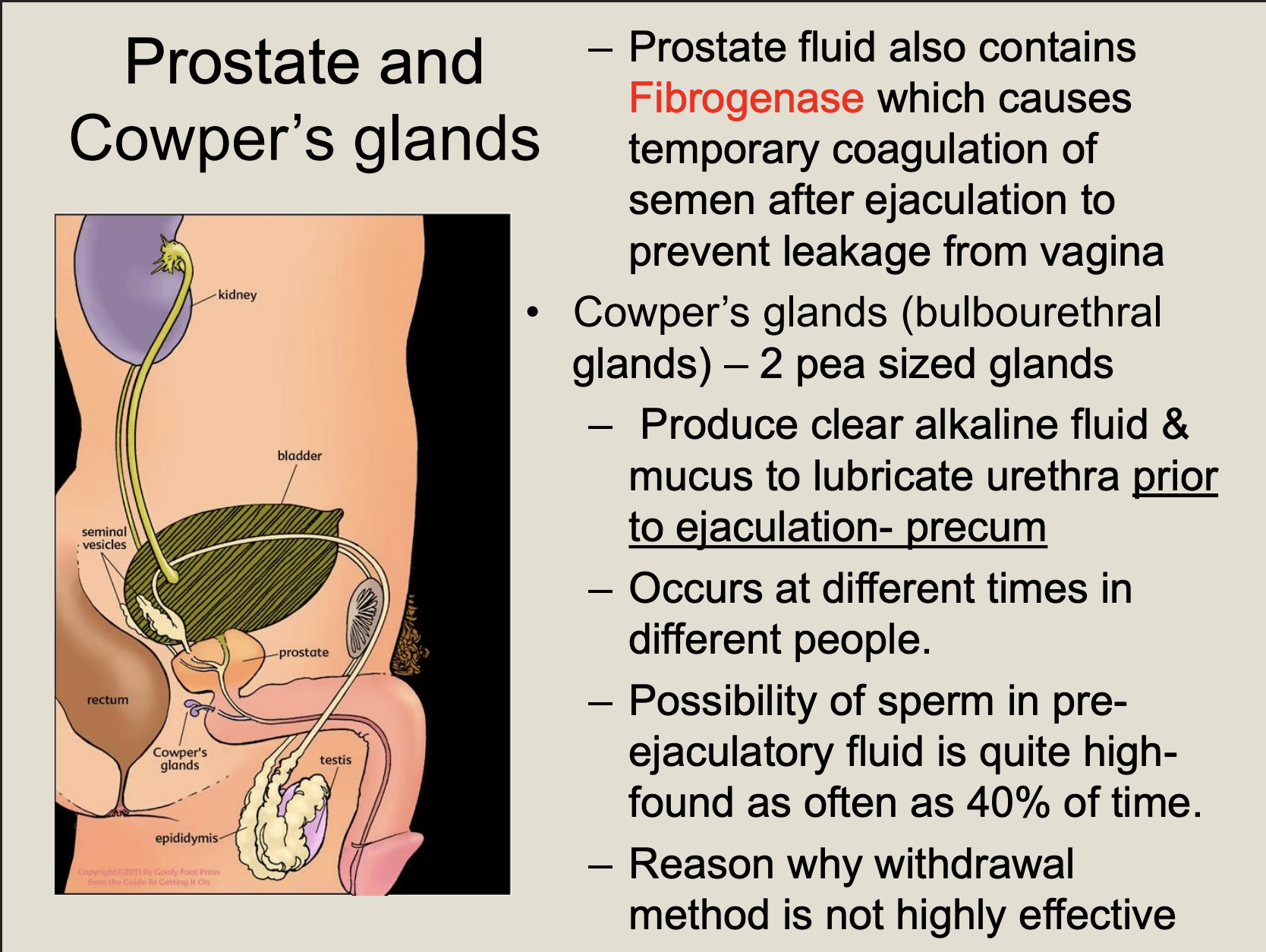
Seminal Vesicle
Seminal vesicles are a pair of glands positioned behind the bladder adjacent to the end of vas deferens
Seminal Vesicle Fluid: Accounts for 70% of semen volume
This fluid is alkaline to help sperm survive longer and contains fructose and vitamins to nourish and provide energy for the sperm to propel themselves by flagella.
Prior to seminal vesicles sperm move via tiny cilia in the vas deferens.
Prostate gland
made up of smooth muscle fibers, connective tissue, small tubes, and clusters of glands that produce a clear fluid.
Makes up about 30% of semen
During ejaculation, the muscle fibers in the prostate squeeze fluid from the tiny glands into the urethra.
produces milky, alkaline fluid with proteins, enzymes, and minerals —> enhance mobility and survival of sperm.
Contains Fibrogenase, an enzyme that causes temporary coagulation (clotting) of semen after ejaculation to prevent leakage from the vagina.

Cowper’s Glands (precum gland)
Consists of 2 pea-sized glands.
Produces a clear, alkaline fluid and mucus to lubricate the urethra prior to ejaculation
The possibility of sperm being present in pre-ejaculatory fluid is quite high—found as often as 40% of the time
The presence of active sperm in pre-ejaculatory fluid is the primary reason why the withdrawal method is not highly effective
The Ejaculatory Pathway
Sperm are produced in seminiferous tubules (within the testes)
From testes they travel to epididymis, they spend three weeks maturing with the help of sperm forward-mobility protein
Mature sperm are carried through vas deferens within spermatic cord.
Fluid from seminal vesicles and prostate get introduced to the sperm in the ejaculatory ducts
over there the semen accumulates in anticipation of being ejaculated

What are Erections: Neural Pathways & Triggers
Erections —> An erection is a spinal reflex occurring in response to erotic thoughts, sensations (sights, odors), physical stimulation, or non-erotic contexts
2 Types of stimulations:
Local stimulation causes nerves to carry information to the spinal cord, which then sends signals to the penis to trigger an erection.
If stimulation originates in the brain, specific pathways transmit information down to the spinal cord and then to the penis
Sleep & Nocturnal Emissions:
Erections occur naturally during sleep, specifically during Rapid Eye Movement (R.E.M.) sleep
These may be accompanied by nocturnal emissions (commonly referred to as wet dreams)
What are Erections: Vascular Mechanism & Neurochemistry
an erection occurs when neural signals cause the arteries supplying the penis to open (dilate), allowing blood to flow freely into the erectile tissue.
The resulting expansion of the tissue compresses the veins exiting the erectile tissue, preventing blood from leaving the penis rapidly
Neurotransmitter called nitric oxide is involved in triggering erection.
Viagra and other ED medications help produce erections by increasing sensitivity of erectile tissue to nitric oxide.

Ejaculation 2 phases
Emission
semen gathering in ejaculatory duct
Expulsion
semen is expelled through urethra

Retrograde ejaculation
Semen is expelled into the bladder
Ejaculation: Emission
Contraction of vas deferens → Sperm moves along the duct
Contraction of seminal vesicles —> Fluid is added to semen
Alkaline
Movement of sperm now independent
of cilia (hair-like structures along wall of Vas Deferens)
Contraction of prostate —> Prostatic fluid is added to seminal fluid
Thin, milky, alkaline
counteract acidity of urethra and vagina
Two urethral sphincters close simultaneously:
one at the bladder (internal)
one at the exit of the prostate (external).
The urethral bulb expands as it fills with the combined seminal fluid.

Ejaculation: Expulsion
Expulsion of semen from the urethra
Strong, rhythmic contractions
muscles surrounding the urethral bulb
muscles in the penile roots
muscles along entire urethral route
Relaxation of external (but not internal!) urethral
Most semen is expelled in the first two or three contractions, with several muscle responses following (total 3-10 seconds)

Penis Issue: Hypospadias
A congenital condition where the urethra does not reach the full length of the penis (urethra is located on underside). Severity can range from mild to severe
Chordee: A condition often associated with hypospadias where abnormal tissue causes the penis to curve downward, which can lead to painful erections later in life.

Penis Issue: Peyronie’s Disease !!
Curvature of the penis caused by the growth of fibrous scar tissue
Penis Issue: Phimosis
Tight, non-retractable foreskin
Solved by circumcision
Penis Issue: Priapism
Prolonged and often painful erection
Can be due to trauma, Infection, sickle cell disease, spinal cord injury & drugs such as Viagra & cocaine
Starves erectile tissue of oxygen
Can lead to impotence
Testicle issue: Varicocele
A dilated vein in the spermatic cord, similar to a varicose vein.
A varicose vein occurs when a valve within a vein fails, causing blood to pool
It impacts sperm production and can potentially lead to infertility

Prostate Issues: Prostatitis !!!
Definition: Inflammation of the prostate gland, usually caused by bacteria entering through the urethra
Symptoms:
Systemic Infection Signals: Fever, chills, and lower back pain.
Localized & Functional Pain: Pain in the pelvis, painful ejaculation, pain with erections, and an array of urination problems.
General Impact: Associated with broad discomfort ("pain with life in general"). Some individuals describe the sensation as feeling like they have a "golf ball up their rear end".
Prostate Issues: Benign Prostatic Hyperplasia (BPH) !!!!
Definition & Prevalence: Non-cancerous enlargement of the prostate. More than 50% of people with prostate glands over the age of 45 fall into this category.
Driven by normal age-related hormone changes.
As age increases, testosterone levels decrease relative to estrogen levels, which is thought to stimulate prostate growth.
Restricts the urethra, leading to difficulty starting urine flow and an increased frequency of urination.
Types of Cancers Related to the Penis
Penile —>
Rare form of cancer
Seek medical advice for any sore on your penis
Risk factors: over age 60, multiple sex partners, chronic irritation due to smegma accumulation, and certain STIs, poor genital hygiene, tobacco use
Testicular —>
More common in younger people
Risk factors include smoking, family history, European ancestry, and cryptorchidism(aka undescended testicle).
Symptoms: hard or irregular mass in testes, fever, groin ache, heaviness in testis, tender breasts, painful fluid accumulation or scrotum swelling
Survival is greater than 90% if detected early
Prostate —>
Most often slow growing, but 2nd leading cause of cancer related death behind lung cancer for being who have a prostate and live in US
Symptoms – like prostatitis, pain in pelvis, lower back pain and urinary complications
Digital rectal exam to test for lumps or hardness
Prostate specific antigen (PSA) blood test
Treatments include radiation, cryosurgery, hormone blocking treatment, or removal
Frequent sexual activity has been reported to reduce the risk of prostate cancer