Quotations test
 Call Kai
 Learn
 Practice Test
 Spaced Repetition
 Match
 Flashcards
 Knowt Play
1/59

There's no tags or description
Looks like no tags are added yet.
60 Terms

Summarize in modern english
Laertes: For Hamlet, and the trifling of his favour,
Laertes: As for Hamlet and his casual flirting,
Hold it a fashion, and a toy in blood,
Consider it just a passing trend and a fleeting impulse of youth,
A violet in the youth of primy nature,
Like an early spring violet:
Forward, not permanent, sweet, not lasting,
Sweet but temporary, beautiful but short-lived,
The perfume and suppliance of a minute;
A pleasant scent that fills only a single minute,
No more.
Nothing more than that.
Ophelia: No more but so?
Ophelia: Is that really all it is?
Laertes: Think it no more:
Laertes: Don't believe it to be anything more than that.
What is the context of this scene (who is being spoken to)
Laertes is read to go to Francyh for his studies, and before he leaves, he sits down with his younger sister for a final goodbye.
Explain what this quote says about the character
Laertes takes his role as an older brother very seriously. Knowing he is leaving the country, he feels a strong moral obligation to shield Ophelia from potential heartbreak or ruin. His warnings show deep affection, but they also show a desire to guard her reputation and virtue, which were crucial for a young noblewoman's future at the time.
Summarize in modern english
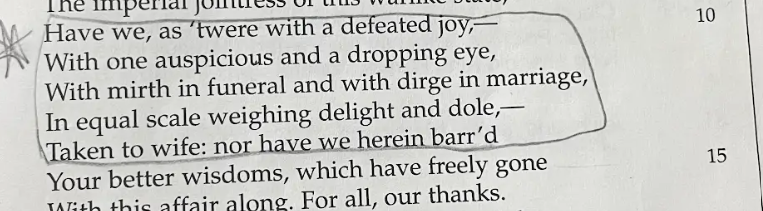
Have we, as 'twere with a defeated joy,—
Therefore, with a mixed sense of subdued or damaged joy,—
With one auspicious and a dropping eye,
With one eye smiling and the other weeping,
With mirth in funeral and with dirge in marriage,
Feeling happiness during a funeral and sadness during a wedding,
In equal scale weighing delight and dole,—
Perfecting a balance between celebration and grief,—
Taken to wife: nor have we herein barr'd
I have married Gertrude. And in doing this, I have not ignored...
Your better wisdoms, which have freely gone
...your excellent advice and counsel, which has fully supported...
With this affair along. For all, our thanks.
...this entire marriage and transition. I thank you all for your support.
Scene Context: What is Happening & Who is Being Spoken To
This is Claudius’s first official public speech as King. He is attempting to smoothly transition the state away from mourning his recently deceased brother (Old Hamlet) and toward celebrating his own sudden rise to power and hasty marriage to his former sister-in-law, Queen Gertrude.
What does it tell us about the character
This quote highlights Claudius's skill as a master manipulator and skilled orator. He uses hyper-balanced language ("mirth in funeral," "dirge in marriage") to smooth over a highly controversial situation: marrying his dead brother's wife mere weeks after the funeral. The calculated oxymorons show he is trying to look rational and empathetic, using poetic language to mask a ruthless political power grab.

Modern English Translation
O, that this too too-solid flesh would melt,
Oh, I wish that my physical body could just melt away,
Thaw, and resolve itself into a dew!
Evaporate, and turn entirely into morning mist!
Or that the Everlasting had not fix'd
Or I wish that Almighty God had not established
His canon 'gainst self-slaughter! God! O God!
His divine law against committing suicide! God! Oh God!
How weary, stale, flat, and unprofitable
How exhausting, pointless, boring, and utterly useless
Seem to me all the uses of this world!
everything in this world feels to me!
Fie on't! O fie! 'tis an unweeded garden,
Curse it! Oh, curse it! The world is like a wild, untended garden
That grows to seed; things rank and gross in nature
that has gone completely to seed; foul and disgusting things
Possess it merely. That it should come to this!
are the only things left to take it over. How could things have gotten this bad!
Scene Context: What is Happening & Who is Being Spoken To
King Claudius, Queen Gertrude, and the rest of the royal court have just departed. Moments earlier, Claudius and Gertrude publicly dismissed Hamlet’s deep mourning for his dead father as "unmanly" and stubborn, while celebrating their own recent marriage. Now left to his own thoughts, Hamlet drops his guarded public persona and reveals the true extent of his psychological agony.
What does this quote tell us about the character
These lines reveal that Hamlet isn’t just experiencing normal grief; he is suffering from severe depression and clinical melancholy. He finds absolutely no value or meaning in life ("weary, stale, flat, and unprofitable / Seem to me all the uses of this world"). He feels completely isolated, paralyzed between a desire to stop existing and the moral boundaries keeping him alive.

Modern English Translation (Lines 376–377)
I am but mad north-north-west: when the wind is
I am only crazy every now and then (when the wind blows from the north-north-west); when the wind blows
southerly I know a hawk from a handsaw.
from the south, I am perfectly sane and can tell the difference between a bird of prey and a tool.
Scene Context: What is Happening & Who is Being Spoken To
A troupe of actors (the Players) has just arrived at Elsinore castle. Right before Polonius enters to announce them, Hamlet drops a massive hint to his suspicious "friends" that he is completely aware they are spying on him. He uses this cryptic riddle to tell them that his insanity is entirely a performance.
Character insight
This quote reveals that despite his deep cynicism, Hamlet still holds a lingering, hidden trust for his childhood friends. By dropping his guard to state, "I am but mad north-north-west," he gives them a cryptic but massive hint that his insanity is entirely a performance. Instead of completely shutting them out or treating them like outright enemies, he drops a riddle that offers them a chance to understand his secret. This moment shows a vulnerable side to Hamlet; he is a isolated prince who desperately wants to trust someone from his past, choosing to test Rosencrantz and Guildenstern with a warning rather than completely discarding their friendship.

Modern English Translation (Lines 33–38)
Fear it, Ophelia, fear it, my dear sister,
Be afraid of it, Ophelia, fear it, my dear sister,
And keep within the rear of your affection,
and hold yourself back, staying behind the safe lines of your feelings,
Out of the shot and danger of desire.
well out of range of the dangerous artillery of lust.
The chariest maid is prodigal enough,
Even the most cautious and modest young woman is being reckless enough
If she unmask her beauty to the moon:
if she exposes her beauty to the night sky alone;
Virtue itself 'scapes not calumnious strokes:
even the purest virtue cannot escape malicious gossip and slander.
Scene Context: What is Happening & Who is Being Spoken To
This is the continuation of Laertes’ farewell speech to Ophelia before he leaves Denmark for France. Having already warned her that Hamlet's love is fleeting and politically restricted, Laertes now transitions into aggressive moral advice. He is explicitly instructing her to lock down her emotions and guard her virginity, warning her that even a tiny slip in judgment could permanently ruin her social standing at court.
Character insight
This quote highlights Laertes' intense anxiety over his sister’s purity and reputation. By repeatedly commanding her to "fear it," he reveals a protective instinct that borders on controlling. He doesn't trust the environment around her or the intentions of young men. His use of aggressive, urgent commands shows that he views Ophelia as highly vulnerable, and he believes it is his fraternal duty to dictate her moral boundaries before he departs.

Modern English Translation (Lines 45–51)
Ophelia: I shall the effect of this good lesson keep,
Ophelia: I will keep the moral of this good lesson in mind,
As watchman to my heart. But, good my brother,
using it as a guard to protect my heart. But, my dear brother,
Do not, as some ungracious pastors do,
do not act like those hypocritical, ungodly preachers who
Show me the steep and thorny way to heaven,
point out the steep, difficult, and painful path to heaven for me,
Whilst, like a puff'd and reckless libertine,
while they themselves, like arrogant and careless pleasure-seekers,
Himself the primrose path of dalliance treads
walk down the easy, pleasant road of sinful indulgence
And recks not his own rede.
and completely ignore their own advice.
Scene Context: What is Happening & Who is Being Spoken To
Laertes has just finished a long, intense lecture commanding Ophelia to guard her virtue, avoid Hamlet, and fear the dangers of romance before he boards a ship for France. Instead of meekly accepting the scolding, Ophelia uses this moment to respond to his speech, playfully yet firmly pushing back against his instructions.
Character Insights
This quote reveals that Ophelia is far sharper, wittier, and more independent than the men in her life give her credit for. While she opens by politely acknowledging his advice ("I shall the effect of this good lesson keep"), she immediately pivots to point out his potential hypocrisy. Her ability to construct a complex, clever metaphor about "ungracious pastors" shows a sharp intellectual agility and proves she is capable of thinking critically rather than blindly absorbing male authority.

Modern English Translation (Lines 115–123)
Doubt thou the stars are fire;
You can doubt that the stars are made of fire;
Doubt that the sun doth move;
you can doubt that the sun moves across the sky;
Doubt truth to be a liar;
you can even suspect the absolute truth of being a lie;
But never doubt I love.
but never, ever doubt that I love you.
O dear Ophelia, I am ill at these numbers; I have
Oh dear Ophelia, I am terrible at writing poetry; I do
not art to reckon my groans; but that I love thee
not have the artistic skill to count and measure my expressions of grief; but believe it,
best, O most best, believe it. Adieu.
that I love you best, oh the absolute best. Goodbye.
Thine evermore, most dear lady, whilst this machine
Yours forever, most dear lady, as long as this physical body (machine)
is to him. Hamlet.
belongs to him. Hamlet.
Scene Context: What is Happening & Who is Being Spoken To
Polonius has intercepted this private, intimate letter that Hamlet sent to Ophelia. He brings it to the King and Queen as physical "proof" of his theory that Hamlet has gone completely insane solely because Ophelia followed orders and rejected his romantic advances.
Polonius’s Ruthless Violation of Privacy
This moment highlights Polonius's completely transactional and invasive nature. He shows zero respect for his daughter's privacy or her emotional life, treating her personal love letters as political currency to gain favor with the King and Queen. By reading Hamlet's vulnerable, private "groans" aloud to the rulers of Denmark, Polonius exposes himself as a cold bureaucrat who views his own child as a tool for his courtly ambitions.

Modern English Translation (Lines 9–13
Ghost: I am thy father’s spirit;
Ghost: I am the soul of your father;
Doom'd for a certain term to walk the night,
condemned to wander through the night for a set period of time,
And for the day confined to fast in fires,
and forced during the day to suffer in flames,
Till the foul crimes done in my days of nature
until the sins and offenses I committed during my human life
Are burnt and purged away. But that I am forbid
are completely burned away and cleansed. But because I am forbidden...
Scene Context: What is Happening & Who is Being Spoken To
The Ghost has appeared on the castle walls several times, but always refused to speak. In this scene, he has successfully signaled Hamlet to leave his friends behind and follow him to a private, isolated area of the battlements. This line marks the absolute beginning of their terrifying conversation, where the Ghost finally breaks his silence to reveal the truth about his death.
Character Insights
Though Hamlet doesn't speak in these exact lines, the Ghost's opening statement highlights Hamlet's extraordinary courage and devotion to his father. To stand alone in the pitch black and listen to a terrifying phantom describe the literal fires of the afterlife requires immense psychological strength. This interaction establishes Hamlet as a deeply loyal son whose love and respect for his father's memory outweigh his natural fear of the supernatural or the damnation of his own soul.
Modern English Translation (Lines 63–66)
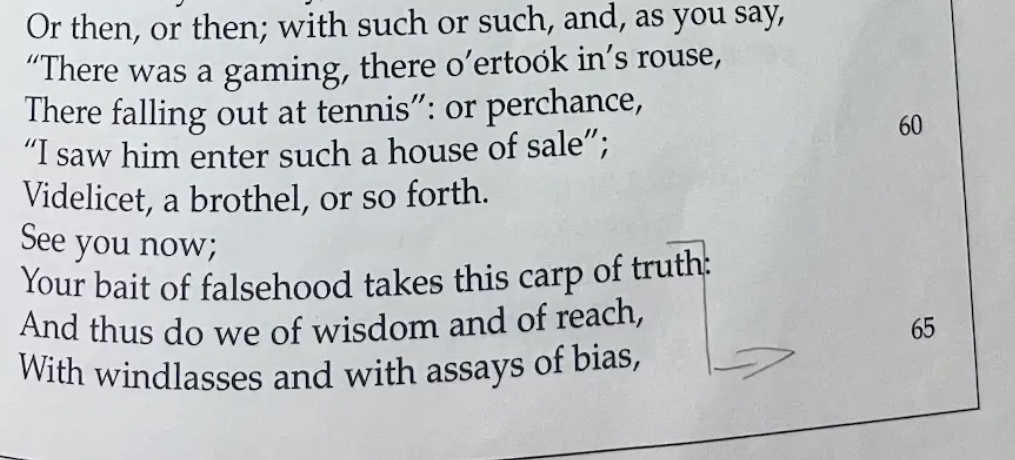
Your bait of falsehood takes this carp of truth:
Your little trap of a lie will catch the actual truth:
And thus do we of wisdom and of reach,
and this is how we wise, far-thinking people,
With windlasses and with assays of bias,
using roundabout methods and indirect approaches,
By indirections find directions out:
figure out what is really going on by taking the long way around.
Scene Context: What is Happening & Who is Being Spoken To
Polonius is preparing to send Reynaldo to Paris, where his son Laertes is currently studying. Before Reynaldo leaves, Polonius gives him detailed, highly manipulative instructions to spy on Laertes. He orders Reynaldo to spread fake, scandalous rumors about Laertes' gambling, drinking, and flirting to see if the Danish community in Paris will confirm whether any of it is true.
Character Insights
By explicitly declaring that "bait[s] of falsehood" are the proper tools to catch the "carp of truth," Polonius aligns himself with a dishonest, calculating worldview. He firmly believes that the end always justifies the means and that lying is a perfectly acceptable political tool. This insight establishes Polonius not just as a foolish old man, but as a genuinely deceptive political operative who helps cultivate the dishonest, performative, and toxic atmosphere of the Danish court.

Modern English Translation (Lines 254–256)
O God, I could be bounded in a nut-shell, and count
Oh God, I could be locked inside a tiny nutshell and still consider
myself a king of infinite space, were it not that I have
myself the ruler of a boundless universe, if it weren't for the fact that I have
bad dreams.
terrible nightmares.
Scene Context: What is Happening & Who is Being Spoken To
Rosencrantz and Guildenstern have just arrived at court. Hamlet has been explaining to them that he views Denmark as a miserable prison. When Rosencrantz tries to dismiss this by claiming Hamlet is just frustrated because his personal "ambition" is too big for Denmark, Hamlet rejects the political explanation. He uses this line to pivot away from worldly politics and explain that his agony is entirely internal and psychological.
Character Insights
The sudden shift to "were it not that I have bad dreams" exposes the severe, inescapable nature of Hamlet’s depression. It reveals that he is completely trapped, not by Denmark or by King Claudius, but by his own subconscious mind. The "bad dreams"—which stem from his grief over his father, his mother's betrayal, and his heavy burden of revenge—corrupt his mental sanctuary, turning his infinite imagination into a haunted prison that he can never run away from.

Modern English Translation (Lines 33–34)
King: Thanks, Rosencrantz and gentle Guildenstern.
King: Thank you, Rosencrantz, and thank you, kind Guildenstern.
Queen: Thanks, Guildenstern and gentle Rosencrantz:
Queen: Thank you, Guildenstern, and thank you, kind Rosencrantz.
Scene Context: What is Happening & Who is Being Spoken To
This is the formal welcoming scene for Hamlet's childhood friends. Claudius and Gertrude have summoned them to court specifically to spy on Prince Hamlet, hoping they can use their past friendship to uncover the secret behind his erratic, "mad" behavior. Rosencrantz and Guildenstern have just finished a speech submissively pledging their complete obedience to the crown.
Character Insights
This brief, echoing exchange exposes that Claudius cannot actually tell Rosencrantz and Guildenstern apart. By immediately swapping the order of their names, the Queen has to subtly correct her husband's mistake, highlighting that the King has no genuine personal relationship with or knowledge of these men. To Claudius, Hamlet’s childhood friends are completely interchangeable, faceless pawns. He treats them with polite courtly etiquette purely because they are useful tools for his espionage, revealing a cold, transactional leader who views the people around him as political instruments rather than individual human beings.

Modern English Translation (Lines 195–199)
Hamlet: Slanders, sir; for the satirical rogue says here that
Hamlet: They are malicious lies, sir; because the sarcastic writer says here in this book that
old men have grey beards, that their faces are
old men have grey beards, that their faces are totally
wrinkled, their eyes purging thick amber and plumtree
wrinkled, and that their eyes constantly ooze out thick, crusty mucus like tree
gum, and that they have a plentiful lack of wit,
sap. He also claims that old men completely lack any intelligence
together with weak hams: all which, sir, though I most
and have very weak thighs. Now, sir, even though I completely...
Scene Context: What is Happening & Who is Being Spoken To
Polonius has approached Hamlet while he is reading a book alone in the castle lobby, trying to secretly interrogate him to see if he is truly crazy. Hamlet uses this opportunity to torment the old man. Pretending to just read lines aloud from his book, Hamlet looks Polonius directly in the eye and describes a disgusting, frail, brainless old man—mocking Polonius to his face while using his "madness" as a perfect shield against getting in trouble.
Character Insights
This moment exposes Polonius’s complete lack of self-awareness. He stands there listening to a highly specific, insulting description of an old, mindless courtier, yet it completely flies over his head that Hamlet is talking about him. He is so desperate to confirm his own theory that Hamlet is lovesick and crazy that he ignores the blatant, direct insults being thrown at his character, proving that his supreme arrogance makes him remarkably easy to fool.

Modern English Translation (Lines 83–89)
Let not the royal bed of Denmark be
Do not allow the royal marriage bed of Denmark to remain
A couch for luxury and damned incest.
a mattress for lustful indulgence and cursed, incestuous relations.
But, howsoever thou pursuest this act,
But, no matter how you choose to carry out this revenge,
Taint not thy mind, nor let thy soul contrive
do not corrupt your own mind, and do not let your soul plot
Against thy mother aught; leave her to heaven,
anything against your mother; leave her punishment to God,
And to those thorns that in her bosom lodge,
and to the sharp prick of her own guilty conscience,
To prick and sting her.
which will stab and sting her internally.
Scene Context: What is Happening & Who is Being Spoken To
Standing on the dark, freezing battlements of the castle, the Ghost has just finished detailing how Claudius murdered him in his sleep. In these lines, he delivers his final, explicit instructions for revenge. He commands Hamlet to assassinate Claudius to purify the kingdom, but draws a strict, sudden line when it comes to Gertrude, forbidding Hamlet from physically harming his mother.
Character Insights
Despite his fury over her hasty remarriage to his murderer, the late King still harbors a protective instinct for Gertrude. By commanding Hamlet to "leave her to heaven" and do nothing "against thy mother aught," he deliberately shields her from his son's physical vengeance. This reveals a complex, bittersweet layer to the Ghost's character: even from beyond the grave, and even while feeling totally betrayed, he cannot bring himself to order the death of the woman he loved, choosing instead to trust that her own conscience ("thorns that in her bosom lodge") will punish her.

Modern English Translation (Lines 160–164)
Polonius: At such a time I’ll loose my daughter to him:
Polonius: When he is walking here, I will release my daughter to go see him.
Be you and I behind an arras then;
You and I will hide behind a wall tapestry at that moment,
Mark the encounter; if he love her not,
and watch their meeting closely. If it turns out he doesn't love her,
And be not from his reason fallen thereon,
and hasn't lost his mind because of his unrequited love for her,
Let me be no assistant for a state,
then fire me from my position as a government advisor,
And keep a farm and carters.
and let me go run a farm and manage cart-drivers instead.
Scene Context: What is Happening & Who is Being Spoken To
Polonius is pitching his grand espionage strategy to discover the true cause of Hamlet's erratic, mad behavior. He suggests using his own daughter, Ophelia, as bait in the castle lobby while he and the King secretly hide behind a curtain to spy on the young couple's interaction. Polonius concludes his pitch by completely staking his professional reputation on the theory being correct.
Character Insights
This quote exposes Polonius's cold, mercenary attitude toward his own child. By using the phrase "loose my daughter to him"—language typically reserved for breeding livestock or releasing hunting hounds—he reveals that he does not view Ophelia as a human being with feelings. Instead, he treats her purely as a political tool and a piece of bait to be deployed for his own professional advancement and to win favor with the King

Modern English Translation (Lines 554–557)
What’s Hecuba to him, or he to Hecuba
What does Hecuba mean to him, or what does he mean to Hecuba,
That he should weep for her? What would he do,
that he should actually cry for her? Just imagine what he would do
Had he the motive and the cue for passion
if he had the same reason and the same call to intense emotional action
That I have?He would drown the stage with tears
that I have! He would flood the entire stage with his tears
Scene Context: What is Happening & Who is Being Spoken To
Hamlet has just witnessed a visiting actor deliver a powerful speech about Hecuba, the ancient Queen of Troy, who wept over her slaughtered husband. The actor became so deeply moved by the performance that his voice broke and he shed real tears. Now completely alone, Hamlet experiences a wave of intense self-loathing, comparing this stranger's overwhelming, manufactured grief to his own real-world inaction.
Character Insights
This quote highlights Hamlet’s deep psychological torment as he compares the actor’s artificial, theatrical sorrow to his own real-world nightmare. You can see how clearly he realizes the absurdity of the situation: the actor is weeping for Hecuba, a completely fictional queen who means absolutely nothing to him. Hamlet recognizes that if this performer can summon such overwhelming, visible grief over a mere script, he would completely "drown the stage with tears" if he were actually placed in Hamlet's shoes. By recognizing how much more explosive the actor's response would be to a real tragedy, Hamlet exposes his own deep feelings of inadequacy and shame, agonizing over the fact that a stranger can easily perform the very passion that Hamlet feels paralyzed to express.

Modern English Translation (Lines 64–65)
I do not set my life at a pin’s fee;
I don't value my physical life at the price of a worthless pin;
And for my soul, what can it do to that,
And as for my soul, what harm can the Ghost possibly do to it,
Scene Context: What is Happening & Who is Being Spoken To
The Ghost of the late King has just appeared and is silently gesturing for Hamlet to follow it alone into the remote darkness. Horatio and Marcellus are absolutely terrified that the spirit might be a demon intending to drive Hamlet insane or force him to leap into the sea. They physically grab Hamlet to restrain him, but Hamlet forcefully objects, delivering these lines to explain why he is not afraid to face the apparition
Character Insights
This quote provides a raw window into Hamlet's internal agony, proving that he is experiencing a suicidal level of despair long before he ever discovers his father was murdered. By declaring that he values his physical existence at less than the price of a worthless pin ("a pin's fee"), he reveals that life has already become completely meaningless, hollow, and burdensome to him. Because he feels he has absolutely nothing left to lose, he greets a potentially lethal supernatural threat with complete indifference rather than normal human fear.

Modern English Translation (Lines 179–180)
Thrift, thrift, Horatio! the funeral bak'd meats
It was all about saving money, Horatio! The leftover food cooked for the funeral
Did coldly furnish forth the marriage tables.
was served cold to supply the feast at the wedding tables.
Scene Context: What is Happening & Who is Being Spoken To
Horatio has just arrived at Elsinore Castle from Wittenberg. When Horatio mentions that he came to Denmark to attend the late King's funeral, Hamlet cynically corrects him, saying Horatio must have actually come for Queen Gertrude's wedding. Horatio admits that the wedding followed the funeral incredibly quickly. In response, Hamlet delivers this biting, famous piece of dark sarcasm, joking that the court remarried so quickly just to reuse the funeral leftovers for the wedding guests.
Character Insights
The literal image of mixing funeral meats with a wedding feast highlights Hamlet’s deep moral outrage over the speed of his mother’s remarriage. By pointing out how the mourning period and the celebration slammed into one another, he reveals a character who is hyper-fixated on propriety, honor, and respect. To Hamlet, the court's actions are not just fast; they are a disgusting violation of natural decency, showing that he cannot comprehend how the world can move on so casually from the death of a great king.

Modern English Translation
To do obsequious sorrow: but to persever
To perform the traditional duties of mourning a dead father is expected; but to persist
In obstinate condolement is a course
in this stubborn, endless grieving is a path
Of impious stubbornness; 'tis unmanly grief:
of unholy and disrespectful stubbornness; it is an unmanly way to grieve.
It shows a will most incorrect to heaven,
It reveals a spirit that rebels against the will of God,
A heart unfortified, a mind impatient,
a weak and unprotected heart, a restless mind,
An understanding simple and unschoold:
and a childish, uneducated way of thinking.
Scene Context: What is Happening & Who is Being Spoken To
Claudius is executing a calculated political move to shut down Hamlet's visible mourning. Hamlet is still dressed in black and weeping for his dead father, which serves as a constant, silent protest against Claudius’s hasty marriage and coronation. To put an end to this, Claudius delivers a sharp, patronizing public lecture, systematically insulting Hamlet's masculinity, faith, emotional strength, and intelligence to force him to fall in line.
Character Insights
This quote highlights Claudius's ruthless willingness to use public humiliation to destroy an opponent's social standing. By calling Hamlet’s grief "unmanly," he deliberately emasculates his stepson in front of the court. Claudius uses standard patriarchal expectations—the idea that men must be stoic and unfeeling—as a political weapon, revealing a manipulative ruler who will gladly exploit personal tragedy to tear down a young man's dignity.

Modern English Translation 66-67
Hamlet: Not so, my lord; I am too much i’ the sun.
Hamlet: That's not true, my lord; I am out in the sunshine far too much.
Queen: Good Hamlet, cast thy nighted colour off,
Queen: My dear Hamlet, please take off your dark, mournful clothing,
Scene Context: What is Happening & Who is Being Spoken To
They are speaking directly to each other, but King Claudius and the entire royal court are standing right there watching the interaction.
Character Insights
This line exposes a profound lack of empathy and deep emotional insensitivity within Gertrude's character. By pleading with Hamlet to "cast thy nighted colour off," she treats his devastating, soul-crushing grief over his father's death as if it were a mere fashion choice or a superficial phase that he can easily throw away. Instead of offering maternal comfort or acknowledging his profound trauma, her primary concern is that his dark wardrobe and brooding presence are ruining the celebratory mood of her new marriage. This reveals a woman who is remarkably shallow about the emotional lives of others, prioritizing public appearance, social comfort, and political convenience far above her own son's genuine psychological agony.

Modern English Translation (Line 90
Marcellus: Something is rotten in the state of Denmark.
Marcellus: Something is deeply corrupted and wrong within the nation of Denmark.
Scene Context: What is Happening & Who is Being Spoken To
The Ghost of the late King has just appeared and signaled for Hamlet to follow it alone into the dark. Horatio and Marcellus physically tried to hold Hamlet back out of fear for his safety, but Hamlet fiercely broke away from their grip and chased the phantom into the night. Left standing alone on the freezing castle battlements, Marcellus utters this line to summarize the terrifying, unnatural situation before they decide to run after the Prince.
Character Insights
This line reveals that despite being a low-level palace guard, Marcellus possesses a remarkably sharp awareness of the world around him. He doesn't just view the Ghost as an isolated supernatural anomaly; he immediately connects this terrifying apparition and Hamlet’s erratic behavior to a deeper, systemic corruption at the highest levels of the Danish government. It shows he is a highly intuitive, observant soldier who can feel the underlying instability and moral decay plaguing his country under its new leadership.