Stats Unit 3
 Call Kai
 Learn
Learn Practice Test
 Spaced Repetition
 Match
Match Flashcards
 Knowt Play
1/23

There's no tags or description
Looks like no tags are added yet.
Name | Mastery | Learn | Test | Matching | Spaced | Call with Kai | Chat |
|---|
No analytics yet
Send a link to your students to track their progress
24 Terms
Probability
Short run is unpredictable
Long run is predictable
Law of Large Numbers
Simulated probabilities tend to get closer to the true probability as the number of trials increases
“After many, many [context], the percent of times [context] approaches [probability] in the long run.”
Probability Sentence
Probability is unpredictable in the short run and streaks are common.
Is probability predictable or not?
Simulation
A way to model random events such that simulated outcomes closely match real world outcomes
Evidence for a claim
Assuming a claim is true, find the true probability of getting the deserved result or more extreme
<5%; statistically significant, convincing evidence against the claim
Probability of gettingC more/less than a result in however many simulated trials.
Where does the percentage you compare to the <5% statistically significant come from?
Complement Rule Notation
P(AC)= 1- P(A)
Complement Rule
Probability of an event not happening
Probability of event A and B happening notation
P(A∩B)
Probability of event A and B happening
Multiply Probabilities
Probability of event A or B happening notation
P(A∪B)
Probability of event A or B happening
Add Probabilities
Mutually Exclusive
two or more outcomes that cannot happen at the same time
Addition Rule Notation
P (A or B) = P(A) + P(B) - P(A and B)
Addition Rule
When two events can happen at the same time (they are not mutually exclusive or are overlapping), you must account for their intersection so you do not count the overlap twice
Drawing a heart or a face card from a deck (there is overlap by 3 cards)
Check if the conditional probability of one event stays the same given whether or not the other event occurs
How can you tell from a two-way table if two events are independent
Conditional Probability Notation
P (A|B) = P(A and B)/ P(B)
Independent Events
Knowing whether or not one event occurs does not change the probability of the other event.
If P(A)= P(A|B) = P(A/Bc)
With Replacement means the events are _____
Independent
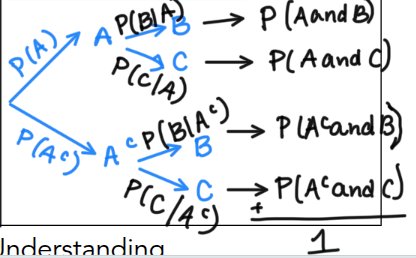
General Multiplication Rule Notation
P(A and B) = P(A) * P(B|A)
General Multiplication Rule
finds the probability that two events, A and B, both happen at the same time using the formula
Used in tree diagrams
P(A) is the first event happening and P(B|A) is the conditional probability given A occured
Tree Diagrams