Exam 4 (Exercise Testing + Prescription)
 Call Kai
 Learn
 Practice Test
 Spaced Repetition
 Match
 Flashcards
 Knowt Play
1/90

There's no tags or description
Looks like no tags are added yet.
91 Terms
What factors determine blood pressure?
BP = Cardiac Output (CO) × Total Peripheral Resistance (TPR)
CO = Heart Rate (HR) × Stroke Volume (SV)
SV is influenced by blood volume.
TPR is mainly determined by blood vessel diameter.
How does the body respond when blood pressure decreases?
↓ BP → Baroreceptors detect the change.
Medulla oblongata activates the response.
↑ Sympathetic activity → ↑ HR and SV
Vasoconstriction → ↑ TPR
↑ CO and TPR → BP returns toward normal
How does the RAAS system respond to decreased blood pressure?
Kidneys release renin.
Angiotensin II → Vasoconstriction → ↑ TPR
Aldosterone → ↑ Sodium and water retention → ↑ Blood volume
↑ CO and TPR → ↑ BP toward normal
Hypertension…
What are the two types of hypertension?
Primary (idiopathic): No identifiable medical cause.
Secondary: Caused by an underlying medical condition (kidneys, arteries, heart, or endocrine system).
What is the difference between primary and secondary hypertension?
Primary (idiopathic): No identifiable underlying cause.
Secondary: Caused by an underlying medical condition. Treating the condition may resolve the hypertension.
What are the criteria for chronic primary hypertension?
No underlying medical cause.
Resting SBP ≥130 mmHg and/or DBP ≥80 mmHg.
Average of ≥2 measurements on ≥2 separate clinic visits.
OR taking antihypertensive medication.
What is the prevalence of controlled and uncontrolled hypertension?
Only ~25% of people with hypertension have it under control.
About half of adults with uncontrolled hypertension have Stage 2 hypertension.
What are the nonmodifiable age and sex risk factors for hypertension?
Men under 60.
Postmenopausal women.
Which racial/ethnic groups have the highest hypertension prevalence?
Non-Hispanic Black adults: 56.8% men, 56.7% women.
Non-Hispanic Asian adults: 49.8% men, 39.1% women.
What defines elevated blood pressure, and how is it treated?
SBP: 120–129 mmHg AND DBP: <80 mmHg
Treatment: Healthy lifestyle modifications.
Reassess in 3–6 months.
What defines Stage 1 hypertension, and how is it treated?
SBP 130–139 OR DBP 80–89 mmHg
Assess 10-year cardiovascular disease risk
Below 10% risk: Healthy lifestyle modifications
Above 10% risk: Healthy lifestyle modifications + 1 antihypertensive medication
OFTEN ASYMPTOMATIC
What defines Stage 2 hypertension, and how is it treated?
SBP ≥140 OR DBP ≥90 mmHg
Healthy lifestyle modifications
2 antihypertensive medications from different classes
What defines severe hypertension, and what should you do?
SBP >180 and/or DBP >120 mmHg
WITHOUT symptoms (chest pain, dyspnea, back pain, weakness, vision or speech changes)
Contact your healthcare provider immediately
What defines a hypertensive emergency, and what should you do?
SBP >180 and/or DBP >120 mmHg
WITH symptoms (chest pain, dyspnea, back pain, weakness, vision or speech changes)
Call 911 immediately
What defines normal blood pressure?
- SBP <120 mmHg AND DBP <80 mmHg
What defines elevated blood pressure?
- SBP 120–129 mmHg AND DBP <80 mmHg
What defines Stage 1 hypertension?
- SBP 130–139 mmHg OR DBP 80–89 mmHg
What defines Stage 2 hypertension?
- SBP ≥140 mmHg OR DBP ≥90 mmHg
What defines severe hypertension, and what should you do?
SBP >180 mmHg and/or DBP >120 mmHg
WITHOUT symptoms
Contact healthcare provider immediately
What defines a hypertensive emergency, and what should you do?
SBP >180 mmHg and/or DBP >120 mmHg
WITH symptoms (chest pain, dyspnea, weakness, vision or speech changes)
Call 911 immediately
What is the DASH diet for managing hypertension?
High in fruits, vegetables, and whole grains
Includes low-fat dairy
Low total fat
What is the recommended daily sodium intake for hypertension?
- <1,000 mg/day (per lecture slide)
What is the recommended daily potassium intake for hypertension?
Women: 2,600 mg/day
Men: 3,400 mg/day
What are the three types of exercise recommended for managing hypertension?
Aerobic exercise
Dynamic resistance training
Isometric resistance training
How can stress management help manage hypertension?
Mind-body exercises and mindfulness
7–9 hours of sleep per night
What are the recommended alcohol limits for managing hypertension?
Men: ≤2 drinks/day
Women: ≤1 drink/day
What is considered one standard alcoholic drink?
12 oz beer
5 oz wine
1.5 oz distilled spirits (80 proof)
What are the consequences of high blood pressure (hypertension)?
Brain: Stroke (blood vessel rupture or blockage)
Eyes: Blood vessel damage
Heart: Cardiac enlargement
Arteries: Narrowing and stiffening
Kidneys: Impaired blood filtration
Sexual dysfunction: Erectile dysfunction in men or sexual dysfunction in women
Hypertension Medications…
What are the two main mechanisms by which antihypertensive medications lower blood pressure?
↓ Cardiac output (CO) = HR × SV
↓ Heart rate
↓ Stroke volume (influenced by blood volume)
↓ Total peripheral resistance (TPR)
Vasodilation of arteries
Medications can target CO, TPR, or both.
What are the main classes of antihypertensive medications?
Cardioselective beta blockers
ACE inhibitors (ACE-Is)
Angiotensin II receptor blockers (ARBs)
Calcium channel blockers (CCBs): DHP and non-DHP
Diuretics
How do cardioselective beta blockers lower blood pressure?
Block sympathetic effects of epinephrine and norepinephrine on cardiac beta receptors.
↓ Heart rate
↓ Force of contraction
↓ Stroke volume
↓ Cardiac output → ↓ Blood pressure
What is the common generic name suffix for beta blockers?
-olol
Examples: Metoprolol, atenolol, bisoprolol
also used to treat anxiety
How do beta blockers affect exercise performance?
↓ Ability to attain age-predicted maximum HR (APHRM)
↓ Exercise HR and BP → ↓ Exercise capacity
↑ Rating of perceived exertion (RPE)
↓ Maximum oxygen uptake (VO₂ max)
Earlier onset of fatigue and lactate threshold
How do beta blockers affect thermoregulation during exercise?
↓ Skin blood flow during heat stress
↑ Risk of hyperthermia
What conditions require caution when taking beta blockers?
Asthma: Can trigger bronchospasm
Diabetes: Increased risk of hypoglycemia and masked warning signs
Endurance and collegiate athletes: May impair exercise performance
What exercise precautions are recommended for individuals taking beta blockers?
Exercise indoors to minimize heat stress
Wear appropriate clothing
Stay hydrated
Use the talk test to monitor exercise intensity
How do ACE inhibitors lower blood pressure?
Inhibit formation of angiotensin II in the RAAS system.
Relax vascular smooth muscle → Vasodilation
↓ Total peripheral resistance (TPR)
↑ Urine output → ↓ Plasma volume
↓ Blood pressure
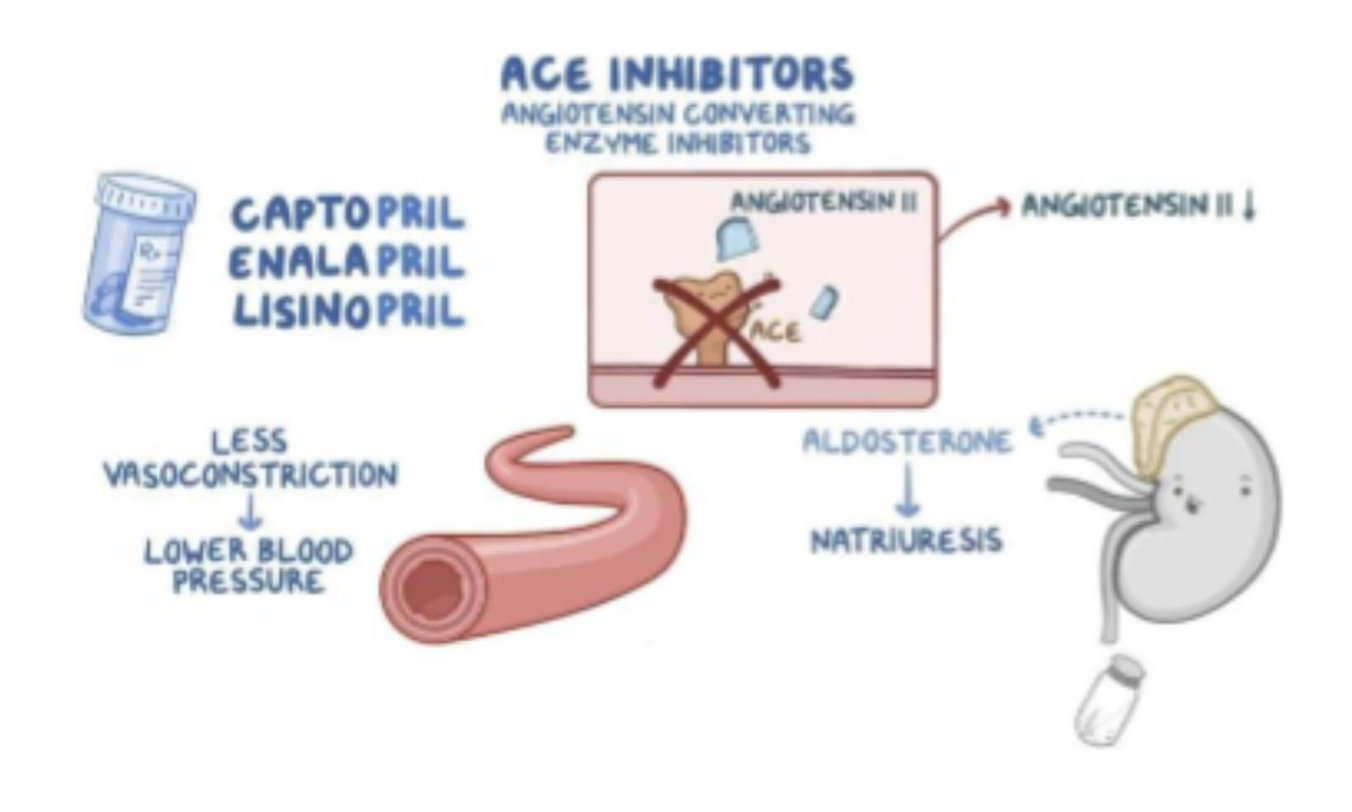
What is the common generic name suffix for ACE inhibitors?
-pril
Examples: Lisinopril, enalapril, captopril
How do ARBs lower blood pressure?
Block angiotensin II receptors on blood vessels
Relax vascular smooth muscle → Vasodilation
↓ Total peripheral resistance (TPR)
↑ Urine output → ↓ Plasma volume
↓ Blood pressure
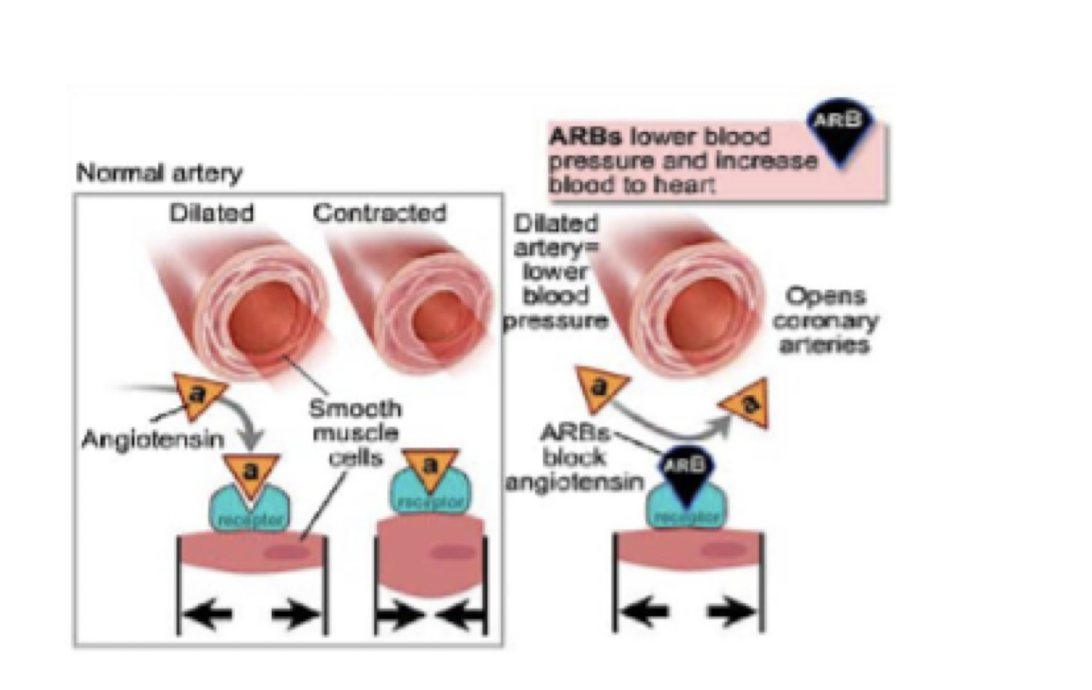
What is the common generic name suffix for ARBs?
-sartan
Examples: Losartan, valsartan, olmesartan
Why should potassium supplements and salt substitutes be limited when taking ACE inhibitors or ARBs?
Both can increase potassium levels
Increased risk of hyperkalemia
Are ACE inhibitors and ARBs considered first-line treatments for hypertension?
- Yes, both are considered first-line antihypertensive medications.
How do ACE inhibitors and ARBs affect exercise?
Little to no impact on exercise capacity
↑ Risk of post-exercise hypotension
↑ Risk of dehydration
What are the contraindications for ACE inhibitors and ARBs according to the lecture
Pregnancy
Breastfeeding
Renal diseases
How do DHP calcium channel blockers lower blood pressure?
Bind to and block calcium (Ca²⁺) channels in arterial smooth muscle cells.
↓ Calcium entry → ↓ Muscle contraction
Vasodilation → ↓ Total peripheral resistance (TPR)
↓ Blood pressure
What is the common generic name suffix for DHP calcium channel blockers?
-ipine
Examples: Amlodipine, nifedipine, felodipine
How do non-DHP calcium channel blockers lower blood pressure?
Block Ca²⁺ entry into heart cells
↓ Heart rate
↓ Force of contraction
↓ Cardiac output (Q)
Block Ca²⁺ entry into vascular smooth muscle
Vasodilation → ↓ Total peripheral resistance (TPR)
↓ Blood pressure
What are the generic names of non-DHP calcium channel blockers?
Verapamil
Diltiazem
What is the main difference between DHP and non-DHP calcium channel blockers?
DHP: Greater effect on vasodilation, less effect on heart function.
Non-DHP: Greater effect on heart function, less effect on vasodilation.

How do DHP calcium channel blockers affect exercise?
No impact on exercise capacity
Can cause reflex tachycardia
↑ Risk of post-exercise hypotension
How do non-DHP calcium channel blockers affect exercise?
- Minor impairment in ability to achieve age-predicted maximum heart rate (APHRM).
What should individuals taking non-DHP calcium channel blockers avoid?
Grapefruit and grapefruit products due to potential drug interactions.
How do diuretics lower blood pressure?
Inhibit reabsorption of sodium and other ions in different parts of the nephron.
↑ Urine output
↓ Plasma volume
↓ Blood pressure (initially through ↓ cardiac output; long-term through ↓ TPR)
Why are thiazide and loop diuretics banned by the USOC and NCAA?
- Banned due to their potential use as masking agents for prohibited substances.
How do thiazide and loop diuretics affect exercise?
Dehydration → Hypotension and hyperthermia
↓ Potassium (K⁺) → Muscle cramps and arrhythmias
High-intensity exercise or warm temperatures → ↑ Risk of rhabdomyolysis
Which athletes should avoid thiazide and loop diuretics according to the lecture?
Collegiate athletes
Endurance athletes
What is exertional rhabdomyolysis, and what causes it?
Excessive muscle breakdown and release of muscle cell contents.
Caused by exercise beyond normal limits or exercise in a susceptible athlete.
What are the risk factors for exertional rhabdomyolysis?
Heat
Dehydration
Altitude
New, intense exercise
Sickle cell
Medications
Eccentric loading
What are the signs and symptoms of rhabdomyolysis?
Muscle weakness and tenderness
Swelling
Pigmenturia (dark urine)
Decreased urine output
Fatigue
What exercise precautions should individuals taking vasodilating antihypertensive medications follow?
↑ Risk of post-exercise hypotension
Gradually terminate exercise
Extend cool-down period
Monitor BP and HR until near resting levels.
Which classes of antihypertensive medications cause vasodilation?
ACE inhibitors (ACE-Is)
Angiotensin II receptor blockers (ARBs)
Calcium channel blockers (DHP and non-DHP)
When is medical clearance required before exercise testing in individuals with hypertension?
Resting SBP ≥160 mmHg
Resting DBP ≥100 mmHg
History of HTN with known cardiovascular, metabolic, renal, or target organ disease (e.g., retinopathy).
Should antihypertensive medications be taken before exercise testing?
- Yes, all antihypertensive medications should be taken before testing, including beta blockers, according to the lecture.
What are the recommended cycle-based exercise testing protocols for hypertensive individuals?
Ramp: Increase 17 W/min (no rest)
Staged: Increase 20–50 W every 3 minutes
What is the recommended treadmill-based exercise testing protocol for hypertensive individuals?
Staged protocol
Increase 2–3 METs every 3 minutes
Rest periods available
What symptoms should be monitored during exercise testing in hypertensive individuals?
Dizziness, angina, vision changes
Ringing in ears, dyspnea
Cyanosis (blue skin)
Nausea, irregular pulse
What ECG abnormalities should be monitored during exercise testing?
ST-segment deviation >1 mm
Onset of frequent or new arrhythmias
What is the normal blood pressure response during cardiorespiratory exercise testing?
SBP increases ~10 mmHg per 1 MET as workload increases.
DBP remains unchanged or slightly decreases.
Pulse pressure (SBP − DBP) widens.
SBP returns to baseline within 3–5 minutes after exercise.

How do you predict systolic BP during exercise based on METs?
SBP increases 10 mmHg per MET above resting level.
Exercise SBP = Resting SBP + [(Exercise METs − 1) × 10]
Example: Resting SBP 110 mmHg at 3 METs → 130 mmHg
How do you estimate exercise HR based on METs according to the lecture?
- Exercise HR = Resting HR + [(Exercise METs − 1) × 10]
What are the recommendations for resistance testing in hypertensive individuals?
Avoid Valsalva maneuver
Determine 1-RM
Estimate 1-RM using 5-RM or 10-RM
Identify maximum voluntary contraction (MVC) threshold
What symptoms should be monitored during resistance testing?
Dizziness, angina, vision changes
Ringing in ears, dyspnea
Cyanosis, nausea
Irregular pulse

What are the key differences in exercise prescription for hypertensive individuals compared to healthy individuals?
Aerobic: 5–7 days/week
Resistance: 2–3 days/week
Beginners/seniors: 40–50% 1-RM
Others: 60–70% 1-RM
Maximum: 80% 1-RM
2–4 sets of 8–12 reps
Precautions: Monitor BP and symptoms; lecture specifies BP below 220/105 mmHg
Flexibility: Same as healthy individuals
What are examples of isometric exercises?
Plank and side plank
Wall sit and squat hold
Wall push
Medicine ball squeeze
Static lunge
Hip lifts
Tree pose and Warrior II (yoga)
Superman hold
How should exercise training progress in hypertensive adults?
Gradually increase FITT components
Avoid large increases, especially intensity
Progress in order: Frequency → Intensity → Load
What additional recommendations are important when training hypertensive adults?
Include stress management techniques
Isometric exercises can have significant antihypertensive effects (↓ BP)
How do you calculate target heart rate (THR) using HRR for a patient taking beta blockers?
Step 1: Calculate modified APHRM
APHRM = 164 − (Age × 0.7)
Step 2: Calculate heart rate reserve (HRR)
HRR = APHRM − Resting HR
Step 3: Calculate target HR range
THR = (HRR × % intensity) + Resting HR
Example: 58-year-old taking bisoprolol, resting HR = 68 bpm, target intensity = 50–60% HRR.
APHRM = 164 − (58 × 0.7) = 123.4 bpm
HRR = 123.4 − 68 = 55.4 bpm
THR at 50% = (55.4 × 0.50) + 68 = 95.7 bpm
THR at 60% = (55.4 × 0.60) + 68 = 101.2 bpm
Answer: 96–101 bpm
Cancer…
How are cancers named based on the tissue affected?
Carcinoma: Epithelial tissue
Sarcoma: Connective tissue
Blastoma: Bone (as listed in lecture)
Leukemia: Blood
Lymphoma: Lymphatic tissue/lymph nodes
What factors determine the stage of cancer?
Tumor size
Type of tumor cells
Extent of spread (metastasis)
Speed of spread
What are the characteristics of cancer stages 0–IV?
Stage 0: Abnormal cells localized to one site.
Stage I: Small, localized tumor.
Stages II–III: Increasing tumor size and/or regional spread.
Stage IV: Cancer has spread to distant body sites (metastasis).
⚠ Stage IV does not necessarily mean a large, rapidly growing tumor. Staging criteria vary by cancer type.
What are the six main cancer treatments and how do they work?
Surgery: Removes localized cancers and tumors.
Radiation therapy: Damages tumor DNA to stop cancer cell growth.
Chemotherapy: Interferes with rapidly dividing cancer and healthy cells.
Immunotherapy: Activates the immune system to attack cancer cells.
Targeted therapy: Targets specific cancer cell receptors or proteins (e.g., HER2).
Hormone therapy: Blocks hormones needed for cancer cell growth.
How does chemotherapy affect the body and exercise capacity?
Anemia and heart muscle damage (anthracyclines, -ubicin)
Exercise intolerance
Overwhelming fatigue
How does radiation therapy to the chest affect exercise capacity?
Damage to lungs and heart
↓ VO₂
↓ Exercise tolerance
How does androgen deprivation therapy (ADT) affect the body?
Muscle atrophy and fat infiltration (myosteatosis)
↓ Muscle strength
↓ Functional capacity
How does cancer surgery affect exercise capacity?
Heart/lung surgery → ↓ Oxygen capacity and delivery
Acute and chronic pain → ↓ Exercise tolerance
Physical inactivity → Deconditioning
How do targeted therapies (VEGF inhibitors) affect exercise?
↑ Arterial stiffness and hypertension
↓ Oxygen delivery to muscles
What are the characteristics of cancer-related fatigue?
Affects >80% of cancer patients, according to the lecture.
Does not go away with rest
↓ Motivation and capacity for exercise