How Fast? The Rate of Chemical Change
 Call Kai
 Learn
 Practice Test
 Spaced Repetition
 Match
 Flashcards
 Knowt Play
1/102

Earn XP
Description and Tags
Contents: Rate of Reaction Measuring Rates of Reaction Collision Theory Factors Aecting Rates of Reaction Activation Energy Energy Proles With & Without Catalysts Maxwell-Boltzmann Distribution Curves Rate Equation (HL) Reaction Orders (HL) The Rate Constant (HL) Reaction Mechanisms (HL) Molecularity (HL) The Arrhenius Equation (HL) Determining Activation Energy & the Arrhenius Factor (HL)
103 Terms
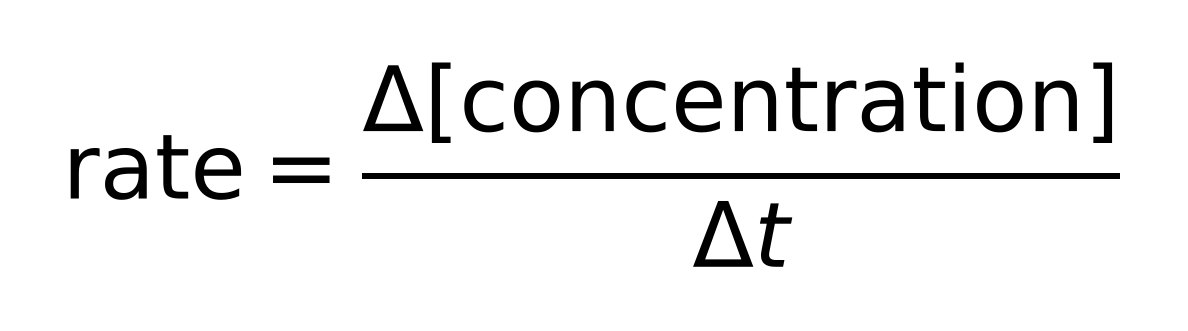
Define reaction rate.
Change in reactant or product concentration per unit time.
What are the usual units of reaction rate?
mol dm^-3 s^-1.
How does reactant concentration change during a reaction?
It normally decreases as reactants are consumed.
How does product concentration change during a reaction?
It normally increases as products form.
How is instantaneous rate found from a graph?
Draw a tangent at the specified time and calculate its gradient.
What does a steeper concentration-time gradient indicate?
A faster reaction at that time.
What does a plateau on a gas-volume graph mean?
No further net gas production is being measured.
How can gas production measure reaction rate?
Record gas volume against time using a gas syringe or collection over water.
When is collecting gas over water appropriate?
When the gas has low solubility in water.
How can mass loss measure rate?
Measure decreasing mass as gaseous product escapes.
What is a limitation of mass-loss measurements?
Small mass changes, especially for light gases, may be difficult to detect.
How does colorimetry monitor rate?
Track absorbance or transmitted light as the concentration of a coloured species changes.
Why can coloured precipitates interfere with colorimetry?
They scatter or block light rather than simply absorbing it.
How can titration be used to monitor rate?
Remove samples at known times, quench them, then titrate to find concentrations.
What does quenching mean in rate experiments?
Stopping a sampled reaction so its composition can be analysed.
When can conductivity be used to follow rate?
When the concentrations or mobilities of ions change during the reaction.
What is a clock reaction?
A method measuring time to a fixed observable endpoint.
Name variables to control in a rate investigation.
Temperature, concentrations not under study, volumes, surface area and catalyst conditions.
What is collision theory?
Reaction occurs when particles collide with sufficient energy and suitable orientation.
What is a successful collision?
A collision that leads to chemical reaction.
Define collision frequency.
Number of collisions per unit time.
What is activation energy (Ea)?
Minimum energy barrier that reacting particles must overcome.
What if collision energy is below Ea?
The collision cannot produce the reaction.
Why is collision orientation important?
Reacting parts of particles must meet in a suitable arrangement.
How does increasing concentration affect rate?
More particles per volume cause more frequent successful collisions.
How does increasing gas pressure affect rate at fixed temperature?
Higher particle concentration generally increases collision frequency and rate.
How does increasing solid surface area affect rate?
More exposed particles can collide with the other reactant.
How can surface area be increased?
Use smaller pieces or powder of the same solid.
How does increasing temperature affect particle energy?
Mean kinetic energy increases, and a larger fraction exceeds Ea.
Why does increasing temperature usually increase rate?
A greater fraction of collisions have enough energy; collisions may also be more frequent.
Does raising temperature lower Ea?
No. It changes the energy distribution, not the barrier itself.
How does a catalyst affect rate?
It provides an alternative mechanism with lower activation energy.
Is a catalyst consumed overall?
No; it is regenerated by the end of the mechanism.
What is a transition state?
A high-energy, unstable arrangement at the top of an energy barrier.
How is Ea read from an energy profile?
Energy difference from reactants to the relevant transition-state peak.
How is reaction enthalpy ΔHr read from a profile?
Energy of products minus energy of reactants.
How does an exothermic energy profile look?
Products lie below reactants; ΔHr < 0.
How does an endothermic energy profile look?
Products lie above reactants; ΔHr > 0.
What is an intermediate?
A species formed in one elementary step and consumed in a later step.
How is an intermediate shown on an energy profile?
As a local minimum between two transition-state peaks.
What does a Maxwell–Boltzmann curve represent?
Distribution of particle kinetic energies at a given temperature.
What does the area under a Maxwell–Boltzmann curve represent?
The total number or proportion of particles.
Where is the most probable energy on the curve?
At the peak.
What happens to the distribution at higher temperature?
The peak lowers and shifts right; the curve broadens.
What happens to the fraction above Ea at higher temperature?
It increases.
Does the area under the curve change when temperature rises?
Not if the total number of particles stays the same.
How does a catalyst appear on a Maxwell–Boltzmann diagram?
The Ea threshold moves left; the energy distribution remains unchanged.
Does a catalyst change ΔHr?
No; reactant and product energy levels are unchanged.
What is homogeneous catalysis?
Catalyst and reactants are in the same phase.
What is heterogeneous catalysis?
Catalyst and reactants are in different phases.
What are enzymes?
Biological catalysts, usually proteins.
Why can catalysts reduce industrial energy use?
Lower Ea allows useful reaction rates at less demanding conditions.
What is a reaction mechanism?
The proposed sequence of elementary steps producing the overall reaction.
What is an elementary step?
A single molecular event within a reaction mechanism.
How is the overall equation obtained from a mechanism?
Add elementary steps and cancel intermediates and regenerated catalysts.
Why is a mechanism considered a hypothesis?
Evidence can support or rule it out but may not uniquely establish it.
What is the rate-determining step?
The slowest step that controls the overall rate under the stated conditions.
What usually distinguishes the slow step on an energy profile?
It often has the largest activation barrier from its preceding minimum.
What is molecularity?
Number of reacting particles in one elementary step.
Define unimolecular step.
An elementary step involving one reacting particle.
Define bimolecular step.
An elementary step involving two reacting particles.
Define termolecular step.
An elementary step involving three reacting particles; it is rare.
Why are termolecular steps rare?
Simultaneous collision of three suitably oriented particles is unlikely.
What is a catalyst in a proposed mechanism?
A species used in a step and regenerated in a later step.
Can reaction orders be read from the overall balanced equation?
No; orders usually require experimental evidence.
What does the order with respect to A mean?
The exponent m of [A] in the experimentally determined rate law.
What is overall reaction order?
The sum of concentration exponents, e.g. m + n.

What is zero order in A?
Rate does not depend on [A] when other conditions are fixed.
What is first order in A?
Rate is directly proportional to [A].
What is second order in A?
Rate is proportional to [A]^2.
What happens to rate when [A] doubles for zero order?
No change.
What happens to rate when [A] doubles for first order?
Rate doubles.
What happens to rate when [A] doubles for second order?
Rate quadruples.
How do you determine an order using initial-rate data?
Compare experiments changing one concentration while keeping others constant.
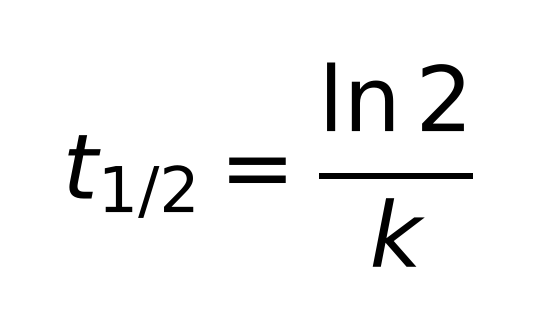
What is the rate constant k?
The proportionality constant in the rate equation at specified conditions.
How does a zero-order rate–concentration graph look?
Horizontal line.
How does a first-order rate–concentration graph look?
Straight line through the origin.
How does a second-order rate–concentration graph look?
Upward-curving parabola through the origin.
Which graph is linear for zero order?
[A] against time; gradient = -k.

Which graph is linear for first order?
ln[A] against time; gradient = -k.

Which graph is linear for second order?
1/[A] against time; gradient = +k.

How does a first-order concentration–time graph look?
Exponential decay.
How does a second-order concentration–time graph look?
Hyperbolic decay; 1/[A] versus time is linear.
What does A mean in the Arrhenius equation?
Pre-exponential or frequency factor reflecting collision frequency and orientation.
What do you plot for a linear Arrhenius graph?
ln k on the y-axis against 1/T on the x-axis.
What is the slope of ln k versus 1/T?
-Ea/R.
What is the intercept of ln k versus 1/T?
ln A.
What happens to k when temperature increases?
It generally increases, often strongly.
What happens to k when a catalyst is introduced?
It increases because the effective activation barrier is lower.