KINS 1223 Lecture Exam 2 #1
 Call Kai
 Learn
 Practice Test
 Spaced Repetition
 Match
 Flashcards
 Knowt Play
1/136

There's no tags or description
Looks like no tags are added yet.
137 Terms
resists friction in special circumstances
keratinized tissues
After shaving, Tom notices he has a small cut on his face. After just a few days the cut is significantly better and almost hardly noticeable. This is an example of what characteristic of epithelial tissue?
regeneration
In observing epithelial cells under a microscope, the cells are arranged in a single layer and look tall and narrow, and the nucleus is located close to the basal side of the cell. The specimen is what type of epithelial tissue?
columnar
Name the epithelial tissue that is primarily found in areas where protection against abrasion is important and lacks the surface layer of dead cells
Nonkeratinized stratified squamous
The simple columnar epithelium that forms the absorptive cells of the digestive tract has which characteristic?
a) Dense microvilli
b)A rich vascular supply
c) Fibroblasts
d) Cilia
a) Dense microvilli
What epithelial tissue lines the interior of blood vessels?
simple squamous
The type of epithelium lining in ovaries is
simple cuboidal
Which type of epithelial tissue specializes in moving particles across its surface and is found in airways and lining of the oviduct?
stratified columnar
Glands that secrete their products directly into the blood (such as the adrenal gland) rather than through ducts are classified as
endorcrine
Increased layers
increased protection
type of tissue that has a sheet of cells that covers, or lines, a body surface or cavity. There are two forms of this tissue that have distinct functions: covers and line cavities, walls, and surfaces; and forms glands.
epithelial tissue
epithelial tissue is _______ _______, which means it creates covering and lining function because tissues are connected to each other (tight junctions, desmosomes, hemidesmosomes)
tightly packed
The tighter the junction is, _____ mechanical force it can be placed under. The more space there is it allows _____ mechanical stress
less; more
epithelial tissue is _______, meaning it is arranged with apical and basolateral surface, each having different functions
organized
absorptive epithelial tissues
apical
nutrients absorbed through into a set of capillaries
basolateral surface
the _______ in epithelial tissues allows molecules to typically move one side to another
polarity
epithelial tissues are ________ through mitosis, typically after damage or when encountering negative environmental substances
regenerative
single layer of cells
simple epithelium

multiple layers of cells; at least two can be more; bottom lately touches basement membrane
stratified epithelium

looks stratified; reason is because nuclei are at different levels; appears stratified but its not really, it is simple. often found in respiratory tract
pseudostratified epithelium

flat, scale-like
squamous epithelium
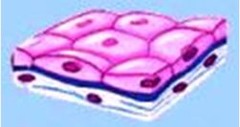
square box-like
cuboidal epithelium
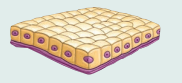
looks like column, tall, rectangle shape
columnar epithelium

stratified, stretches and can change a little bit
transitional epithelium

Flattened nuclei; Thin area between basement membrane and top of cell; Great for movement of materials like filtration and diffusion
(See these in air sacs of lung, blood vessel and capillary lumens, and body cavity linings)
simple squamous

In simple cuboidal epithelium, _______ prob won't be happening, there would be more resistance than in simple squamous.
diffusion
In _______ ________ ________, more space allows secretion and absorption to take place because cells can interact with molecules, create substance (see these in ovaries, thyroid gland, ducts and glands, kidney tubules)
simple cuboidal epithelium

Single row of cube shaped cells
simple cuboidal epithelium
Single row of columnar, tall cells, rectangle, same height in cell, creates lined uniformed look
simple columnar epithelium

have elongated nuclei, Microvilli and cilia common on apical surface, function in absorption and secretion (see these in digestive and respiratory tract lining)
Simple Columnar epithelium
_____ _____ epithelium allows for increased protection while still being able to partake in absorption in secretion
simple columnar
simple columnar epithelium, ______ _______ secrete mucus and mucus is moved around by cilia
goblet cells
What descriptor of cells would you most likely find in an area which resists friction?
a)Stratified
b)simple
c)keratinized
d)columnar
a) stratified
If your patient had an inability to absorb nutrients from the small intestine, it might indicate a disorder in which tissue(s)?
a) Simple squamous epithelium
b) Transitional epithelium
c) Simple columnar epithelium
d) Stratified squamous epithelium
a) simple squamous or c) simple columnar
Which of the following is the epithelial tissue that lines the interior of blood vessels?
a) columnar
b) pseudostratified
c) simple squamous
d) transitional
c) simple squamous
Stomach acid is very acidic. So, the stomach secretes a mucosal barrier to protect itself from the acid used to digest food. The lining responsible for creating the mucosal barrier is most likely comprised of which epithelial cell?
a) Simple squamous
b) Stratified squamous
c) Stratified cuboidal
d) Simple columnar
d) simple columnar
psedostratified columnar epithelium can be _______, which aids their function in secretion and propulsion
ciliated
Mult levels of flat/scale-like cells, can be keratinized or nonkeratinized, Allows top layer of cells to shed off "exfoliation" and protects cells underneath.
stratified squamous epithelium

in _______ _______ epithelium, there are box-like cells, secretion of materials occur and each cell produces little bit of substance than secreted from cells. (see these in male sperm duct, mammary glands, male urethra)
stratified cuboidal

Looks cuboidal at first then stretches it becomes more squamous; basal cells are cuboidal; changes as we go (found in ureters, urethra, bladder)
transitional stratified epithelium

what are the four main groups of connective tissues?
Connective tissue proper
Blood
Bone
Cartilage
what are the four characteristics of connective tissues?
Protection
structural support
energy storage/insulation
transporting substances
blood transports substances in which tissue type?
connective tissue
osteocytes: cells of
bone
fibroblasts/fibrocytes: cells of
connective tissue proper
chondroblasts/chondrocytes: cells of
cartilage
Adipocytes: cells of
fat tissue
blood cells: cells of
immunitiy
most abundant fiber of connective tissues, assemble into cross-linked fibrils that are lined vertically, bundle into thick robe-like fibers, and resists tension
collagen
long branched fiber, can stretch & recoil, and provides flexibility to tissues
elastin
short and thin collagenous fibers, assemble into mesh-like network, and provides greater degree of movement than collagen fibers
reticulin
what are the loose connective tissue types?
areolar, adipose, reticular
connective tissue that cushion organs, contains fibroblasts and collagen fibers, has immune response, water in space btwn cells to provide added protection for organs, and typically found under epithelial tissue
loose areolar
type of connective tissue whose matrix crowded by tightly packed adipocytes, Serves to insulate & protect organs as it gives extra padding, provides energy storage as it holds triglycerides, and found under the dermis (located around major organs)
loose adipose
type of connective tissue that contains a flexible meshwork of reticular fibers (string of collagen), and supports tissue and immune cells (can be found in lymph nodes & bone marrow)
loose reticular
What are dense connective tissues?
regular, irregular, elastic
type of connective tissue that is an organized tissue, has fibroblasts embedded within a regularly ordered assembly of collagen fibers, resists pulling stress, and has no/very little extracellular space (found in ligaments and tendons)
dense regular
type of connective tissue that is scattered & unorganized, has unevenly arranged collagen fibers with fibroblasts embedded within, becomes stronger when pulled, and resists force in many directions (found in dermis, joint capsules, underlying epithelial linings such as digestive tract)
dense irregular
______ tissue is made to withstand the pulling of our arm in opposite directions
dense
type of connective tissue that is enriched with elastin fibers in an ordered arrangement, allows for stretch & recoil of tissue, and can be stretched but when its released from the tension it goes back to its original length (can be found in walls of arteries to increase BP, walls of bronchial tubes to accomodate more air, & some ligaments)
dense elastic
connective tissue that supports and protects structures, is more evascalur, but does not heal very well
cartilage
type of cartilage that is flexible, has firm gel matrix secreted by chondroblasts which becomes embedded in lacunae (chondrocytes), and cushions, supports, and reinforces other tissues and organs (can be found in nose, trachea, and ribs for breathing)
hyaline
type of cartilage that has firm gel matrix secreted by chondroblasts which becomes embedded in lacunae (chondrocytes), is enriched with elastin fibers, has more degree to stretch, and allows for tissues to return to original shape (can be found on outer ear & epiglottis)
elastic
type of cartilage that has firm gel matrix secreted by chondroblasts which becomes embedded in lacunae (chondrocytes), more organized collagen fibers, resists compressive force, and is really strong (can be found in intervertebral discs, mensici, and pubic symphysis)
fibrocartilage
type of connective tissue that is fluid, contains erythrocytes, leukocytes, and platelets within a plasma matrix, and transports oxygen, carbon dioxide, nutrients & other dissolved molecules throughout the body (found within arteries (away), veins (towards), & capillaries (gas exchange))
blood
type of connective tissue that is tightly packed together with calcified collagen matrix with embedded osteocytes, has a high degree of vascularity, and functions in calcium storage, attachment for muscles, and movement (located in skeleton)
bone
cell that will break the bone and then free calcium from the collagen fibers so the calcium can be used for something else
osteocytes
type of muscle tissue that has elongated myotubes formed that fused cells, is multinucleated, is the only contractile tissue, has visible striations that line on top of eachother, is responsible for locomotion & walking and functions in voluntary skeletal movement. (found attached to bones)
skeletal muscle
type of muscle tissue that has elongated myotubes with greater degree of branching, has specialized cell junctions (intercalated discs: rhythm) seen as deep red margins between cells, ensures flow of blood to all body tissues, is involuntary, and has visible striations (located in heart wall only)
cardiac muscle
type of muscle tissue that is important in digestive system, has slow, wave like contractions, has spindle shaped cells, organized in layers that form sheets, can provide force (uterine contractions), and can accommodate stretch (digestive system) (located in walls of hollow organs)
smooth muscle
main cell in nervous tissue that receives sensory information & carries it to the brain, transmit motor impulses from brain to effector organs, and forms synapses with one another
neuron
type of nervous tissue cell that regulates environment around a neuron, and provides structural support, protection & nourishment for neurons in the brain & the spinal cord.
glial
Where is nervous tissue found?
Brain, spinal cord, and cranial & peripheral nerves
occurs at axon, where one neuron communicates with the next
synapse
What are the main parts of a neuron?
cell body, axon and dendrites.
Dendrites receive ______
info
Transitional epithelium is classified as a simple epithelium and is specialized to withstand a change in tension. True or False
False
What is the purpose of a keratinized cell in the body?
To provide protection from abrasions to the skin
What tissues function is to protect deeper tissues from an abrasive force?
stratified
Which of the following would you find in cartilage?
Osteoblasts
Adipocytes
Fibroblasts
Fibrocytes
Chondroblasts
Chondroblasts
Which connective tissue would be able to withstand that greatest amount of tension stress in a single direction?
dense regular connective tissue
what are the layers of the skin in order from the surface
Epidermis (above)
Dermis
Hypodermis
what are the functions of the integumentary system?
protection, sensation, vitamin d production, immunity, body temperature and excretion
Main cell type of epidermis, produces keratin, provides structure to skin, hair, & nails, and are water-proofing
keratinocytes
cell found in epidermis that produces pigments the eumelanin & pheomelanin giving skin & hair its color, and protects from UV rays
melanocytes
keratinized tissue =
dry
non keratinized tissue =
wet
single layer of newly produced cuboidal cells at the bottom of the epidermis, touches basement membrane, anchors epidermis and has melanocytes inside of it, contains epidermal ridges, and is a highly mitotic layer
stratum basale
spiny layer of epidermis with 8-10 rows of keratinocytes, and accumulates lamellar bodies and keratohyalin which turns to keratin
stratum spinosum
layer of epidermis that has 3-5 rows of keratinocytes, spotted layer, and large amounts of keratohaylin are produced (granules)
stratum granulosum
layer of epidermis that is a layer of dead keratinocytes, looks clear under a microscope, only found in thick skin (palms & soles of your feet), and contains translucent protein eledin
stratum lucidum
layer of epidermis that is 15-30 layers of dead keratinocytes, and lipid coating forms water resistant layer (more layers more stress)
stratum corneum
Name the layers of the epidermis from superficial to deep
corneum, lucidum, granulosum, spinosum, and basale
layer of skin that provides first line of defense for immune response; essentially a layer inside a layer of skin that sends signals to lymphatic system to produce white blood cells if a pathogen is detected
epidermis
___________ cells of the epidermis are found in all but the stratum corneum
langerhans
Melanocytes produce melanin from tyrosine in specialized organelles called __________
melanosomes
Melanosomes are transferred to ________ upon stimulation
keratinocytes
Melanosomes in keratinocytes contribute to skin's _____________
pigmentation
______ _____ _______ are not located in the top of the epidermis bc it gets rubbed off & replaced, however does not get replaced frequently in deeper layers. Are associated with pain, itching, & tickling
free nerve endings
