Chemistry Lesson 7 Electromagnetic Spectrum
 Call Kai
 Learn
 Practice Test
 Spaced Repetition
 Match
 Flashcards
 Knowt Play
1/61

There's no tags or description
Looks like no tags are added yet.
62 Terms
Wave
A wave is an oscillation or periodic movement that can transport energy from one point in space to another.
Not all waves are travelling waves.
Standing Wave
(also known as stationary waves) remain constrained within some region of space. As we shall see, standing waves play an important role in our understanding of the electronic structure of atoms and molecules. The simplest example of a standing wave is a one-dimensional wave associated with a vibrating string that is held fixed at its two end points.
Quantization
A system with fixed end points such as this restricts the number and type of the possible waveforms. This is an example of quantization, in which only discrete values from a more general set of continuous values of some property are observed.
Nodes
all have one or more points between the two end points that are not in motion. These special points are nodes.
Electromagnetic Spectrum
electromagnetic radiation and showed that light was the visible part of a vast spectrum of electromagnetic waves, the particle view of light became thoroughly discredited. By the end of the nineteenth century, scientists viewed the physical universe as roughly comprising two separate domains: matter composed of particles moving according to Newton's laws of motion, and electromagnetic radiation consisting of waves governed by Maxwell's equations.
Examples of waves
Shaking the end of a rope transfers energy from your hand to the other end of the rope,
dropping a pebble into a pond causes waves to ripple outward along the water's surface,
and the expansion of air that accompanies a lightning strike generates sound waves (thunder) that can travel outward for several miles.
In each of these cases, kinetic energy is transferred through matter (the rope, water, or air) while the matter remains essentially in place.
Light Constant c
Waves need not be restricted to travel through matter
These waves can travel through a vacuum at a constant speed of 2.998 ×10⁸ m/s (meters per second), the speed of light (denoted by c).
How waves act on objects
the light striking the metal surface should not be viewed as a wave, but instead as a stream of particles (later called photons). Electrons were ejected when hit by photons having sufficient energy (a frequency greater than the threshold). The greater the frequency, the greater the kinetic energy imparted to the escaping electrons by the collisions. This explains why the number of ejected electrons increased with increasing brightness, since the greater the number of incoming photons, the greater the likelihood that they would collide with some of the electrons.
a wavelength
a wavelength (denoted by λ, the
lowercase Greek letter lambda) Electromagnetic waves have wavelengths that fall within an enormous range-wavelengths of kilometers (103 m) to picometers (10−12 m) have been observed.

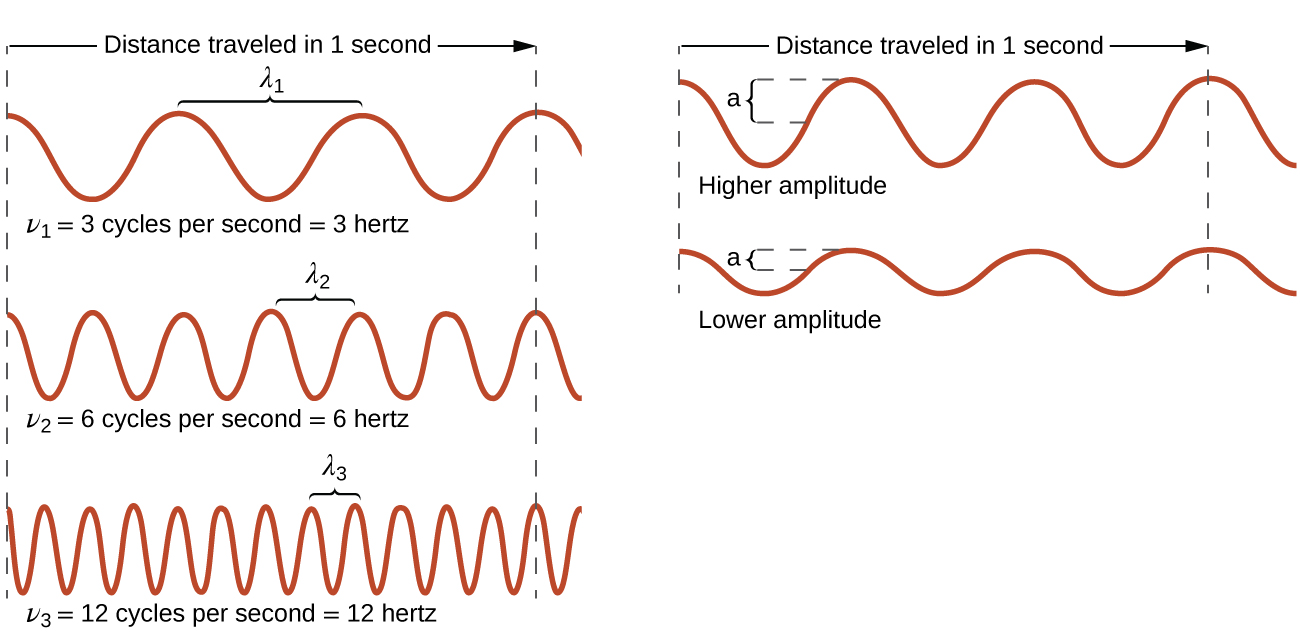
Frequency
frequency (denoted by ν, the lowercase Greek letter nu) The frequency is the number of wave cycles that pass a specified point in space in a specified amount of time (in the SI system, this is measured in seconds).
Amplitude
wave is the height of the wave from its center line (or resting position) to its peak (crest) or trough. In physics, it essentially measures the maximum displacement or amount of energy a wave carries—for example, in sound waves, greater amplitude corresponds to a louder volume.

Photoelectric effect
If light were only a wave, shining a very bright, intense light of a low frequency should eventually build up enough energy to knock electrons off a metal surface.
But in reality, intensity doesn't matter if the frequency is too low. You can shine a blindingly bright red light on metal, and nothing happens. Yet, a faint ultraviolet light with a high enough frequency will knock electrons loose instantly.
This proves light behaves like a particle: one photon interacts with one electron in a direct collision. If a single photon doesn't have enough energy (threshold frequency), it bounces off, no matter how many other photons are around.
Increasing the brightness of incoming light increases the kinetic energy of the ejected electrons?
a) False. Increasing the brightness of incoming light has no effect on the kinetic energy of the ejected electrons. Only energy, not the number or amplitude, of the photons influences the kinetic energy of the electrons.
Increasing the wavelength of incoming light increases the kinetic energy of the ejected electrons?
False. Increasing the frequency of incoming light increases the kinetic energy of the ejected electrons. Frequency is proportional to energy and inversely proportional to wavelength. Frequencies above the threshold value transfer the excess energy into the kinetic energy of the electrons.
Increasing the brightness of incoming light increases the number of ejected electrons
True. Because the number of collisions with photons increases with brighter light, the number of ejected electrons increases.
Increasing the frequency of incoming light can increase the number of ejected electrons.
True with regard to the threshold energy binding the electrons to the metal. Below this threshold, electrons are not emitted and above it they are. Once over the threshold value, further increasing the frequency does not increase the number of ejected electrons
Blackbody Radiation
is the visible glow that solid objects emit when heated. The amount of energy depends on the frequency. E = hv = hc/lambda
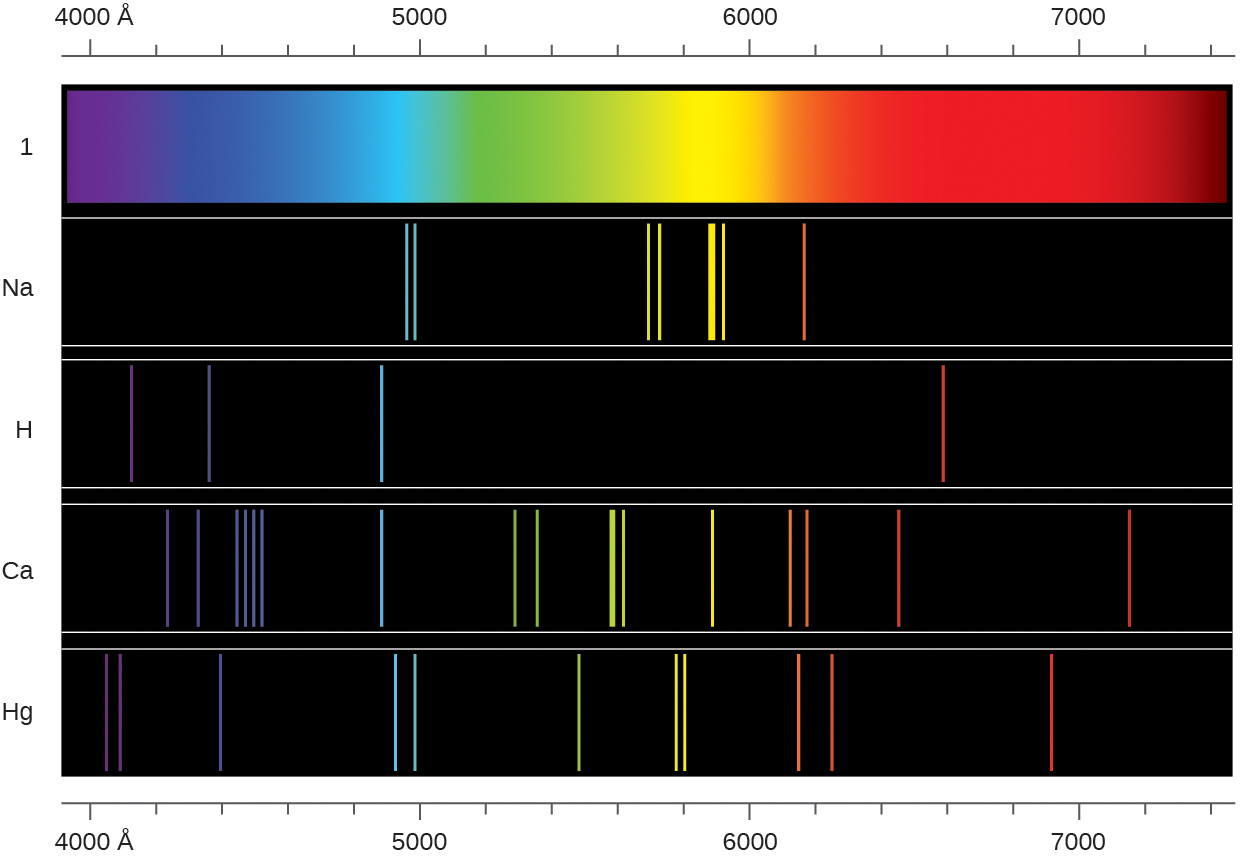
Line Spectra
In contrast to continuous spectra, light can also occur as discrete or line spectra having very narrow line widths interspersed throughout the spectral regions such as those shown in Figure 6.13. Exciting a gas at low partial pressure using an electrical current, or heating it, will produce line spectra.
quantized
The energies of electrons (energy levels) in an atom are quantized, described by quantum numbers: integer numbers having only specific allowed value and used to characterize the arrangement of electrons in an atom
Quantization Example
is that electrons can only exist in certain energy states like 1,2,3 but not 1.5,2.5,3.5 these energies are determined by the Principle Quantum Number (n) which can be any positive integer.
Principle Quantum Number (n)
is that electrons can only exist in certain energy states like 1,2,3 but not 1.5,2.5,3.5 these energies are determined by the Principle Quantum Number (n) which can be any positive integer.
Properties of Principle quantum number (n)
when n is getting larger and larger it is energy level is getting closer to infinity. When n reaches infinity, the energy is so high, which means the electron has completely broken away from the atom.
shells
An electrons energy increases with increasing distance from the nucleus.
Examples of Quantization and specific discreate values
When an electron falls from a higher level (like ) to a lower level (like ), it must release an exact packet of light energy (a photon) equal to the difference between those two levels.
Examples of Quantization and specific discreate values
For hydrogen, the jump from one energy level to releases a specific wavelength of red light ("656 nanometers) which is part of hydrogen's distinct emission spectrum (known as the H - a,"line).
Heisenberg uncertainty principle
It is fundamentally impossible to determine simultaneously and exactly both the momentum and the position of a particle.
Wavefunctions
Schrödinger described electrons as three-dimensional stationary waves, or wavefunctions, represented by the Greek letter psi, ψ. Electrons are still particles, and so the waves represented by ψ are not physical waves but, instead, are complex probability amplitudes.
Shells
The shells of an atom can be thought of concentric circles radiating out from the nucleus. The electrons that belong to a specific shell are most likely to be found within the corresponding circular area. The further we proceed from the nucleus, the higher the shell number, and so the higher the energy level

Photons interacting on atoms
An atomic orbital is a general region in an atom within which an electron is most probable to reside. The quantum mechanical model specifies the probability of finding an electron in the three-dimensional space around the nucleus and is based on solutions of the Schrödinger equation.
atomic orbital
An atomic orbital is a general region in an atom within which an electron is most probable to reside. The quantum mechanical model specifies the probability of finding an electron in the three-dimensional space around the nucleus and is based on solutions of the Schrödinger equation.
Principle quantum number (n)
Allowable values any integer from (1,2,3-infinity). As n increases, the electrons get farther from the nucleus. As n increases, the electrons' energy increases. Each value of n is generally called a shell.
Angular Momentum Quantum Number (l)
n principle quantum number dictates the values for angular momentum quantum number. This gives us the subshell notation: I = 0 = s orbital, I = 1 = p orbital, I = 2 = d orbital, I = 3 = f orbital, I = 4 = g orbital.
s orbital
l = 0
p orbital
l = 1
d orbital
l = 2
f orbital
l = 3
g orbital
l = 4
n-1 rule
The n-1 rule this means that any value of n is -1 applied to it, but the values is also a range like 2 - 1 is 0-1. Example. If (First shell): can range from up to 1-1 = 0, meaning can only be (which corresponds to an s orbital).
If (Second shell): can range from 0-1 up to , meaning can be or (corresponding to and s, and p orbitals).
If (Third shell): can range from 0-2 up to, meaning can be or (corresponding to and s, p, and d orbitals).
Magnetic Quantum Number (ml)
Angular momentum quantum number (l) dictates magnetic quantum number (ml). Its allowable value is from -l to +l. If l = 0 giving ml = 0, I = 1 giving lml = -1, 0, +1, l = 2 giving ml = -2, -1, 0, 1, 2
Spin Quantum Number (ms )
no two electrons can have the same four quantum numbers. ms = +1/2 rotates left, ms = -1/2 rotates right.
Electron Radial Distribution
Why is there 1s, 2s, 3s if n-1 is 1-1 = 0 and that is an s orbital? Well 2s will also have 0,1 energy level thus have subshell of s orbital and p orbital this is because it could be 0-1. 3s will have 3 -1 is 0,1,2 is 3 numbers so a 3s orbital, 3p orbital

Formula to find Energy of a Wavelength
E = hc/lambda
formula to find frequency
v = c/lambda
What does it mean to say that the energy of the electrons in an atom is quantized?
Quantized energy means that the electrons can possess only certain discrete energy values; values between those quantized values are not permitted.
electron volt (eV)
is a convenient unit of energy for expressing atomic-scale energies. It is the amount of energy that an electron gains when subjected to a potential of 1 volt; 1 eV = 1.602 × 10^–19 J.
ground electric state
Determine the lowest possible energy for an electron 1
wave-particle duality
Somehow, at a deep fundamental level still not fully understood, light is both wavelike and particle-like.
excited electronic state
possible for the electron to move to an orbit with a higher n value and the atom is now in an excited electronic state (or simply an excited state) with a higher energy.
Electrons transition energy state properties
When an electron transitions from an excited state (higher energy orbit) to a less excited state, or ground state, the difference in energy is emitted as a photon. Similarly, if a photon is absorbed by an atom, the energy of the photon moves an electron from a lower energy orbit up to a more excited one.
what is a0 ?
is a constant called the Bohr radius, with a value of 5.292 10-11 m or 0.529 A
Formula for finding electrons radius
Bohr radius = (n2)(a0)/ Z
How are the Bohr model and the Rutherford model of the atom similar? How are they
different?
Both involve a relatively heavy nucleus with electrons moving around it, although strictly speaking, the Bohr model works only for one-electron atoms or ions. According to classical mechanics, the Rutherford model predicts a miniature “solar system” with electrons moving about the nucleus in circular or elliptical orbits that are confined to planes. If the requirements of classical electromagnetic theory that electrons in such orbits would emit electromagnetic radiation are ignored, such atoms would be stable, having constant energy and angular momentum, but would not emit any visible light (contrary to observation). If classical electromagnetic theory is applied, then the Rutherford atom would emit electromagnetic radiation of continually increasing frequency (contrary to the observed discrete spectra), thereby losing energy until the atom collapsed in an absurdly short time (contrary to the observed long-term stability of atoms). The Bohr model retains the classical mechanics view of circular orbits confined to planes having constant energy and angular momentum, but restricts these to quantized values dependent on a single quantum number, n. The orbiting electron in Bohr’s model is assumed not to emit any electromagnetic radiation while moving about the nucleus in its stationary orbits, but the atom can emit or absorb electromagnetic radiation when the electron changes from one orbit to another. Because of the quantized orbits, such “quantum jumps” will produce discrete spectra, in agreement with observations.
Describe the properties of an electron associated with each of the following four quantum numbers: n, l, ml, and ms
n determines the general range for the value of energy and the probable distances that the electron can be from the nucleus. l determines the shape of the orbital. m1 determines the orientation of the orbitals of the same l value with respect to one another. ms determines the spin of an electron.
working with Shells, and subshells
Indicate the number of subshells, the number of orbitals in each subshell, and the values of l and ml for the orbitals in the n = 4 shell of an atom.
For n = 4, l can have values of 0, 1, 2, and 3. Thus, s, p, d, and f subshells are found in the n = 4 shell of an atom. For l = 0 (the s subshell), ml can only be 0. Thus, there is only one 4s orbital.
For l = 1 (p-type orbitals), m can have values of –1, 0, +1, so we find three 4p orbitals.
For l = 2 (d-type orbitals), ml can have values of –2, –1, 0, +1, +2, so we have five 4d orbitals.
When l = 3 (f-type orbitals), ml can have values of –3, –2, –1, 0, +1, +2, +3, and we can have seven 4f orbitals.
Thus, we find a total of 16 orbitals in the n = 4 shell of an atom.
ml is equal to the amount of orbitals
When n = 2, l = 0, 1 subshell s, p. If 2s subshell expect ml = 0 counts as 1 - 2s orbital. If 2p subshell ml = -1, 0, 1. 3- 2p orbitals.
Maximum number of electrons
When n = 2, l = 0, 1 subshell s, p. If 2s subshell expect ml = 0 counts as 1 - 2s orbital. If 2p subshell ml = -1, 0, 1. 3- 2p orbitals. Therefore with n = 2 shell we can expect 4 orbitals in total because of 1 - 2s orbital and 3 - 2p orbital. And 2 electrons are allowed per orbital that gives us a maximum of 8 electrons for n = 2.
If a shell contains a maximum of 32 electrons, what is the principal quantum number, n?
Set up the equation: Substitute your given number of electrons (32) into the formula:
2n2=32
Isolate n2: Divide both sides by 2
n2=232
n2=16
Solve for n: Take the square root of both sides:
n=16
n=4
What is ml Degeneracy?
Its just looking for the orbitals in a 7f? f = -3,-2, -1, 0, 1, 2, 3 so 7 degenerate 7f orbitals.
Why do we have 3 ms +1/2…?
The orbitals are filled as described by Hund’s rule: the lowest-energy configuration for an atom with electrons within a set of degenerate orbitals is that having the maximum number of unpaired electrons. Thus, the two electrons in the carbon 2p orbitals have identical n, l, and ms quantum numbers and differ in their ml quantum number (in accord with the Pauli exclusion principle).

Electron Configuration of Ions
electrons in the s orbital are easier to remove than the d or f electrons, and so the highest ns electrons are lost, and then the (n – 1)d or (n – 2)f electrons are removed.
Predicting Electron Configurations of Ions
(a) Na+
(a) Na: 1s22s22p63s1. Sodium cation loses one electron, so Na+: 1s22s22p63s1 = Na+: 1s22s22p6
shortcut remove electrons from highest energy of quantum principle n.
Predicting Electron Configurations of Ions
Fe: 1s22s22p63s23p64s23d6. Iron(II) loses two electrons and, since it is a transition metal, they are removed from the 4s orbital Fe2+: 1s22s22p63s23p64s23d6 = 1s22s22p63s23p63d6.
shortcut remove electrons from highest energy of quantum principle n.