AP Biology Unit 7
 Call Kai
 Learn
 Practice Test
 Spaced Repetition
 Match
 Flashcards
 Knowt Play
1/52

There's no tags or description
Looks like no tags are added yet.
53 Terms
Evolution
Evolution is the change in the genetic makeup of a population over time and is supported by multiple lines of evidence.
Natural selection is the process by which organisms that have adaptations best suited for a particular environment, have a greater chance of survival and reproduction, therefor passing the adaptations to subsequent generations
Charles Darwin is mainly credited with the development of the theory of natural selection
Natural Selection
In order for natural selection to occur, the following needs to be true
Organisms face a constant struggle to survive and reproduce
Organisms tend to produce more offspring than can survive to maturity
Individuals of a species vary in their traits
Competition
Not all organisms in a population have the same chance of survival when resources are limited
Competition occurs when organisms struggle with other organisms to get limited resources
Organisms will compete for resources such as space, food, mates, nutrients, and light
Differences in phenotypes will determine how competitive an organism is
Differences in competitiveness can lead to differential survival
Genetic Variation
Mutations
Sexual Reproduction
Crossing over
Independent assortment in gametes
Fertilization
Genetic variation can lead to traits that are positive, negative, or neutral
Adaptations
Favorable phenotypes improve chances of survival and differences in phenotype come from variation
Variation refers to genetic differences among organisms within a population
Mutations and sexual reproduction increase variation within populations
Adaptations are traits that provide an advantage in a particular environment
Individuals with adaptations have a greater chance of survival and reproduction
The number of individuals within a population having adaptations can increase over time
Evolutionary Fitness
Fitness refers to the ability of an organism to survive and produce fertile offspring
Reproductive success refers to production of offspring
Reproductive success over several generations is a component of evolutionary fitness
Heritability is the ability to pass on adaptations to successive generations
Due to selection, the traits of individuals that have more reproductive success become more common in the population
Evolutionary Fitness
Survival of the fittest refers to organisms with the best adaptations having the most offspring to pass on those traits to.
Reproductive success and the heritability of adaptations contribute to evolutionary fitness
What is considered an adaptation is determined by the environment the organism is in
If the environment changes, the adaptive trait may change as well
Ecosystem Stability
Ecosystem stability determines the rate and direction of evolution
Biotic and abiotic environments can remain more or less stable
Environments can experience major disruptions and change quickly or can show slow gradual change over time
Populations are less likely to evolve in environments that remain stable over long periods of time
The more unstable the environment, the faster the rate of evolution
Phenotypic Variations
Due to natural selection, individuals with more favorable traits are more likely to survive and reproduce.
Genetic variation increases the probability a population of organisms will survive under changing environmental conditions
If the environment changes, one phenotype may be better suited for the changed condition
Selective Pressure
Selective pressure refers to any biotic of abiotic factors influencing survivability such as disease, predation, climate, and food availability.
As environments change, different selective pressures may act on the populations
The selective pressures will determine which traits are adaptations and which are selected against (die out)
Phenotypic Variations
Some phenotypic variations significantly increase or decrease fitness of the organism.
Any phenotype that decreases chances of survival and reproduction negatively impacts fitness
Any phenotype that increases chances of survival and reproduction positively impacts fitness
Descent from common ancestors can result in similar genetics and traits
Structures that are similar in anatomy but may be different in function are homologous structures
Result from divergent evolution
Homologous Structures
Common descent relies on common structure, not common function.

Vestigial Structures
Vestigial structures are homologous structures that no longer serve a purpose due to environmental conditions.
The pelvic bone of whales and dolphins show that these organisms evolved from an ancestor that used to walk on land.
It is believed that vestigial structures remain because they do not negatively impact that organisms fitness and therefore were not selected against.

Phenotypic Adaptations
Similar selective pressures result in similar phenotypic adaptations
Convergent evolution is the process by which similar environmental conditions select for similar traits in different populations or different species over time
When similar traits are observed in distantly related or unrelated species it is called analogous structures
Analogous Structures
Structures that share a common function, but not structure, are called analogous structures

Convergent vs. Divergent
Convergent Evolution
Similar traits evolve independently of each other in different species
Species are not closely related
Have similar selective pressures (similar habitats/niches)
Have many genetic differences
Creates analogous structures/traits
Divergent Evolution
Closely related organisms develop different traits from each other
Have different selective pressures (different habitats/niches)
Have many genetic similarities
Creates homologous structures/traits
Artificial Selection
Through artificial selection, humans affect variation in other species. This can increase or decrease genetic variation in a population.
Humans can select any trait (or combination of traits) as desirable, and choose to breed individuals within the population to get that desired outcome
Depending on which traits are selected for and how often they are selected, the genetic diversity of a population can change over time
By decreasing the genetic variation, organisms are more susceptible to dying out due to environmental change.
Decrease in genetic variation also leads to more genetically linked diseases or mutations as recessive traits are more likely to be expressed and become more pronounced.

Population
Population = a group of individuals of the same species living and breeding in the same area
Evolution is Driven by Random Occurrences
A mutation is a random change in an organism's genome
● Mutations create genetic variation in a population
● Can provide new phenotypes that contribute to evolution by natural
selection
● Can contribute to changes in the genetic makeup of a population over
time
Other Drivers of Evolution
Reduction of genetic variation can increase the differences between
populations of the same species
● Genetic drift - the random change in the frequency of a particular allele
within a population
● This is a nonselective process generally occurring in small populations
○ Increased death rates and low reproductive rates
○ Natural catastrophes (fires, volcanic eruptions, etc.
Genetic Drift
Genetic drift can occur due to a bottleneck event
● A large, diverse population is suddenly reduced to a small population

Genetic Drift - Founder Effect
Founder effect refers to a random process that reduced genetic variation
within a small population due to separation from a larger population
● Migration and geological events can isolate populations
● The genetic makeup of a founder population can be different from the original population

Gene Flow
The diversity of a population can be influenced by migration or gene flow
which refers to the movement of individuals between populations causing an exchange of alleles between populations
● New genes are introduced into a population, increasing genetic variation
● Continued migration between populations reduced genetic diversity between populations over time

Evolution
● Random processes play a role in the evolution of specific populations
● Genetic variation is the raw material of evolution
● Fitness is relative to specific environmental conditions
● As conditions change, fitness can change
● Different phenotypes can be selected for or against according to changes in the environment
● Evolution of a population cannot occur if there is no genetic variation within the population
Hardy-Weinberg
Hardy-Weinberg is a model for describing and predicting allele frequencies in a non-evolving population.
A population in Hardy Weinberg equilibrium is not evolving. The frequencies of alleles and genotypes stay the same generation after generation
Hardy-Weinberg Conditions
Five conditions must be met for a population to be in Hardy-Weinberg
Equilibrium
1. Large population - no genetic drift
2. Absence of migration - no gene flow
3. No net mutation - no genes are modified, deleted or duplicated
4. Random mating - no sexual selection
5. Absence of selection - no natural selection
Hardy-Weinberg Equations
These conditions are rarely met, but they provide a valuable null hypothesis
● It is a baseline to compare a population to
● If we reject the null, then the population is evolving
If a trait has 2 alleles, we can predict the frequency of each in a population
p + q = 1
p = frequency of dominant allele
q = frequency of recessive allele
Hardy-Weinberg Equations pt2
Allele frequencies in a population can be calculated from genotype frequencies. This can be used to determine genotype and/or phenotype frequencies of a individuals in a population.

p = dominant allele
q = recessive allele
p2 = homozygous dominant
2pq = heterozygous
q2 = homozygous recessive
p + q is used for allele frequency
p2 + 2pq + q2 is used for genotype frequency
Can also be used to determine phenotypes
Allele Frequencies
Changes in allele frequencies provide evidence for the occurrence of evolution in a population. There are factors that can disrupt Hardy-Weinberg equilibrium and change allele frequencies within a population.
1. Mutations - changes in genes
2. Non-random mating - individuals choose to mate with another based on
certain traits
3. Gene flow - new genes introduced (migration in or out of population)
4. Genetic drift - changes in the allele frequency within a population due to
random environmental events (bottleneck and founder effect)
5. Natural selection - alleles improve or reduce fitness of individuals
How to Solve Hardy-Weinberg Problems
1. Determine the frequency of homozygous recessive individuals (q2 ). This is usually given but, in some cases, you must calculate the value from data
2. Calculate the frequency of the recessive allele (q) by taking the square root of q2
3. Calculate the frequency of the dominant allele (p) by subtracting q from 1 (p + q = 1)
4. Calculate the frequency of homozygous dominant individuals (p2) by squaring p
5. Calculate the frequency of heterozygous individuals (2pq) by multiplying 2 x p x q
Using chi-square with Hardy-Weinberg
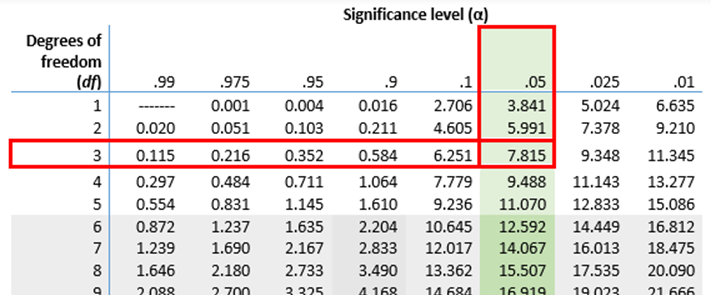
We can use chi-square to determine if a population is evolving
● The Hardy-Weinberg equilibrium will always be the Null hypothesis
● As a population size changes over time the frequencies of each allele will remain the same unless evolution is occurring.

To use the chi-square equation:
● Observed values: Count phenotypes and use hardy weinberg to determine current allele frequencies
● Expected values: Use past allele frequencies to determine current expected genotype numbers based on total population
Compare chi-square number to critical value to determine if the difference in frequencies between observed and expected values is significant or not
● If they are not significant- then the population is not evolving and any changes are due to random chance
● If they are significant - the population is evolving and we can make a hypothesis about which evolutionary factor is affecting it
Phylogeny
Phylogeny refers to the evolutionary development and diversification of a species or group of organisms, or of a particular feature of an organism. To study phylogeny we use models and diagrams called phylogenetic trees and cladograms
● Models show relationships between lineages (evolutionary lines)
● Both represent hypotheses and are constantly being revised based on the most current evidence.
● Can be based on morphological similarities from living or fossil species or DNA and protein sequence similarities
○ Molecular data typically provides more accurate evidence
Phylogenetic Trees
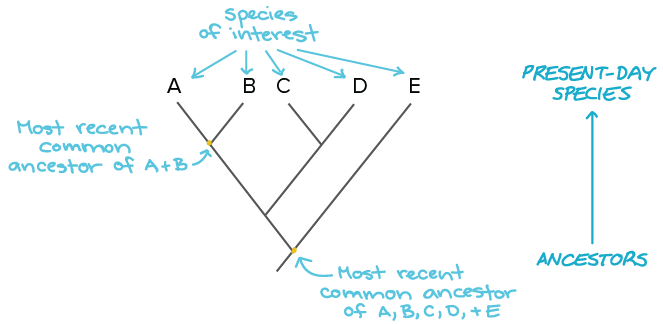
A phylogenetic tree is a branched diagram showing the evolutionary relationships amongst species
● Shows pathways of evolution and can show where a speciation event occurred
● Shows most recent common ancestors of different present day and extinct species
Reading the diagrams
The node is where two lines meet
● Represents the most recent common ancestor
● The root represents the common ancestor of all species on the diagram
They can be drawn in all different configurations, but the general concepts stay the same so find the root and nodes to orient yourself
Cladograms
A cladogram is a diagram used to show evolutionary relationships amongst species usually in relation to specific traits. A clade includes any group on a cladogram sharing a common ancestor.
● Doesn’t necessarily show evolutionary succession of species but it does of traits
Phylogenetic Trees and Cladograms
Traits that are either gained or lost during evolution (derived traits) can be used to construct phylogenetic trees and cladograms
● Shared characteristics are present in more than one lineage
● Shared, derived characteristics indicate common ancestry and are informative
The out-group represents the lineage that is least closely related to the remainder of the organisms
● This provides a reference of comparison that helps determine how the main group fits in the evolutionary tree of life
Species
The biological species concept:
● A species can be defined as a group capable of interbreeding and exchanging genetic information to produce viable, fertile offspring
Speciation
Speciation refers to the creation of new species
● Speciation occurs when populations are reproductively isolated from each other
● There are several mechanisms that can separate members of the same population, potentially leading to speciation
● Speciation results in diversity of life forms
Reproductive Isolation
Reproductive isolation is critical for speciation
● Prevents gene flow between populations
● Biological barriers keep members of two species from interbreeding or
producing fertile offspring
Types of Barriers
● Prezygotic
● Postzygotic
Prezygotic Barriers
Prezygotic barriers prevent production of a fertilized egg.
Habitat isolation
● Species occupy different habitats and rarely come in contact with each
Temporal isolation
● Species breed during different times of day, seasons, or years
Prezygotic Barriers
Behavioral isolation
● Species have different courtship behaviors or mate preferences
Mechanical isolation
● Reproductive structural differences prevent successful mating
Gamete isolation
● Sperm of one species may not be able to fertilize the eggs of another species
Postzygotic Barriers
Postzygotic barriers prevent a zygote from developing into a viable, fertile offspring
Hybrid inviability
● Mating results in a zygote, but incompatibility may stop the development of the zygote
Hybrid sterility
● A hybrid offspring is produced that is fully developed but is sterile
Hybrid breakdown
● First-generation hybrids are viable and fertile but resulting generations are feeble or sterile
Allopatric
Allopatric speciation refers to the evolution of new species due to individuals from the same population being geographically isolated over a long period of time.
● No gene flow occurs between populations
● Populations may be exposed to different selection pressures

Sympatric
Sympatric speciation refers to the evolution of a new species due to individuals being reproductively isolated from a surviving ancestral population
● There is no geographic barrier
● Can result from genetic mutations
○ Polyploidy
● Can result from habitat differentiation
● Can result from sexual selection

Rate of Evolution
Punctuated Equilibrium
● Evolution occurs rapidly after a long period of stasis
○ Stasis refers to periods of little to no change
○ Species may experience no change for long periods
● Changing ecological conditions are the stimulus for evolution
Gradualism
● Evolution occurs slowly over hundreds of thousands or even millions of years
● Ecological conditions change gradually over a long period of time
Gradual vs sudden changes in ecological conditions

Divergent Evolution
Divergent evolution occurs when adaptation to new habitats results in phenotypic diversification
● Speciation rates can be especially rapid during times of adaptive radiation as new habitats become available
● Adaptive radiation refers to the evolution of new species that allows empty ecological roles or niches to be filled
Extinction
Extinction refers to the disappearance of a species, such that no future
generations will naturally populate the earth.
● Naturally occur and are a part of the history of life on Earth
● Can be ongoing and occur on a small scale over long periods of time
● Can serve as a marker for geologic time
Extinction rates can be rapid during times of ecological stress
● Extinctions can occur on a large scale and wipe out large numbers of species at one time
● Can be caused by catastrophic changes to an ecosystem such as, solar flares, rising sea levels, volcanic eruptions, or asteroid impacts
● The Earth has experienced several large-scale extinction events.
Humans and Extinction
Global human activity can drive catastrophic ecosystem change
● Habitat loss
● Climate change
● Habitat degradation
● Pollution
● Poaching
● Invasive species
Extinction and Diversity
After an extinction event, species diversity severely decreases
● High species biodiversity can result from high levels of speciation and low levels of extinction
● Low species diversity can result from low levels of speciation and high levels of extinction
● The earth can (and has) recover from large-scale extinction events
Extinction provides newly available niches that can the be exploited by different species
● A niche describes the role an organism plays within its environment
● An organisms role may be a producer, decomposer, scavenger, consumer, etc.
● What a species goes extinct, it leaves an open niche for another species to occupy
Extinction, Diversity, Niches
When new niches become available, it can lead to rapid speciation rates and adaptive radiation.
● After dinosaurs went extinct, the ancestral mammal group occupied the open niche and experiences adaptive radiation
Variation in a Population
The level of variation in a population affects population dynamics
● Genetic diversity influences a population's ability to respond to changes in the environment
● Populations with little genetic diversity are at risk of extinction
Origin of Life
There are several hypotheses about the origin of life on Earth that are supported with scientific evidence
● Earth formed approximately 4.6 bya
● The environment was too hostile for life until 3.9 bya
● The earliest fossil evidence for life dates to 3.5 bya
● This provides a plausible range of dates when the origin of life could have occurred.
● Primitive Earth provided inorganic precursors from which organic molecules could have been synthesized
● There was a presence of free energy and an absence of a significant quantity of atmospheric oxygen (O2)
● One theory says that organic molecules could have been transported to Earth by a meteorite or other celestial event
Origin of Life pt2
Another theory states that complex organic molecules can be formed from inorganic molecules in the absence of life. Chemical experiments show it is possible.
● Organic molecules, called monomers served as the building blocks for the formation of more complex molecules
● The joining of monomers produced polymers with the ability to replicate, store, and transfer information
● The RNA World Hypothesis proposed that RNA could have been the earliest genetic molecule