6C- acids, esters and polyesters
 Call Kai
 Learn
Learn Practice Test
 Spaced Repetition
 Match
Match Flashcards
 Knowt Play
1/62

There's no tags or description
Looks like no tags are added yet.
Name | Mastery | Learn | Test | Matching | Spaced | Call with Kai | Chat |
|---|
No analytics yet
Send a link to your students to track their progress
63 Terms
what is the name of salt of carboxylic acids
carboxylates e.g. methanoate, propanoate -COO-
when comparing boiling points of carboxylic acids with other molecules what needs to be considered
similar number of electrons so strength of London Forces are similar e.g. propanoic acid compared to pentane
why is the boiling point of propanoic acid much higher than pentane
propanoic acid has hydrogen bonds whereas pentane only has London forces
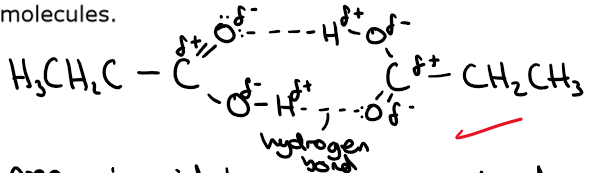
are carboxylic acids soluble in water
yes- shorter chains only
why are longer carboxylic acids almost insoluble
all carboxylic acids contain -COOH which is the soluble part (can form hydrogen bonds with water) whereas the alkyl group is insoluble, in smaller carboxylic acids the alkyl group is relatively small so the molecule is soluble, in octanoic acid the alkyl group is much larger so more of the molecule is insoluble so overall the molecule is insoluble
what forms when carboxylic acids react with metals
a salt and hydrogen
e.g. methanoic acid + sodium → sodium methanoate + hydrogen
what forms when carboxylic acids react with alkalis
salt and water
e.g. benzoic acid + potassium hydroxide → potassium benzoate + water
what forms when carboxylic acids react with carbonates
salt, water and carbon dioxide
e.g. propanoic acid + calcium carbonate → calcium propanoate + water + carbon dioxide
what is the test for carboxylic acids
add a carbonate, effervescence occurs
define salt
the product of a reaction in which H+ ions from an acid are replaced by metal or ammonium ions
what are the reagents and conditions necessary to form an ester the standard way
heat an alcohol and carboxylic acid under reflux with conc. H2SO4
why is the percentage yield of an esterification reaction likely to be low
the reaction is reversible so will not go to completion
what is a carboxylic acid derivative and what are the examples
compounds that can be hydrolysed to form carboxylic acids e.g. acyl chlorides, acid anhydrides, ester, amides
what is the structure of an acyl chloride
R-COCl
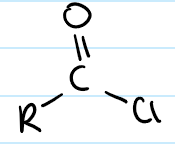
how to name acyl chlorides
carbonyl chloride e.g. propanoyl chloride, 2-methylbutanoyl chloride
how to form acyl chlorides
carboxylic acid + SOCl2 → acyl chloride + SO2 + HCl

what conditions are needed for acyl chlorides to react with aromatic compounds
halogen carrier catalyst e.g. AlCl3- must be anhydrous
what happens if acyl chlorides come into contact with water
react violently- must be kept dry, would produce a carboxylic acid and HCl
how reactive are acyl chlorides
very reactive, usually react by substituting the Cl for other groups
what happens if an acyl chloride is reacted with an alcohol or phenol
an ester is formed and HCl
why is forming an ester from an acyl chloride very useful
it is a non-reversible reaction so percentage yield should be higher than alternative methods
what is an acid anhydride
two carboxylic acids joined
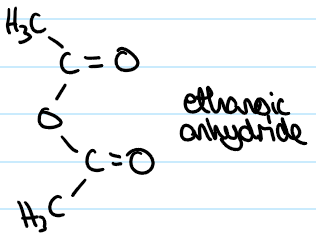
how can acid anhydrides be made
reacting two carboxylic acids together
what are the ways esters can be made
carboxylic acid and alcohol (reversible)
acyl chloride and alcohol (higher yield as not reversible)
acid anhydride and alcohol (higher yield as not reversible)
how can an ester be made from an acid anhydride
acid anhydride + alcohol → ester + carboxylic acid
why might using an acid anhydride to synthesise an ester be preferred to using a carboxylic acid
the reaction is not reversible so higher yield of ester
heating is not necessary so energy costs are reduced
reaction does not requires a catalyst so may be less hazardous
are acyl chlorides or acid anhydrides more reactive
acyl chlorides
what can an acyl chloride react to form
a carboxylic acid, an ester, a primary or secondary amide
how does an acyl chloride form a primary amide
react with NH3
how does an acyl chloride form a secondary amide
react with R-NH2
what needs to be considered when forming primary amides
further reactions occurring
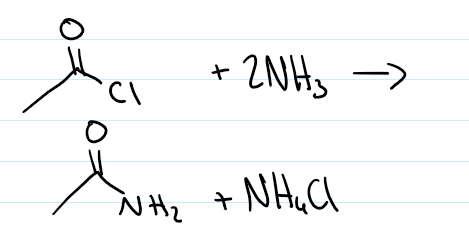
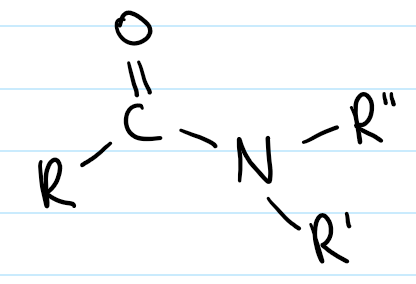
what is an amide
a nitrogen atom adjacent to a carbonyl group
define hydrolysis
a reaction with water that breaks a chemical compound into two compounds, the H and OH in a water molecule become incorporated into the two compounds
how does the conc. H2SO4 affect rate of reaction/position of equilibrium in forming an ester from a carboxylic acid and alcohol (reversible reaction)
conc. H2SO4 has a low water conc. so the equilibrium shifts to the right to increase water conc. and so increases yield of ester
also acts as a catalyst to increase rate of reaction by providing an alternative pathways with lower activation energy
what are the methods of ester hydrolysis
acid hydrolysis- dilute HCl/H2SO4 (aq), heat under reflux (reversible)
alkaline hydrolysis- dilute NaOH/KOH (aq), heat under reflux (not reversible)
what is the equation for acid hydrolysis of an ester
ester + H2O ←→ carboxylic acid + alcohol
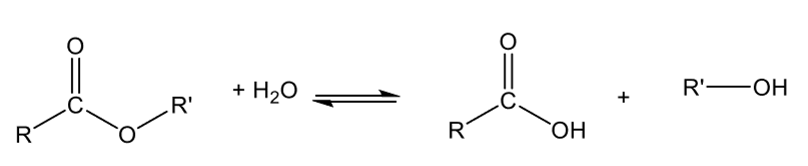
why is the dilute acid not in the equation of acid hydrolysis of an ester given is it necessary for the reaction to occur
the acid is a catalyst not reagent
what happens when an ester reacts with a dilute acid
acid hydrolysis- ester reacts with the water, acid is the catalyst
why is it impossible to achieve a 100% yield from acid hydrolysis of esters
reversible reactions do not go to completion so there will always be some starting material left
what is the equation of alkaline hydrolysis
ester + NaOH → carboxylate salt + alcohol (not reversible)
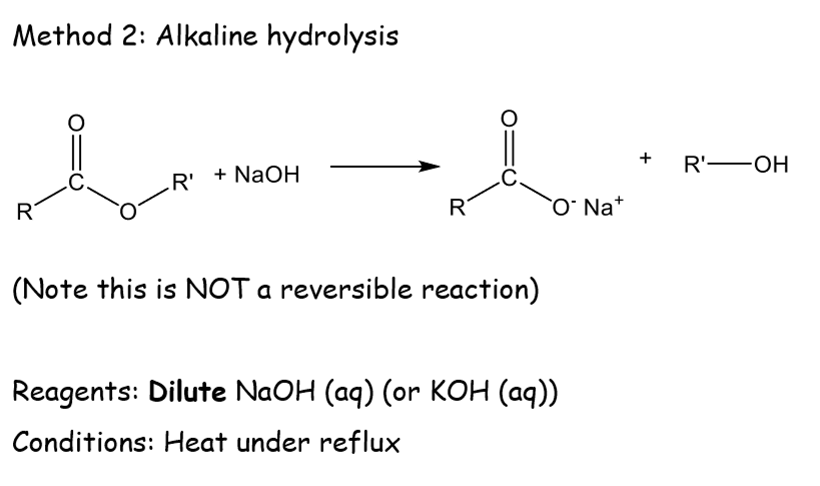
what is the more efficient way to break down an ester
alkaline hydrolysis (not reversible so higher percentage yield)
how can a carboxylic acid be recovered from the carboxylate salt from alkaline hydrolysis
carboxylic acids are weak acids, add strong acid solution e.g. HCl, this will cause carboxylate ion to be protonated to form the carboxylic acid
R-COO- + H+ ←→ R-COOH
HCl will increase [H+] so position of equilibrium will shift to right
what is the type of polymer produced from an alkene monomer
addition polymerisation
what are the types of polymerisation
addition and condensation
what is condensation polymerisation
joining of many monomers by the elimination of a small molecule such as HCl or H2O
from what can polyesters be made
from two monomers (more common): dicarboxylic acid + diol, diacyl chloride + diol
from one monomer: hydroxy carboxylic acid, hydroxy acyl chloride
what type of polymerisation is used for polyesters
condensation as two small molecules react together to form a larger molecule with elimination of a small molecule e.g. H2O
what are dimers
two hydroxy carboxylic acids react to form a ring
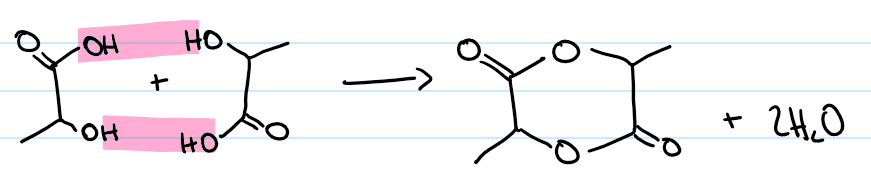
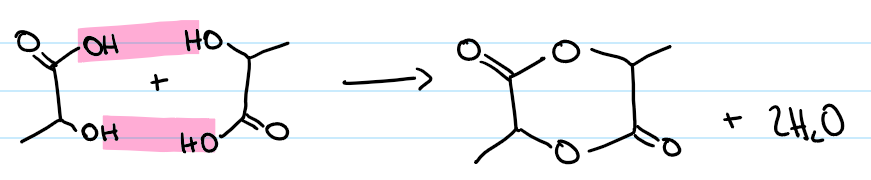
what is it called when two hydroxy carboxylic acids react to form a ring
a dimer
equation for formation of polyesters from dicarboxylic acid and diol

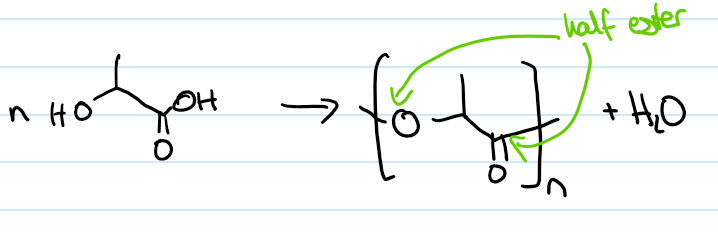
equation for formation of polyesters from hydroxy carboxylic acid
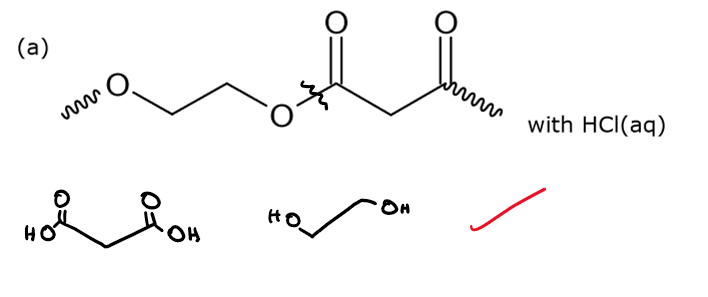
what is formed in polyester acid hydrolysis
diol and dicarboxylic acid or hydroxy carboxylic acid
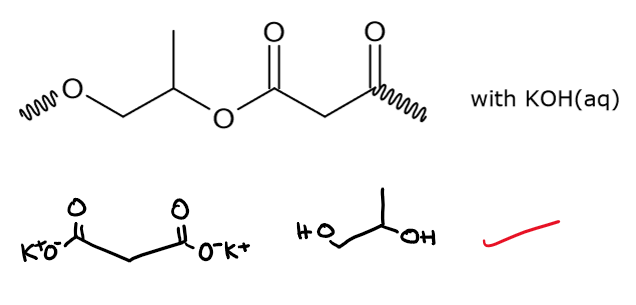
what is formed in polyester alkaline hydrolysis
dicarboxylate salt and diol or hydroxy carboxylate salt
what are the conditions for acid hydrolysis of polyesters
dilute HCl(aq), heat under reflux
what are the conditions for alkaline hydrolysis of polyesters
NaOH(aq), heat under reflux
how do you synthesis an organic solid
heat under reflux
how do you synthesis an organic liquid
heat under reflux
how do you isolate an organic solid
filtration under reduced pressure- buchner apparatus/funnel
how do you isolate an organic liquid
using a separating funnel
how do you purify an organic solid
recrystallisation
how do you purify an organic liquid
use separating funnel, add anhydrous magnesium sulfate
how do you check purity of an organic solid
measure melting point, compare to data book
how do you check purity of an organic liquid
distillation- measure boiling point