NEUR30080 L4 SQ synaptic transmission at NMJ
 Call Kai
 Learn
 Practice Test
 Spaced Repetition
 Match
 Flashcards
 Knowt Play
1/51

There's no tags or description
Looks like no tags are added yet.
52 Terms
learning goals

NMJ vs CNS synapse
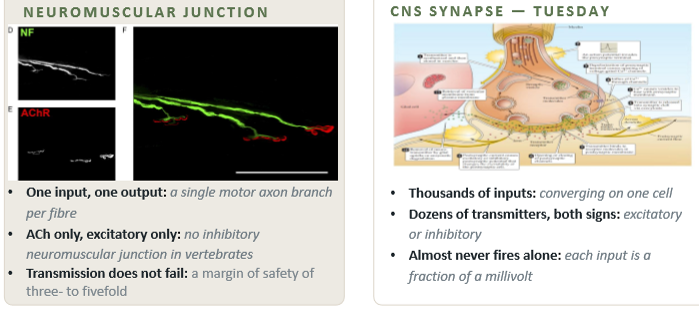
motor neuron
cell body in the ventral horn
myelinated up until microns of the terminal
schwann cells
myelinating or terminal
the cleft
about 50 nm
filled with basal lamina
junctional folds
in the sarcolemma
one branch
one fibre
motor neuron and fibres
ONE motor neuron innervates many fibres, but each fibre is innervated by exactly ONE neuron
anatomy of NMJ image
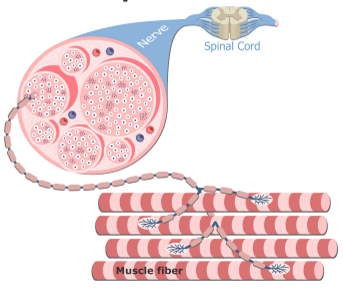
NMJ and schwann cells image

oligodendrocytes
on axon in CNS
schwann cell
on axon in PNS
postsynaptic fibre: receptor localisation
AChRs are concentrated on crests of junctional folds at approx. 10,000 per um2
among the highest memb protein densities recorded
postsynaptic fibre: Nav1.4 localisation
voltage-gated Na+ channels are confined to the depths of the folds (not crests)
postsynaptic fibre: intervening distance
the EPP must spread a fraction of a micron down the wall of each fold to reach that Nav population
postsynaptic fibre: negligible attenuation
the distance is small relative to lambda, so attenuation of the EPP between crest and fold depth is negligible
postsynaptic fibre: summary
the folds place a high density of Nav1.4 within a fraction of a micron of the receptor array, so endplate current reaches those channels essentially undiminished

EPP
end plate potential
development of NMJ: agrin
the motor nerve terminal releases agrin into the synaptic basal lamina
agrin binds Lrp4, which activates the associated MuSK receptor tyrosine kinase

development of NMJ: rapsyn and AChR
rapsyn is recruited to the sarcolemma downstream of MuSK activation
AChR anchored to the post-synaptic memb (on the muscle fibre)
the Lrp4-MuSK complex anchors AChesterase in the basal lamina through ColQ

synaptic vessicle image

AP propagation: 7 steps
one pre-syn AP produces one muscle AP
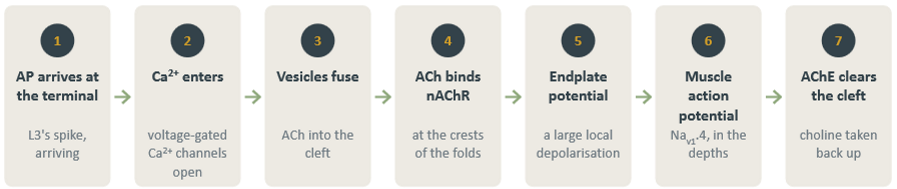
where each step happens image

non-selective cation channel: cooperative binding
2 ACh molecules must bind at separate subunit interfaces, a single molecule does not open the channel
non-selective cation channel: non-selective cation conductance
the pore passes Na+ and K+ without meaningful discrimination between them
non-selective cation channel: reversal potential
= approx. 0 mV
the permeability-weighted midpoint between ENa and Ek
non-selective cation channel: driving force
with muscle Vm at approx. -85 mV, the inward driving force is approx. 85 mV
non-selective cation channel image

non-selective cation channel: I = g(Vm - E)

adult isoform of the receptor
brief openings and higher single-channel conductance

embryonic isoform of receptor
prolonged openings and lower single-channel conductance


which receptor isoform is this?
embryonic

which receptor isoform is this?
adult
developmental switch
gamma is replaced with e as the synapse matures, and the substitution reverses following denervation
distinct from the neuronal receptor
the alpha7 receptor (from lecture 1) is a related but structurally distinct (different) protein
embryonic and adult receptors image

the sequence image

spontaneous activity at the resting endplate
at rest, the endplate shows small spontaneous depolarisations - miniature EPPs (MEPPs)
when the nerve is stimulated, the memb potential is depolarised. The EPP triggers an AP when it reaches threshold
recordings turned out to be similar to the responses at synapses elsewhere in the NS. MEPPs and EPPs are thus particular forms of excitatory post-synaptic potential (EPSP)
spontaneous activity at the resting endplate image

electrophysiology: ACh image

every response is multiple of same unit
lower external Ca2+: release becomes unreliable, so responses fluctuate
peaks evenly spaced: at 1x, 2x, 3x the size of one spontaneous blip
therefore, discrete packets: not a continuous stream of NT
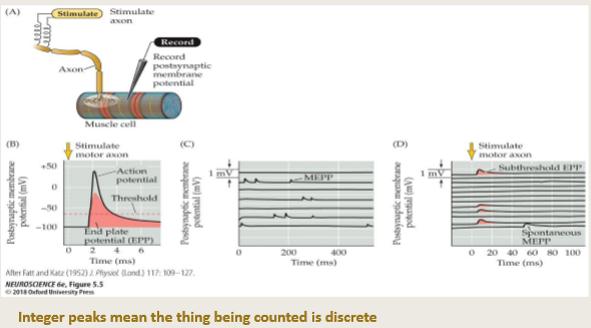
a quantum: the unit

a quantum: the unit - quantal size and content

quantal size and content table


Q:

Ca2+ is trigger
conc dependence: reducing Ca2+ diminishes EPP, raising it increases EPP
pharmacological manipulation: The Kv blockers prolong the pre-syn spike, admitting more Ca2+ and releasing more quanta
quantal content as readout: most pre-syn manipulations act on quantal content rather than size

calcium in, transmitter out

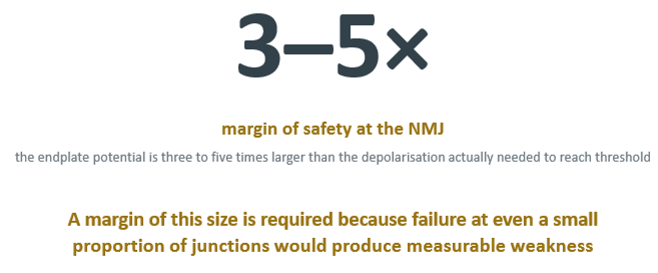
safety factor
myesthenia gravis

passive transfer

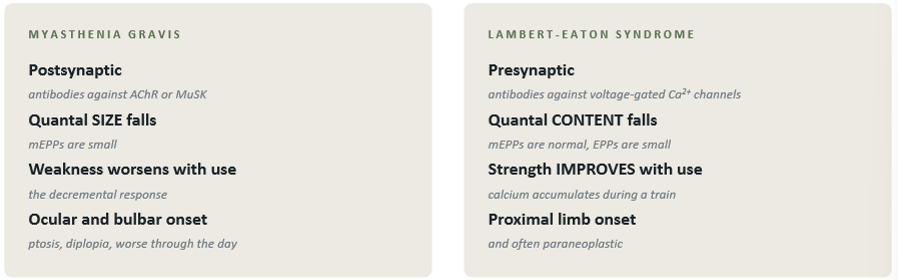
myesthenia gravis vs lambert-eaton syndrome
learning outcomes
