AP Music Theory Chapter 6
 Call Kai
 Learn
 Practice Test
 Spaced Repetition
 Match
 Flashcards
 Knowt Play
1/23

Earn XP
Description and Tags
Chapter 6 Definitions & Stuff to Know
24 Terms
Motive (Motif)
A short, recurring figure that appears throughout a composition

Melodic Motive
A repeated pitch pattern; usually recurring with the same/similar rythmic pattern
Rhythmic Motive
A recurring rhythmic pattern; often function independently from melodic patterns, also commonly appears as the motive in accompaniment

Sequence
The immediate restatement of a melodic motive or longer figure in the same instrumental or vocal part at a higher or lower pitch
Characteristics of Sequences
Requires at least two segments
Most sequences contain no more than 3-4 segments
Usually only have one direction-the segments succeed each other at continuingly higher or lower pitches
Sequence segments usually continue by the same interval distance
Real Sequence
A sequence containing segments that are exact transpositions of the first segment

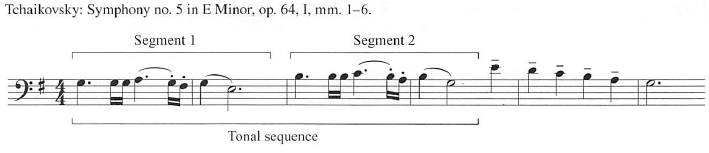
Tonal Sequence
A sequence transposed with the diatonic scale (key signature) in mind; not exact transposition
Modified Sequence
A sequence where some segments are decorated or embellished in a way that does not destroy their original character

False Sequence
A sequence where a part of a figure is repeated and states the remainder in sequence (mix of sequence & repetition)

Phrase
A substantial musical thought usually ending with a harmonic, melodic, and rhythmic cadence
Phase Member
The slight melodic interruptions that are separated by a longer note value or rest, or essentially the separate parts of a melody that form one phrase

Factors that allow 2 adjacent phrases to form a period
The second phrase ends with a strong cadence (usually perfect authentic); a sense of closure is required at the end of the second (final) phrase
The first phrase ends with a weaker cadence than the second (often half cadence)
The two phrases bear some musical relationship with each other; often creating a “question-answer” effect (antecedent-consequent) with phrase 1 being the antecedent and phrase 2 being the consequent
Parallel Period
When two adjacent phrases begin in the same manner, no matter the cadence or length of similarity

Contrasting Period
When two phrases are not similar in melodic content

Three-Phrase Period
When a period is composed of 3 phrases, organized either as A-A-B (antecedent, antecedent, consequent) or A-B-B (antecedent, consequent, consequent)

Double Period (Four-Phrase Period)
When 4 phrases form a one period, same rules apply as 2-phrase period
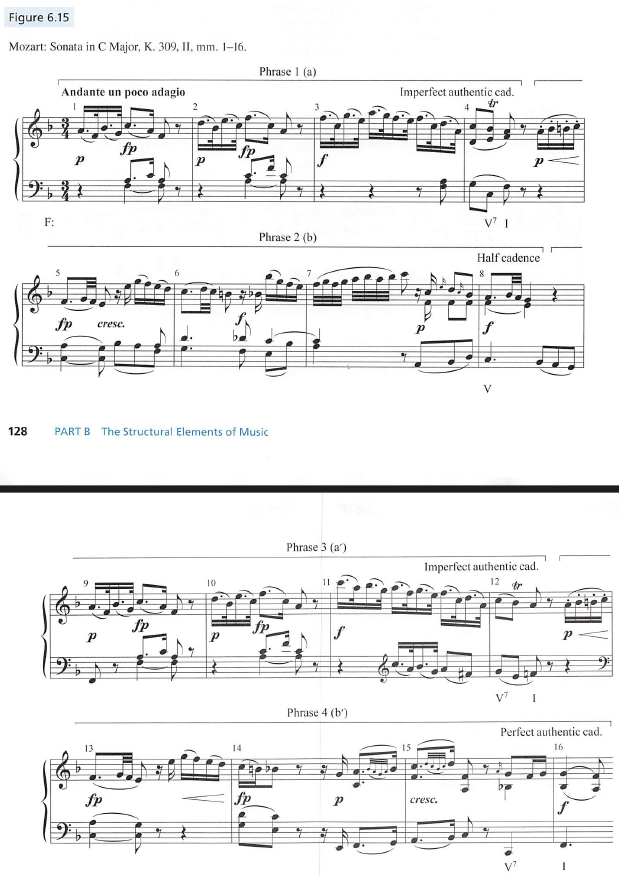
Repeated Phrases
When the second phrase is not dependent on the first, antecedent-consequent doesn’t apply

Dissimilar Phrases
A series of phrases that are either unrelated or lack closure; do not form periods
Extended Phrase
A phrase being lengthened through extended a certain part of it; extended by a few beats to double the normal length
Beginning Extension
Extending a phrase through sequencing or repeating a few opening tones
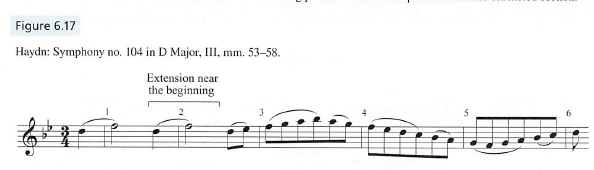
Internal Extension
Extending a phrase by repeating a small melodic group in the middle of a phrase

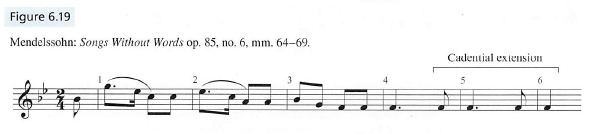
Cadential Extension
Extending a phrase by elaborating or repeating a cadence, cadence figure, or individual cadence chords
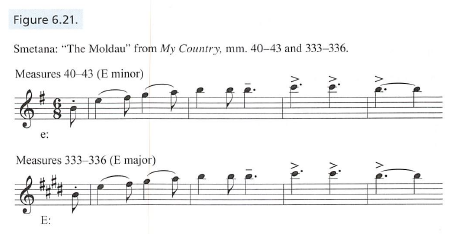
Change of Mode
When a phrase is modified by changing from major to parallel minor or vice versa
Characteristics of Melodic Structure
Climax tone - the highest stressed pitch of a phrase or other unit, only reached once normally
Ascent & decent from climax tone
Melodic phrases contain significant use of triad pitches (scale degrees 1, 3, 5)