ACLS Drugs
 Call Kai
 Learn
 Practice Test
 Spaced Repetition
 Match
 Flashcards
 Knowt Play
1/66

There's no tags or description
Looks like no tags are added yet.
67 Terms
Adenosine (Adenocard)
-Dose
-MOA
6-mg rapid IV bolus over 1 to 3 seconds, followed by a 20-mL saline flush and elevate the extremity.
If no response after 1 to 2 minutes, administer second dose of 12-mg rapid IV bolus over 1 to 3 seconds
-Record rhythm strip during administration
MOA: Slows conduction through the AV node; can interrupt reentrant AV nodal pathways.
Contra considerations: ; bronchoconstrictive or bronchospastic lung disease (asthma, COPD); poison- or drug-induced tachycardia.
Transient side effects include flushing, chest pain or tightness, brief periods of asystole or bradycardia, ventricular ectopy
Amiodarone (Cordarone, Pacerone)
VF/pVT Cardiac Arrest Unresponsive to CPR, Shock, and Vasopressor
MOA:
• First dose: 300 mg IV/IO push
-repeat in 3-5min
• Second dose (if needed): 150 mg IV/IO push
MOA: Antidysrhythmic (Class III- K+ channel blocker)
Blocks sodium, potassium, and calcium channels; prolongs the action potential and repolarization; decreases AV conduction and sinoatrial (SA) node function
Amiodarone (Cordarone, Pacerone)
“Stable” VT/VF
Infusion after conversion:
Loading dose of 150 mg IV/ IO over 10 minutes;
may repeat every 10 minutes if needed
Amiodarone (Cordarone, Pacerone)
Infusion after conversion (Maintenance)
Max dose:
1-mg/ min infusion for 6 hours and then a
0.5-mg/min maintenance infusion over 18 hours.
Maximum cumulative dose: 2.2 g IV/IO per 24 hours
Considerations:
-Rapid infusion may lead to hypotension
-With multiple dosing, cumulative doses >2.2 g over 24 hours are associated with significant hypotension in clinical trials
-Do not administer with other drugs that prolong QT interval (eg, procainamide)
Terminal elimination is extremely long (halflife lasts up to 40 days)
Life-Threatening Arrhythmias Maximum cumulative dose:
2.2 g IV over 24 hours. May be administered as follows:
Rapid infusion: 150 mg IV over first 10 minutes (15 mg/min).
May repeat rapid infusion (150 mg IV) every 10 minutes as needed
Slow infusion: 360 mg IV over 6 hours (1 mg/min)
Maintenance infusion: 540 mg IV over 18 hours (0.5 mg/min
Atropine Sulfate
Class/MOA
Bradycardia (With or Without ACS)
max dose:
Ineffective for which HB? may cause?
Anticholinergic agent; Inhibits the action of acetylcholine at postganglionic parasympathetic neuroeffector sites. Increases heart rate in symptomatic bradydysrhythmias.
1 mg IV every 3 to 5 minutes as needed, not to exceed total dose of 0.04 mg/kg (total 3 mg)
not likely to be effective for type II second degree or third degree AV block or a block in non-nodal tissue
May not be effective for infranodal (type II) AV block and new third degree block with wide QRS complexes (in these patients may cause paradoxical slowing; be prepared to pace or give catecholamines)
Organophosphate Poisoning Extremely large doses (2 to 4 mg or higher) may be needed
GPT: Paradoxical Slowing: In these cases, atropine can sometimes worsen the block by suppressing the higher pacemakers (SA/AV node) without improving conduction in the diseased His-Purkinje system. This can lead to further bradycardia.
Second-line drug for symptomatic bradycardia (after atropine)
Dopamine IV infusion
Usual infusion rate is 5-20 mcg/kg/min
—>crit care: titrate 2mcg/kg/min q 10min
-Correct hypovolemia with volume replacement before initiating dopamine
2 mcg/kg/min IV: dopaminergic effects.
5-10 mcg/kg/min IV: beta effects.
10-20 mcg/kg/min IV: alpha effects.
Dopamine lb method:
patient’s weight in pounds and divide by six.
Whatever the answer is, drop anything to the right of the decimal. Add one. That’s the drip rate for 5mcg/kg/min. If you want to be dead-on accurate simply divide the patient’s weight in pounds by 5.86666667
Double that and you have 10mcg/kg/min.
Double that and you have the rate for 20mcg/minute (the top end). Remember to titrate to the desired effect.
This works for 200mg Dopamine in 250ml solute (NS, D5, whatever) with 60 gtts/min administration set.
ex. patient weighs 187 pounds and you want 10mcg/kg/minute.
187/6 =31.1…. Now we drop the .1….. gives us 31. Add 1 and you have 32gtts/minute (for 5mcg/kg/minute). Double that for 10mcg/kg/minute 64/gtts/minute
EPINEPHrine (Adrenalin)
Class/ MOA
Dose
-Arrest
-Profound Bradycardia or Hypotension
-Sympathomimetic; Direct-acting alpha and beta agonist. Alpha: vasoconstriction. Beta-1: positive inotropic, chronotropic, and dromotropic effects. Beta-2: bronchial smooth muscle relaxation and dilation of skeletal vasculature. Blocks histamine receptors
IV/IO dose: 1 mg (10 mL of 0.1 mg/mL solution) administered every 3-5 minutes during resuscitation; follow each dose with 20 mL flush, elevate arm for 10-20 seconds after dose
Profound Bradycardia or Hypotension 2-10 mcg/min infusion; titrate to patient response
• Higher dose: Higher doses (up to 0.2 mg/kg) may be used for specific indications (β-blocker or calcium channel blocker overdose)
• Continuous infusion: Initial rate: 0.1-0.5 mcg/kg per minute (for 70-kg patient: 7-35 mcg/min); titrate to response
• Endotracheal route: 2–2.5 mg diluted in 10 mL NS
-Cardiac arrest: VF, pulseless VT, asystole, PEA
-High doses do not improve survival or neurologic outcome and may contribute to postresuscitation myocardial dysfunction
What can be considered after atropine as an alternative infusion to dopamine
EPI
Drugs for ET tube:
NAVEL:
N- Naloxone (Narcan)
A - Atropine
V- Vasopressin
E - Epinephrine
L- Lidocaine
Lidocaine Hydrochloride (Xylocaine)
Class/MOA
Cardiac Arrest From VF/pVT
Refractory
Antidysrhythmic (Class Ib- Na+ channel blocker), anesthetic; Cardiac: Decreases automaticity by slowing the rate of spontaneous phase 4 depolarization. Local anesthetic: Inhibits transport of ions across the neuronal membrane, blocking conduction of normal nerve impulses
- Initial dose: 1-1.5 mg/kg IV/IO
For refractory VF, (half of initial)
may give additional 0.5-0.75 mg/kg IV push and
repeat in 5-10 minutes;
maximum 3 doses or total of 3 mg/kg
Alternative to amiodarone in cardiac arrest from VF/pVT
Stable monomorphic VT with preserved ventricular function
Stable polymorphic VT with normal baseline QT interval and preserved LV function when ischemia is treated and electrolyte balance is corrected
Can be used for stable polymorphic VT with baseline QT-interval prolongation if torsades suspected
Lidocaine Hydrochloride (Xylocaine)
Perfusing Arrhythmia
Doses ranging from 0.5-0.75 mg/kg and up to 1-1.5 mg/kg may be used
Repeat 0.5-0.75 mg/kg every 5- 10 minutes; maximum total dose: 3 mg/kg
Maintenance Infusion
1-4 mg/min (30-50 mcg/kg per minute)
Lidocaine Hydrochloride (Xylocaine)
Maintenance Infusion (mg/min and mcg/kg)
pt considerations
1-4 mg/min (30-50 mcg/kg per minute)
Reduce maintenance dose (not loading dose) in presence of impaired liver function or LV dysfunction
Discontinue infusion immediately if signs of toxicity develop
Magnesium Sulfate
Cardiac Arrest (Due to Hypomagnesemia or Torsades de Pointes)
CA: 1-2 g (2-4 mL of a 50% solution diluted in 10 mL [eg, D5W, normal saline] given IV/IO)
-Recommended for use in cardiac arrest only if torsades de pointes or suspected hypomagnesemia is present
Life-threatening ventricular arrhythmias due to digitalis toxicity
•Occasional fall in blood pressure with rapid administration
Use with caution if renal failure is present
-hypoK+ often correlates with hypoMg+
Magnesium Sulfate
Torsades de Pointes With a Pulse or AMI With Hypomagnesemia
-Load Dose
-Infusion
Loading dose of 1-2 g mixed in 50-100 mL of diluent (eg, D5W, normal saline) over 5-60 minutes IV
Follow with 0.5-1 g per hour (1/2 of push) IV (titrate to control torsades)
If the patient has polymorphic VT, treat as VF with high-energy ____ shocks
unsynchronized shocks (eg, defibrillation doses).
If you have any doubt about whether an unstable patient has monomorphic or polymorphic VT….
defib (unsynchronized)
do not delay treatment for further rhythm analysis. Provide high- energy, unsynchronized shocks (defibrillation doses)
Sotalol
100 mg (1.5 mg/kg) IV over 5 minutes.
Avoid if prolonged QT.
Procainamide Hydrochloride (Pronestyl)
-Dose
-Stopping points (4)
-max dose:
Infusion
20 to 50 mg/min IV until
arrhythmia suppressed,
hypotension ensues,
QRS duration increases more than 50%, or
maximum dose 17 mg/kg IV is given.
Maintenance infusion: 1 to 4 mg/min IV.
Avoid if prolonged QT or congestive heart failure
Morphine Sulfate (Roxanol, MS Contin)
Adult: STEMI:
NSTEMI/unstable angina: 1 to 5 mg IV push if symptoms not relieved by nitrates, use with caution
STEMI: Initial dose: 2 to 4 mg slow IV (over 1 to 5 minutes). Repeat dose: 2 to 8 mg at 5 to 15 minute intervals.
NSTEMI/unstable angina: 1 to 5 mg IV push if symptoms not relieved by nitrates, use with
Use morphine with caution in NSTE-ACS because of an association with increased mortality.
When is morphine indicated? Relationship with ASA?
-indicated in STEMI when chest discomfort does not respond to nitrates
morphine may mask symptoms of myocardial ischemia and decrease absorption of important orally administered drugs, such as antiplatelets (P2Y 12 inhibitors)
morphine can decrease absorption of oral antiplatelet medications.
Morphine may be used to manage ACS because it
Produces central nervous system analgesia, which reduces the adverse effects of neurohumoral activation, catecholamine release, and heightened myocardial oxygen demand
Alleviates dyspnea
Produces venodilation, which reduces LV preload and oxygen requirement
Decreases systemic vascular resistance, which reduces LV afterload
Helps redistribute blood volume in patients with acute pulmonary edema
The major contraindications to aspirin are (2)
true aspirin allergy and active or
recent GI bleeding.
Immediate ED and Cath Lab General Treatment
Unless allergies or contraindications exist, consider these 4 agents in patients with ischemic- type chest discomfort:
If oxygen saturation is less than 90%: Start oxygen at 4 L/min and titrate.
Aspirin 162 to 325 mg (if not given by EMS)
Nitroglycerin sublingual or translingual
Morphine IV if discomfort not relieved by nitroglycerin
Remember, morphine is a venodilator. As with nitroglycerin, use smaller doses and carefully monitor physiologic response before administering additional doses in patients who may be preload dependent. If hypotension develops, administer ___ as a first line of therapy.
fluids
Nitro Contras
Hypotension, bradycardia, or tachycardia.
Avoid using nitroglycerin in patients with hypotension (SBP less than 90 mm Hg), marked bradycardia (heart rate less than 50/min), or marked tachycardia
Recent phosphodiesterase inhibitor use.
Avoid using nitroglycerin if you suspect or know that the patient has taken sildenafil or vardenafil within the previous 24 hours or tadalafil within 48 hours. These agents are generally used for erectile dysfunction or in cases of pulmonary hypertension, and in combination with nitrates, they may cause severe hypotension refractory to vasopressor agents.
@armyemdoc
"Don't give nitrates to right-sided myocardial infarctions"
This is a myth that continues to get taught due to the theory that right-sided MIs are sensitive to preload, which nitrates reduce.
A recent systematic review (n=1113) failed to substantiate this purported risk.
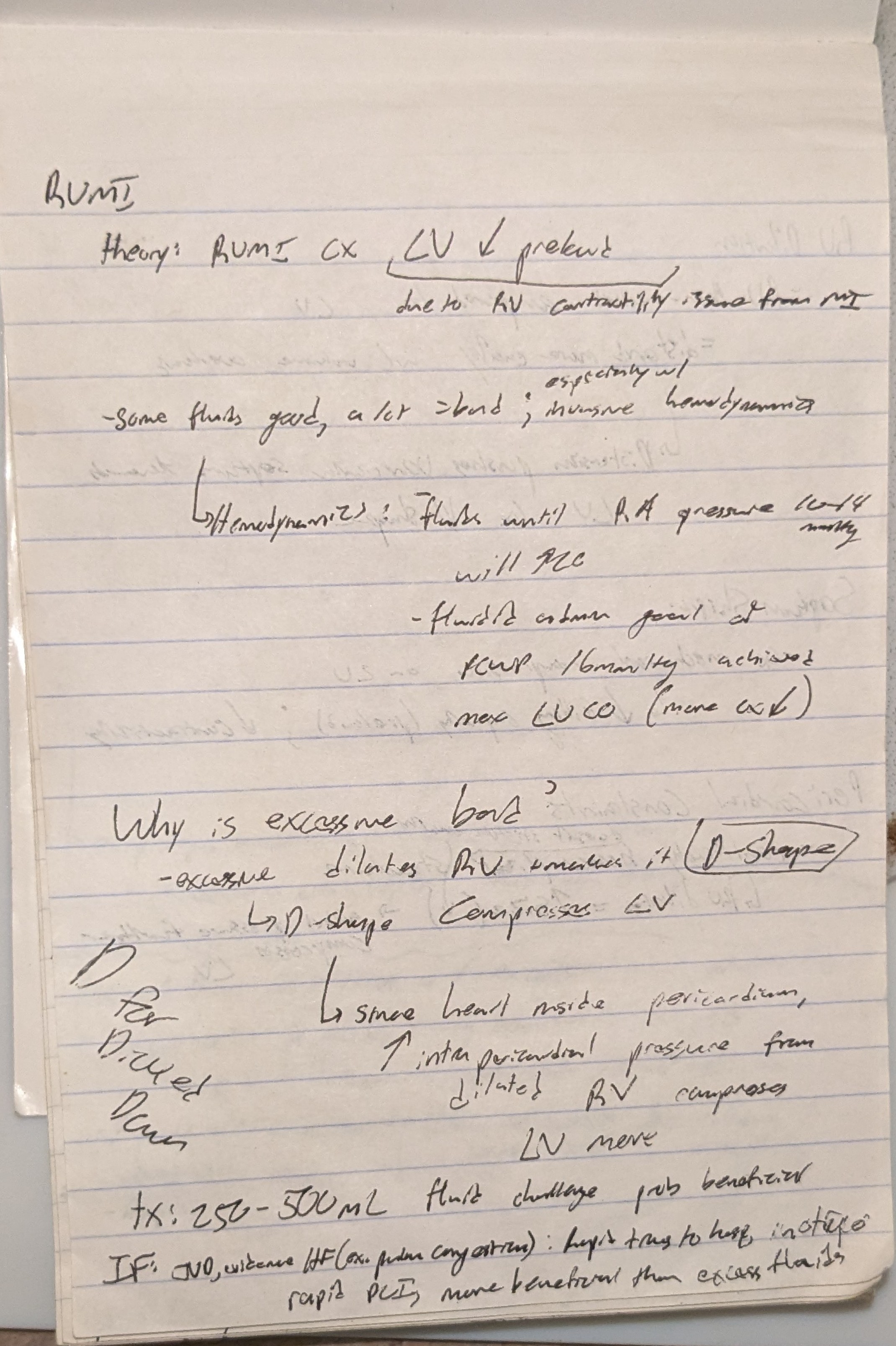
Inferior wall MI and RV infarction. RV infarction may complicate an inferior wall MI. Patients with acute RV infarction depend on RV filling pressures to maintain cardiac output and blood pressure. If you cannot rule out RV infarction, use caution in administering nitrates to patients with inferior STEMI. If you confirm RV infarction by right-sided precordial leads, or if an experienced provider confirms it through clinical findings, then nitroglycerin and other vasodilators (morphine) or volume-depleting drugs (diuretics) are contraindicated as well.
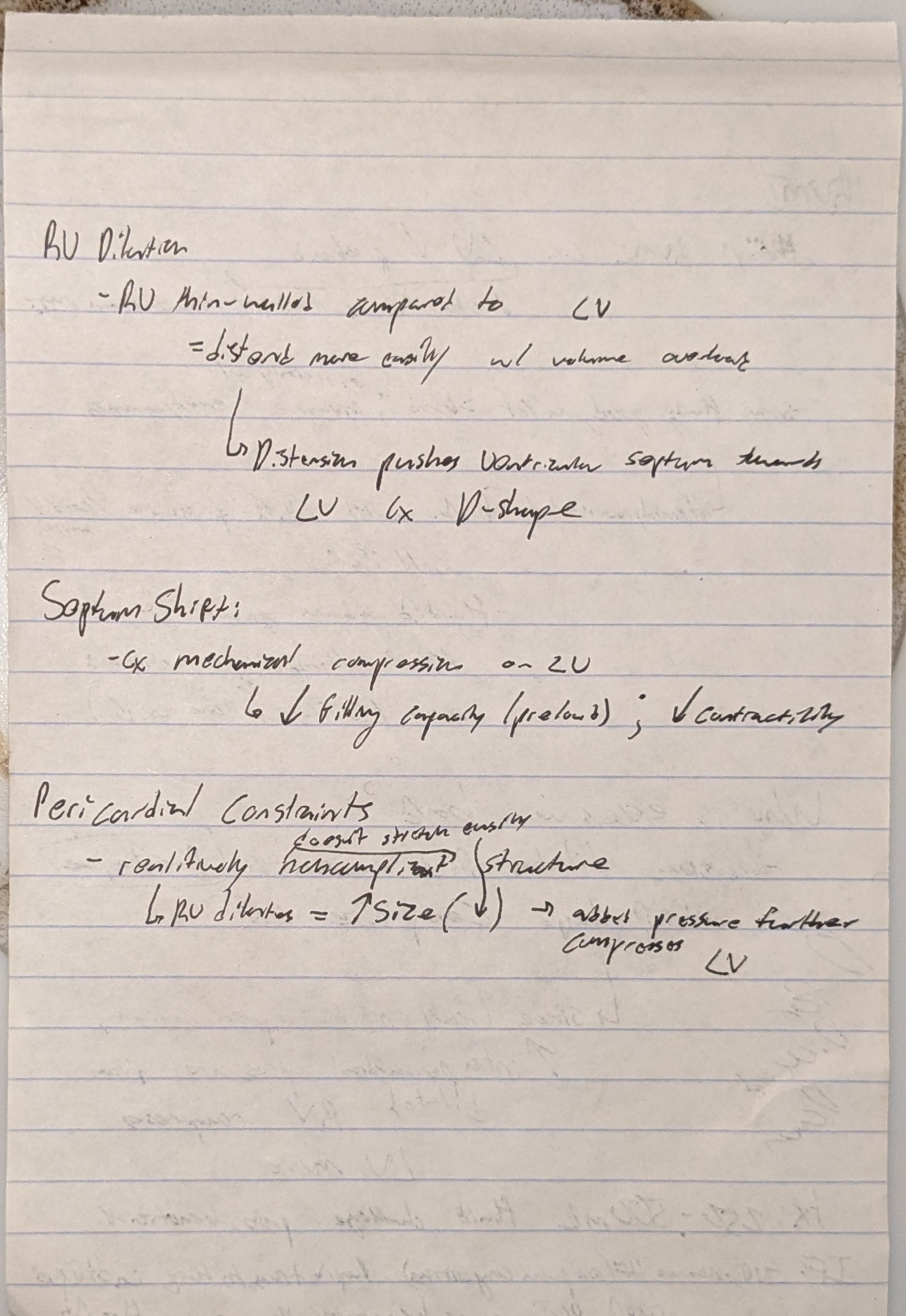
Why is a bunch of fluid in RVMI bad?
Give the patient 1 sublingual nitroglycerin tablet (or translingual dose) every 3 to 5 minutes for ongoing symptoms if permitted by medical control and no contraindications exist. You may repeat the dose ____ (______).
Administer nitroglycerin only if the patient remains hemodynamically stable: (3)
twice (total of 3 doses)
SBP is greater than 90 mm Hg or
no lower than 30 mm Hg below baseline (if known) and
heart rate is 50 to 100/min.
Defib doses
200, 300, 360J
Advanced AW= 1 breath every
1× 6seconds
First drug, even in pulseless VF/VT
EPI
Persistently low PETCO2 values less than _______ during CPR in intubated patients (Figure 46B) suggest that ROSC is unlikely, and it is reasonable to try to improve chest compressions and vasopressor therapy
10 mm Hg
If PETCO2 abruptly increases to a normal value of ______ it is reasonable to consider this an indicator of ROSC.
35 to 40 mm Hg or higher,
sustained increase in PETCO2 (typically 40 mm Hg or higher)
How many Hs and Ts?
5 Hs, 5Ts
Hs
Hypovolemia
Hypoxia
Hydrogen ion (acidosis)
Hypothermia
Hypo-/Hyperkalemia
Ts
Tension Pneumo
Tamponade, cardiac
Toxins
Thrombosis, pulmonary
Thrombosis, coronary
ETCO2
-Poor Perfusion state (in general)
-CPR Goal
Poor perf: <20
Goal: 10-20
ROSC:
-Respiratory parameters
-Hemodynamic Parameters
-12 lead considerations
-10breaths/ min, SpO2 92-98%, PaCO2 35-45 mmHg
-SBP > 90, Map> 65
-Waiting eight minutes can reduce the false positivity rate by more than 60 percent.
x
32°C and 36°C for at least 24 hours
Comatose PT:
-TTM
-obtain brain CT
-EEG
-other critical care management
ACS Door to:
-balloon
-needle
balloon: 90 min
needle: 30min (first dose of fibrinolytic medication)
Neuro Door to:
-CT
-Read
-Fibrinolytic
-CT: 20min
-Read: 45min
-Fibrinolytic: 60
Adult chest compression depth
2 to 2.4 inches (5 to 6 cm)
A general approach is to stop CPR after ___ minutes if there is no ROSC or viable cardiac rhythm re-established, and no reversible factors present that would potentially alter outcome.
20 minutes
LVAD ABCs
-assist vents if needed
assess perfusion by
-Normal Skin CCT?
-Normal Capillary Refill?
LVAD Adequate perfusion:
-treat ___ causes of AMS such as ___
-Non-LVAD causes ex.
hypoxia
BGL
Overdose
stroke
Assesss LVAD function by: (2)
If LVAD cannot be restarted:
-look/listen for alarms
-listen for LVAD hum
-Perform Chest compressions
-attempt to restart:
-Driveline connected?
-Power source connected?
-Need to replace system controller?
If LVAD functioning, what respiratory and hemodynamic value are we assessing?
-PETCO2 > 20mmHg?
-Map > 50?
-YES= no compressions
-No= no cpr
Persistent bradycardia causing: (5)
-HR:
-No=
-Yes=
-hypotension?
-Acutely AMS?
-signs of Shock?
-Ischemic Chest discomfort?
-Acute HF?
-HR typically <50 if bradyarrhythmia
No= Monitor and observe
Yes= Meds/ pacing —> If the patient has persistent bradyarrhythmia causing poor perfusion, proceed
Are the signs and symptoms related to the slow heart rate?
Sometimes the symptom is not due to the bradycardia. For example, hypotension associated with bradycardia may be due to myocardial dysfunction rather than the bradycardia. Keep this in mind when you reassess the patient’s response to treatment.
Critical Concepts: Bradycardia The key clinical question is whether the bradycardia is causing the patient’s symptoms or some other illness is causing the bradycardia.
Treatment Sequence for Bradycardia:
-First Drug:
-If first-line pharm ineffective:
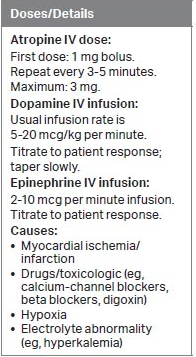
Give atropine as first-line treatment: atropine 1 mg IV—may repeat every 3-5min to a total dose of 3 mg IV
If atropine is ineffective,
provide transcutaneous pacing and/or
dopamine 5 to 20 mcg/kg per minute infusion (chronotropic or heart rate dose) or
epinephrine 2 to 10 mcg/min infusion.
-Atropine sulfate acts by reversing cholinergic-mediated decreases in the heart rate and AV node conduction.
-Dopamine and epinephrine may be successful as an alternative to TCP.
Note that atropine doses of less than 0.5 mg IV may further slow the heart rate.
When should you avoid relying on atropine for bradycardia?
Avoid relying on atropine in Mobitz type II second-degree or third-degree AV block or in patients with third-degree AV block with a new wide QRS complex where the location of the block is likely to be in infranodal tissue (such as in the bundle of His or more distal conduction system).
These bradycardias likely will not respond to reversal of cholinergic effects by atropine; preferably, treat them with TCP or βadrenergic support as temporizing measures while the patient is prepared for transvenous pacing.
Atropine administration should not delay external pacing or β-adrenergic infusion for patients with impending cardiac arrest. A β-adrenergic infusion (ie, dopamine, epinephrine) is not a first-line agent for treating unstable bradycardia, but it can be used as an alternative when a bradycardia is unresponsive to treatment with atropine. You can also use a β-adrenergic infusion as a temporizing measure while the patient is prepared for transvenous pacing.
Persistent tachyarrhythmia causing: (5)
-HR:
-No=
-Yes=
-hypotension?
-Acutely AMS?
-signs of Shock?
-Ischemic Chest discomfort?
-Acute HF?
-HR: typically >/= 150 if tachyarrhythmia
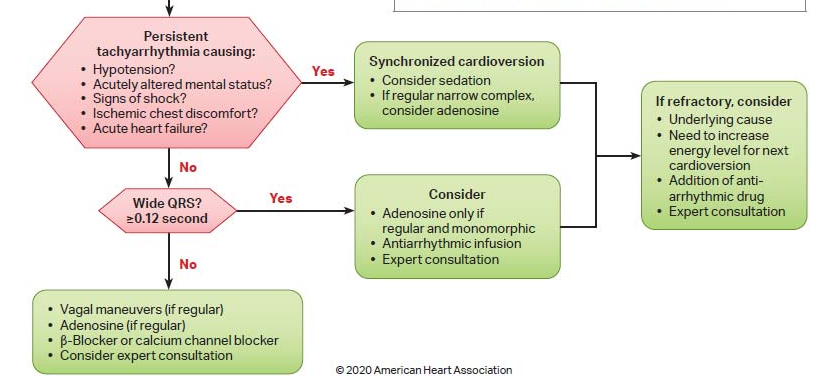
No= Wide QRS (>/= 0.12ms)?
Yes= Synchronized Cardioversion
Serious signs and symptoms are unlikely if the ventricular rate is less than 150/min in patients with a healthy heart. However, if the patient is seriously ill or has significant underlying heart disease or other conditions, symptoms may be present at a lower heart rate.
It is unlikely that symptoms of instability are caused primarily by the tachycardia when the heart rate is less than 150/min unless the patient has impaired ventricular function
Beating so fast that cardiac output is reduced; this can cause pulmonary edema, coronary ischemia, and hypotension with reduced blood flow to vital organs (eg, brain, kidneys)
Beating ineffectively so that coordination between the atrium and ventricles or the ventricles themselves reduces cardiac output
Consideration for Stable tachyarrhythmia:
If the patient does not have rate-related cardiovascular compromise, proceed to Step 6. You’ll have time to obtain a 12-lead ECG, evaluate the rhythm, determine the width of the QRS, and determine treatment options.
For stable patients, seek expert consultation because treatment has the potential for harm.
Stable Tachyarrhythmia Wide QRS meds:
Procainamide 20 to 50 mg/min IV until
arrhythmia suppressed,
hypotension ensues,
QRS duration increases more than 50%, or
maximum dose 17 mg/kg IV is given.
Maintenance infusion: 1 to 4 mg/min IV. Avoid if prolonged QT or CHF
Amiodarone (first dose) 150 mg IV over 10 minutes. Repeat as needed if VT recurs.
Follow by maintenance infusion of 1 mg/min IV for first 6 hours.
Sotalol 100 mg (1.5 mg/kg) IV over 5 minutes. Avoid if prolonged QT
Recent evidence suggests that if the rhythm etiology cannot be determined and is regular in its rate and monomorphic, IV adenosine is relatively safe for both treatment and diagnosis. IV antiarrhythmic drugs may be effective
In the case of irregular wide-complex tachycardia, management focuses on control of the rapid ventricular rate (rate control), conversion of hemodynamically unstable atrial fibrillation to sinus rhythm (rhythm control), or both. Seek expert consultation.
Stable Tachyarrhythmia narrow QRS:
Regular:
Irregular:
Regular:
-Vagal Maneuvers (if regular)
-Adenosine (if regular)
6-mg rapid IV bolus over 1 to 3 seconds, followed by a 20-mL saline flush and elevate the extremity.
If no response after 1 to 2 minutes, administer second dose of 12-mg rapid IV bolus over 1 to 3 seconds
-Record rhythm strip during administration
Irregular:
-B-blocker (ex. Metoprolol) or Ca+ channel blocker (ex. diltiazem)
consider expert consultation
Synchronized Cardioversion:
-Narrow and regular:
-Narrow and irregular:
-Narrow and regular: 50-100J
-Narrow and irregular: 120-200J
Synchronized Cardioversion:
-Wide and Regular:
-Wide and irregular:
-Wide and Regular: 100J
-Wide and irregular: 200-360J
monomorphic QRS= sync
polymorphic QRS= defib
Tachyarrhythmia: If refractory, consider: (4)
-underlying cause
-Need to increase energy level for next cardioversion
-Addition of anti-arrhythmic drug
-Expert consultation
If the patient has a wide-complex tachycardia and is unstable, assume it is ___
If you have any doubt about whether an unstable patient has monomorphic or polymorphic VT ___
VT until proven otherwise. The amount of energy required for cardioversion of VT is determined by the specific device’s recommended energy level to maximize first shock success.
If the patient is unstable but has a pulse with regular uniform wide complex VT (monomorphic VT), treat with synchronized cardioversion. Follow your device’s specific recommended energy level to maximize the success of the first shock. If the patient does not respond to the first shock, increasing the dose stepwise is reasonable. (This recommendation represents expert opinion.)
Arrhythmias with a polymorphic QRS appearance (polymorphic VT), such as torsades de pointes, will usually not permit synchronization. If the patient has polymorphic VT, treat as VF with high-energy unsynchronized shocks (eg, defibrillation doses).
If you have any doubt about whether an unstable patient has monomorphic or polymorphic VT, do not delay treatment for further rhythm analysis. Provide high-energy, unsynchronized shocks (defibrillation doses).
Sinus tachycardia is a heart rate that is greater than ____ , has P waves, and is generated by sinus node discharge. The heart rate in tachycardia typically does not exceed 220/min and is age-related. Sinus tachycardia usually does not exceed ___, and it has a gradual onset and gradual termination.
Reentry SVT has an abrupt onset and termination.
100/min
120 to 130/min, GRADUAL onset and termination
Reentry SVT= ABRUPT onset/term
Narrow–QRS complex (SVT) tachycardias (QRS less than 0.12 second) in order of frequency
Regular or irregular tachycardias
Irregular narrow-complex tachycardias are probably ___
Wide–QRS complex tachycardias (QRS 0.12 second or more)
Narrow–QRS complex (SVT) tachycardias (QRS less than 0.12 second) in order of frequency
Sinus tachycardia
Atrial fibrillation
Atrial flutter
AV nodal reentry
Regular or irregular tachycardias
Irregular narrow-complex tachycardias are probably atrial fibrillation
Wide–QRS complex tachycardias (QRS 0.12 second or more)
Monomorphic VT
Polymorphic VT
SVT with aberrancy
Determine if the rhythm is regular or irregular.
A regular wide-complex tachycardia is presumed to be ___or ___ with aberrancy.
An irregular wide-complex tachycardia may be ___, ___, or ___. These advanced rhythms require additional expertise or expert consultation. In addition, consider adenosine (only if regular and monomorphic) and antiarrhythmic infusion.
regular wide-complex tachycardia
VT or SVT with aberrancy.
irregular wide-complex tachycardia
atrial fibrillation with aberrancy
pre-excited atrial fibrillation (atrial fibrillation using an accessory pathway for antegrade conduction)
polymorphic VT/torsades de pointes
Recent evidence suggests that if the rhythm etiology cannot be determined and is regular in its rate and monomorphic, IV adenosine is relatively safe for both treatment and diagnosis. IV antiarrhythmic drugs may be effective
In the case of irregular wide-complex tachycardia, management focuses on control of the rapid ventricular rate (rate control), conversion of hemodynamically unstable atrial fibrillation to sinus rhythm (rhythm control), or both. Seek expert consultation.
Critical Concepts: Drugs to Avoid in Patients With Irregular WideComplex Tachycardia
-avoid ___ agents
Avoid AV nodal blocking agents such as
adenosine, calcium channel blockers,
digoxin, and
possibly β-blockers in patients with pre-excitation atrial fibrillation,
because these drugs may cause a paradoxical increase in the ventricular response.
Tachyarrhythmia Narrow QRS, Regular:
Adenosine increases AV block and will terminate approximately 90% of reentry arrhythmias within 2 minutes. Adenosine will not terminate ___ or ____ but will ___, allowing you to ___
Adenosine may cause ____, so generally, you should not give adenosine to patients with ___or ___, particularly if patients are ___.
If the rhythm converts with adenosine, it is probable ___. Observe patients for recurrence, and treat any recurrence with ___or ___, such as the non-dihydropyridine calcium channel blockers (verapamil and diltiazem) or β-blockers. Typically, you should obtain expert consultation if the tachycardia recurs.
If the rhythm does not convert with adenosine, it is possible___, ___, ___, or ___, and you should obtain expert consultation about diagnosis and treatment.
atrial flutter or atrial fibrillation but will slow AV conduction, allowing you to identify flutter or fibrillation waves.
Adenosine may cause bronchospasm, so generally, you should not give adenosine to patients with asthma or COPD, particularly if patients are actively bronchospastic.
probable reentry SVT. Observe patients for recurrence, and treat any recurrence with adenosine or longeracting AV nodal blocking agents,
such as the non-dihydropyridine calcium channel blockers (verapamil and diltiazem) or β-blockers. Typically, you should obtain expert consultation if the tachycardia recurs.
not convert with adenosine= possible
atrial flutter,
ectopic atrial tachycardia,
sinus tachycardia, or
junctional tachycardia,
and you should obtain expert consultation about diagnosis and treatment.
Adenosine is safe and effective in pregnancy, but it has several important drug interactions. Patients with significant blood levels of theophylline, caffeine, or theobromine may require larger doses, and you should reduce the initial dose to 3 mg IV for patients taking dipyridamole or carbamazepine. Due to recent case reports of prolonged asystole after adenosine administration to patients with transplanted hearts or after central venous administration, you may consider lower doses such as 3 mg IV in these situations.
Verapamil Hydrochloride (Isoptin, Calan)
-Class:
-Dose: initial, repeat, max
-Calcium channel blocker.
2.5 to 5 mg IV bolus over 2 minutes (3 minutes in older patients).
Repeat dose of 5 to 10 mg may be given every 15 to 30 minutes.
Maximum dose 20 mg
Mechanism of action Slow calcium channel blocker that selectively blocks the transmembrane influx of calcium ions into arterial smooth muscles and myocardial cells, prolongs AV nodal refractory period, reduces systemic vascular resistance and selective vasodilation of peripheral arteries, and dilates coronary arteries and arterioles.
DilTIAZem (Cardizem)
-Class:
-Dose: initial, re-bolus, maintenance
Calcium channel blocker, antidysrhythmic (Class IV).
Initial dose: 0.25 mg/kg IV over 2 minutes.
If inadequate response, may re-bolus in 15 minutes with
0.35 mg/kg IV over 2 minutes.
Maintenance infusion of 5 to 15 mg/h titrated to physiologically appropriate heart rate
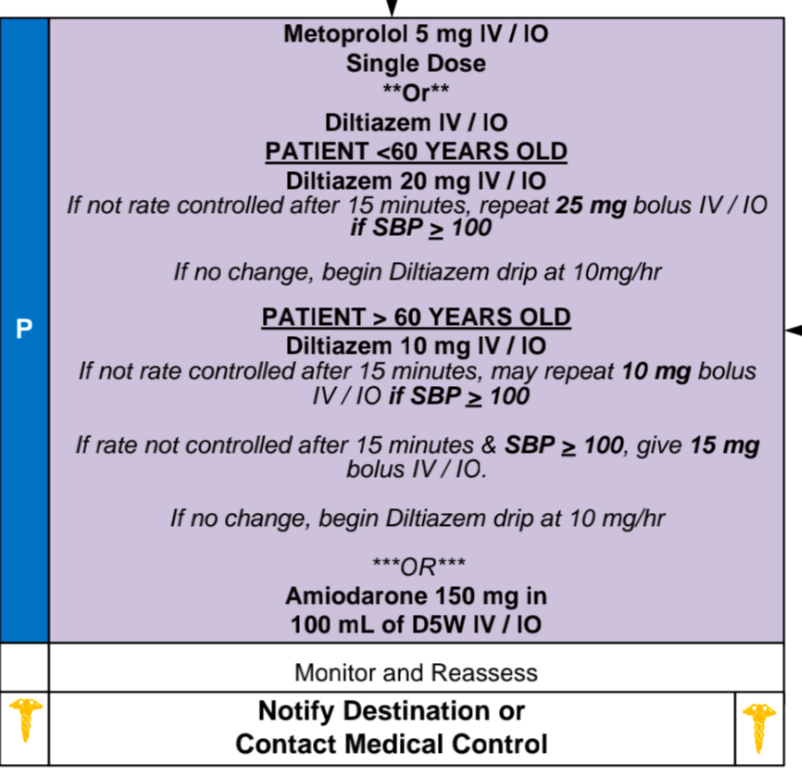
Cumberland:
<60y/o, SBP >/= 100:
20mg,
if rate uncontrolled after 15min, repeat 25mg if SBP >/= 100
if no change, begin drip at 10mg/hr
>60y/o, SBP >/= 100:
10 mg,
if rate uncontrolled after 15min, repeat 15mg if SBP >/= 100
if no change, begin drip at 10mg/hr
Mechanism of action Inhibits extracellular calcium ion influx across membranes of myocardial cells and vascular smooth muscle cells, resulting in inhibition of cardiac and vascular smooth muscle contraction and thereby dilating main coronary and systemic arteries; no effect on serum calcium concentrations; substantial inhibitory effects on the cardiac conduction system, acting principally at the AV node, with some effects at the SA node.
Cumberland: Stably, narrow Tachyarrhythia:
Metoprolol Tartrate (Lopressor)
-Class: initial, repeat every, max
Class Beta-blocker, beta-1 selective; antihypertensive, antidysrhythmic.
5 mg IV over 1 to 2 minutes. May repeat as needed every 5 minutes for a
total of three doses (15mg)
-Cumberland: single dose of 5mg
Mechanism of action Decreases heart rate, conduction velocity, myocardial contractility, and cardiac output. Used to control ventricular response in SVT (PSVT, AF, atrial flutter). Considered second-line agent after adenosine, dilTIAZem, or digitalis derivative.
Examples of Some Av Nodal Blocking Agents:
adenosine,
calcium channel blockers,
digoxin, and
possibly β-blockers in patients with pre-excitation atrial fibrillation,