Approach to Suspected Toxicities in Small Animals Part 2
 Call Kai
 Learn
Learn Practice Test
 Spaced Repetition
 Match
Match Flashcards
 Knowt Play
1/33

Earn XP
Description and Tags
This part goes over the different toxins mentioned in this lecture, and how they effect the body
Name | Mastery | Learn | Test | Matching | Spaced | Call with Kai | Chat |
|---|
No analytics yet
Send a link to your students to track their progress
34 Terms
PARACETAMOL
How is this toxic to animals, and why are cats more susceptible to paracetamol toxicity?
Paracetamol is metabolized in the liver
Broken down into NON-toxic metabolites via the sulphation and glucoronidation pathways
This is why Paracetamol is non-toxic to a point in dogs; able to metabolize it well enough
Cats LACK the glucoronidation pathway!!!
Sulphation pathway then becomes overwhelmed, and the remaining Paracetamol is then OXIDIZED into TOXIC metabolites
NAPQI metabolites
NAPQI metabolites are initially deactivated by the glutathione that’s present in the liver, but once THOSE become overwhelmed, the NAPQI metabolites cause:
Oxidative damage to RBCs
Hepatic cell injury / death
In Paracetamol toxicity, will overall see hepatocellular necrosis, methemoblobin formation, and Heinz body anemia
Random: dry eye in dogs

What are the clinical signs of Paracetamol toxicity at <24 hours post ingestion? (6)
1) Cyanosis / muddy brown mucus membranes
2) Tachycardia, tachypnea
3) Lethargy
4) Facial or paw edema
5) Vomiting
6) Anemia
What are the clinical signs of Paracetamol toxicity at >24 hours post ingestion? (5)
1) Liver failure
2) Icterus
3) Seizures / coma
4) Renal failure (RARELY)
5) Hematuria / hemaglobinuria
At what dose of Paracetamol ingested would you treat a dog for paracetamol toxicity? What about a cat?
Cat → ANY DOSE
Dog → anything greater than 50-100 mg/kg
What is the ANTIDOTE for Paracetamol toxicity
N-acetylecysteine (Parvolex)
Acts as a glutathione precursor, binding to NAPQI metabolites and inactivating them
Dilute, and give slow over IV every 6 hours for 7 doses
What are some other things that you would do for treatement of paracetamol toxicity? (Remember, some of these would really depend on the circumstances of the case…)
1) Emetics - depends on timing
2) Adsorbents
Get them on IV fluids for sure and give O2 if needed
If super advanced, may need blood transfusion
METALDEHYDE
What is it, and how toxic is it?
Slug killer
HIGHLY TOXIC
Treat for even the smallest of doses ( >2mg/kg)
Any dose extremely toxic
What are the early signs of metaldehyde toxicity? What will it progress to?
Early signs:
Vomiting
Diarrhea
Hypersalavation
Soon after: “Shake and Bake”
TREMORS AND SEIZURES
Hyperasthesia - extreme sensitivity to touch and other stimuli
Hyperthermia
Mydriasis - excessive dilation of the pupil
Death will then occur due to respiratory arrest and multiple organ dysfunction
How should you treat a metaldehyde toxicity? Think of how quickly it sets in…
Not likely emesis, as it is rapid onset and neurological signs develop quickly
Activated charcoal can help + enema to flush out the intestines and prevent further absorption
Should also focus on seizure control:
Benzodiazepines
Propofol
Methocarbamol - muscle relaxant
IVFT
Manual cooling
O2
Slow recovery over 24 hours; 15% of cases even with treatment can be fatal
Unfortunately no antidotes
ANTICOAGULANT RODENTICIDES
How are they toxic to animals? What is their mechanism of action?
Slowly absorbed, with a long plasma half life
Mechanism - Work by blocking Vitamin K activation, which is needed to produce clotting factors II, VII, IX, and X
Leads to a defect in secondary hemostasis and causes coagulopathy (takes 1-5 days to reach this stage, depending on dose)
After 3-5 days post-ingestion, what clinical signs would you see after a rodenticide poisoning? (8 overall; think of what could be affected if your blood can’t clot)
1) Lethargy
2) Body cavity hemorrhaging
3) Dyspnea / cough
4) Hemoabdomen
5) Epistaxis - nose bleed
6) Melaena / hematemesis - blood in stool / vomit
7) Joint pain
8) Anemia
** image shows blood seeping into the lungs
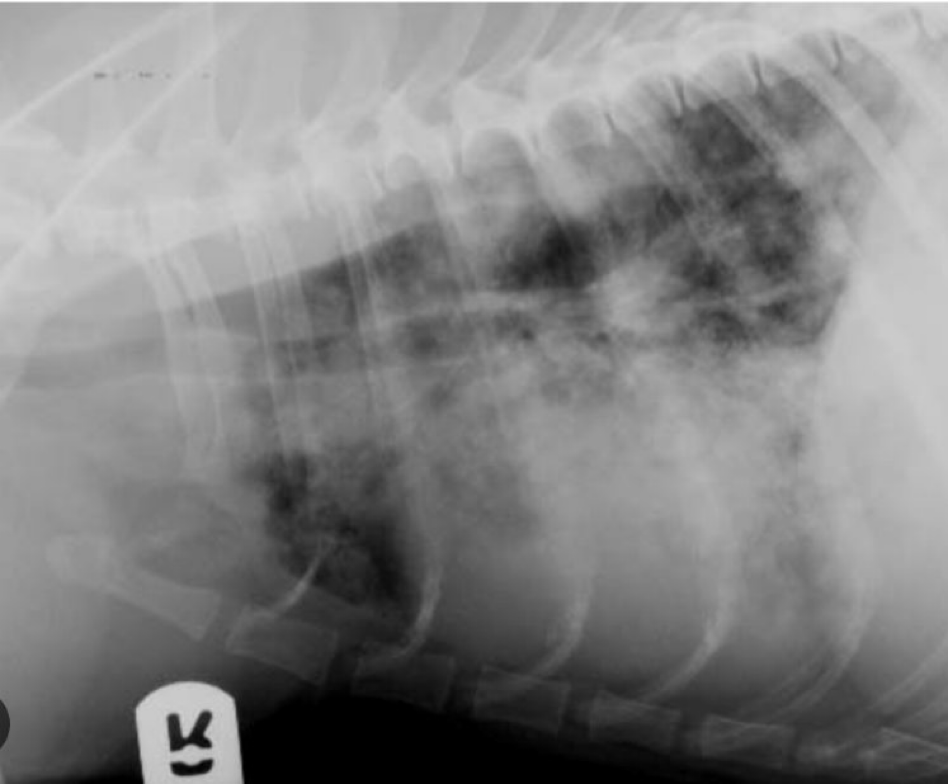
What is the main method to definitively diagnose a rodenticide poisoning?
Prolonged Prothrombin Time (PPT) - do this first (from 36hr post ingestion)
Can then do:
Prolonged APTT (from 72 hr post)
Check the platelets; are they normal or decreased?
Check PIVKA levels
Proteins induced by Vit K antagonism
Blood panel for anemia
What is the ANTIDOTE for a rodenticide poisoning?
VITAMIN K1
How would you treat for an anticoagulant rodenticide poisoning in an ASYMPTOMATIC animal?
Most cases will be asymptomatic, but you should treat if a patient gets 10% of the LD50 for the rodenticide
Treat with emesis and activated charcoal and, if it calls for it, the ANTIDOTE -> Vitamin K1
Sometimes you shouldn’t start with Vitamin K1, as rodenticides have a long half life and can still be in the body if not flushed out. So, do emesis and activated charcoal first, check PPT 48hr and 72hrs post ingestion, then treat with Vitamin K1 if initial attempt was unsuccessful
How would you treat a rodenticide poisoning in a SYMPTOMATIC animal?
No point in emesis or charcoal, poison has already taken effect
ABSOLUTELY VIT K1 TREATMENT
May need O2 supplementation
TRANSFUSION ideal if bad enough; specifically plasma, ± RBCs
ETHYLENE GLYCOL (anti-freeze)
How is ethylene glycol toxic to animals?
Very poor prognosis; rapidly absorbed, can be fatal at 1mL/kg in cats and > 4mL/kg in dogs
Is metabolized in the liver by alcohol dehydrogenase; metabolites are toxic
Glycoaldehyde -> CNS effects
Glycolic acid -> metabolic acidosis
Oxalate -> binds to calcium (CaOx), leads to hypocalcemia and is deposited in the renal tubules, leading to acute kidney injury

What are the signs of anti-freeze poisoning in the first 12 hours? (4)
** Think about the order of the toxic metabolites and when they are made… and which what effects which body system…
Neurological signs
Ataxia
Twitching
Seizures
Vomiting
After 24 hours?
Cardiopulmonary signs
Tachypnea
Tachycardia
Metabolic acidosis
Pulmonary edema
Shock
After 24 hours?
Acute Kidney Injury
Swollen / painful kidneys
Vomiting
Anorexia
Oral ulceration
Oliguria / anuria
How would you diagnose an anti-freeze poisoning within the first 12 hours?
Patient would be in metabolic acidosis
Calcium oxalate crystals present in urine (CaOX crystalluria)
Isosthenuria (UPG = 1.008-1.012)
How would you diagnose anti-freeze poisoning AFTER 24 hours?
Blood panel!! Will show:
Azotemia (once that is present = grave prognosis)
Hyperphosphatemia
Hyperkalemia
HypOcalcemia
Hyperglycemia
All indicative of Acute Kidney Injury
What would a urinalysis show > 12 hours POST anti-freeze poisoning?
Reduced USG (isosthenuria)
Glycosuria
Hematuria
Proteinuria
Clacium oxalate crystals (see image)
Cellular casts (from cell death)
pH <6.5

What is the ANTIDOTE for ethylene glycol poisoning?
ETHANOL
Blocks alcohol dehydrogenase from metabolizing anti-freeze… allows ethylene glycol to pass through the kidneys unchanged
Only effective < 3 hrs post ingestion in CATS
Effective < 8 hrs post ingestion for DOGS
******** ONCE KIDNEY INJURY IS PRESENT, ETHANOL WILL MAKE IT WORSE ********
What is the dosage for an IV treatment of ethanol?
5% solution as a constant rate infusion at a rate of 5 ml/kg/hour OR
5 ml/kg body weight 20% ethanol in saline IV every 6 hours for 5 doses then every 8 hours for 4 doses.
How would you make a 20% dilution of ethanol from 40% vodka? What about a 5% dilution?
To make a 20% solution:
dilute an equal volume of vodka with IV fluids such as lactated Ringer's or saline (e.g. 500 ml with 500 ml). An in-line filter should be used for the IV.
To make a 5% solution:
add 125 ml of vodka to 875 ml of IV fluid lactated Ringer's or saline, that is remove about 125 ml from the bag and replace with vodka. An in-line filter should be used for the IV.
What are the side effects to treating anti-freeze poisoning with ethanol? (4)
CNS depression
Bradycardia
Hypoventilation
Hypothermia
THEOBROMINE (chocoloate)
What are the signs of theobromine poisoning at a 20 mg/kg dose? 40 mg/kg? 60 mg/kg?
20 mg/kg chocolate consumption causes:
GI sins
Hyperactivity (energetic; like being given caffiene)
Panting
Shaking
40 mg/kg chocolate consumption causes:
Cardiotoxicity
Tachycardia
Arrhythmias
60 mg/kg chocolate consumption causes:
Seizures
What kind of chocolate has the MOST theobromine content? After how much chocolate consumption would you treat?
DARK CHOCOLATE → ~ 5.3 mg/g theobromine content
**** Treat if patient eats > 3.5 g/kg of dark chocolate
Reduces as it gets lighter
White chocolate is negligible
For milk chocolate → 1.4 mg/g theobromine content
**** treat if patient eats > 14 g/kg of milk chocolate
**** Most accurate to calculate theobromine content from total cocoa solids
Theobromine content in mg/g = cocoa % x 0.16
Ex: for 75% dark chocolate = 12 mg/g (75 × 0.16)
What are the general treatments for a mild theobromine poisoning?
1) Emesis - depends on timing of consumption
2) Charcoal
3) IVFT if needed
4) Urinary catheter
Theobromine is absorbed through the bladder, so getting them to urinate as frequently as possible is best
Can be controlled via catheter
How would you treat a more advanced theobromine poisoning (w/ neurological signs or arrhythmia)?
Seizure control (from most effective to least)
Benzodiazepines
Phenobarbitone
Leviteracetam
Propofol
Arrhythmias
Supraventricular tachycardia
Beta blocker
Ventricular tachycardia
Lidocaine
Of course this would be on top of the general treatments (IVFT, catheter, etc.)
XYLITOL
How is xylitol toxic to animals? At what dose of xylitol consumption should you begin treatment?
RAPID absoption and onset of symptoms
Hypoglycemia
Due to insulin spike caused by xylitol
Reported at > 100 mg/kg ; see within the first 30 mins
Hepatic necrosis
Reported at > 500 mg/kg
Signs delayed by up to 72 hrs
Causes coagulopathy
Treat with even the smallest dose ( > 50mg/kg, which is one piece of sugar free gum)
How would you treat an animal with xylitol poisoning? What if they become hypoglycemic or had received a hepatotoxic dose?
General treatments:
Emesis? Remember, rapid absorption
Monitor BG levels
IVFT
If hypoglycemic…
Dextrose CRI
Frequent, small meals
Monitor K and Phos.
If ingested a hepatotoxic dose…
Liver protectants
Monitor ALT, TBIL, and clotting times
Transfusions?
Vitamin K supplementation?
RAISINS / GRAPES
What is the “toxic component” in grapes and raisins? Is it toxic for every animal? What can it cause?
Is an IDIOSYNCRATIC reaction in ~ 10% of dogs; most don’t react, but some are more susceptible
Toxic component: Tartaric acid
Can cause:
GI signs early on (V/D, abd pain)
AKI from 24-72hr
How would you treat a raisin/grape poisoning?
Emesis!! Useful even up to 6hrs post ingestion
± charcoal
MONITOR
Establish bloods → urea, creat, lytes (+ phos and Ca)
Check urine
Then continue to monitor as outpatient
Establish bloods baseline, then recheck q 24hrs for 72 hrs
*** START IVFT if creat. INCREASES > 26.4 umol/L