Birds after midterm 2
 Call Kai
 Learn
 Practice Test
 Spaced Repetition
 Match
 Flashcards
 Knowt Play
1/56

There's no tags or description
Looks like no tags are added yet.
57 Terms

• Upperparts finely barred black and white with black primary coverts
• Underparts clean white
• Black eye line
• Bill reddish in adults (yellow in juveniles)
Order: Phaethontiformes
Family: Phaethontidae
Red-billed Tropicbird
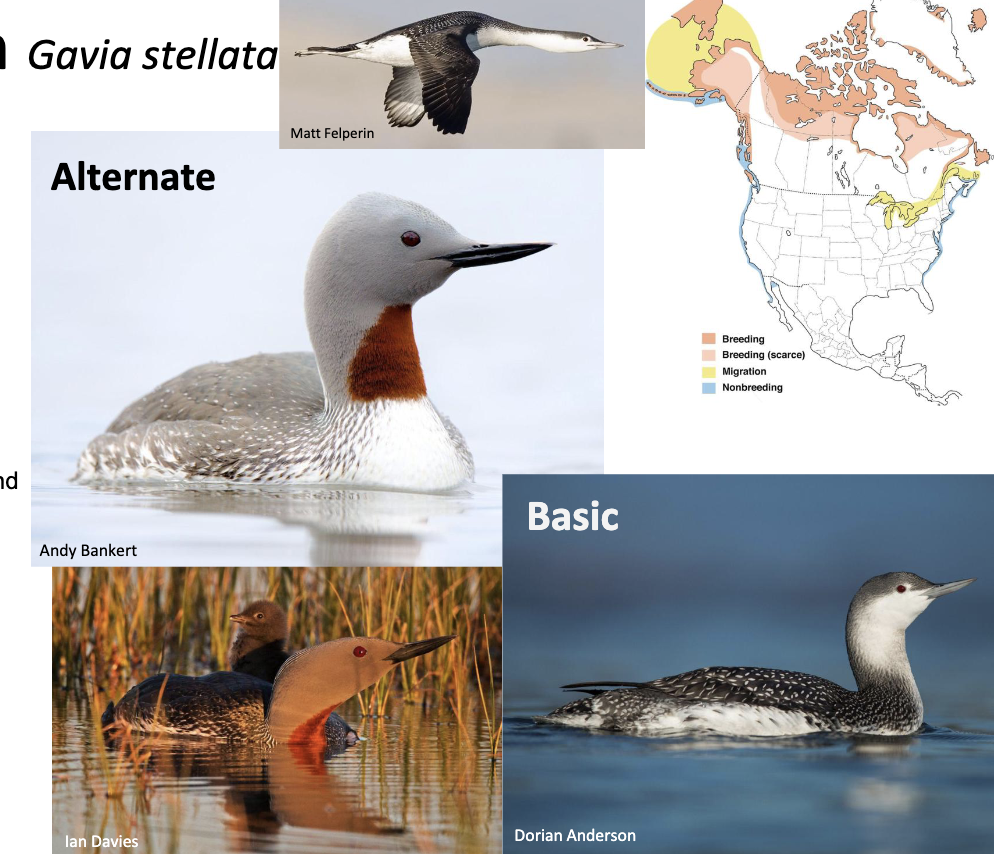
• Upperparts brownish-black to grayish-black, mottled with white
• In basic plumage, head and neck mostly white, with white around eye
• In alternate plumage, pale gray head and neck with rust-red throat patch; fine black and white vertical stripes on nape
• Smallest loon, with slender neck and bill
• Commonly floats with upright posture – head and
bill tilted up
Red-throated Loon

• Small to medium-sized
Basic plumage:
• Brownish-gray upperparts with white underparts.
• Most have a dark “chinstrap,” neck otherwise cleanly
divided into dark hindneck and white foreneck
• Gray on head extends to or just below eye
Alternate plumage:
• Pale gray nape contrasts with dark face and neck
• Vertical black and white stripes on sides of neck
• Bold white spots on back
Order: Gaviiformes
Family: Gaviidae
Pacific Loon
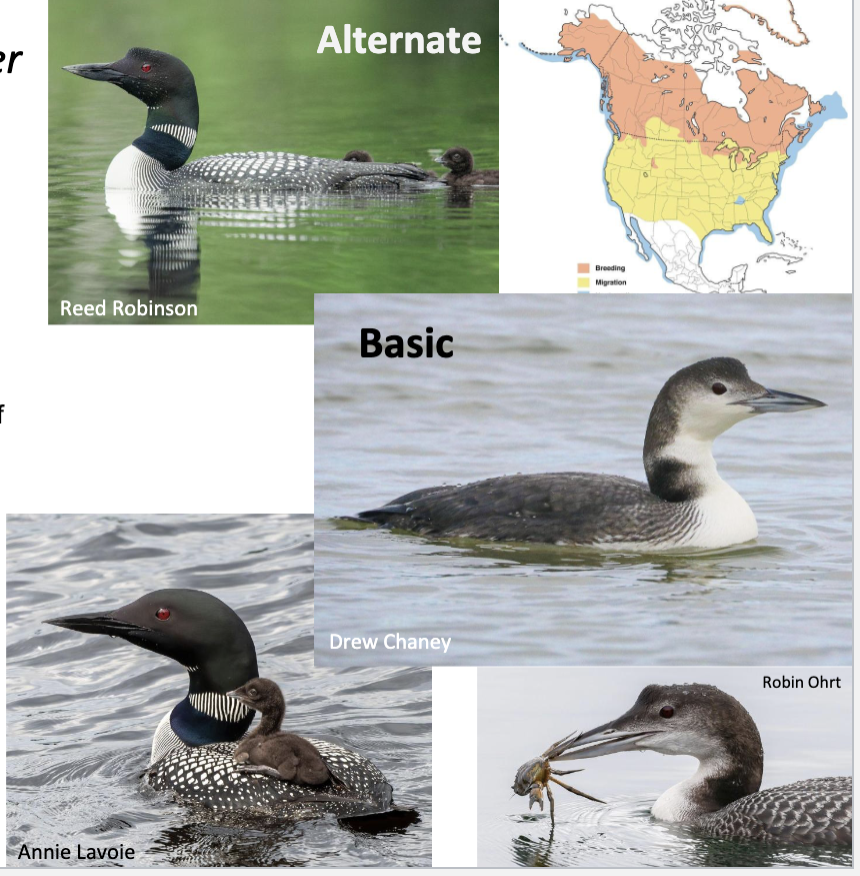
• Gray to gray-brown upperparts with white underparts
• Grayish-white throat with white wedge extending toward nape
• Gray half-collar at base of neck; usually some white around eye
• In alternate plumage, upperparts black with large white spots on back; large patch of vertical stripes on sides of neck, smaller patch on chin
• Large size
Order: Gaviiformes
Family: Gaviidae
Common Loon
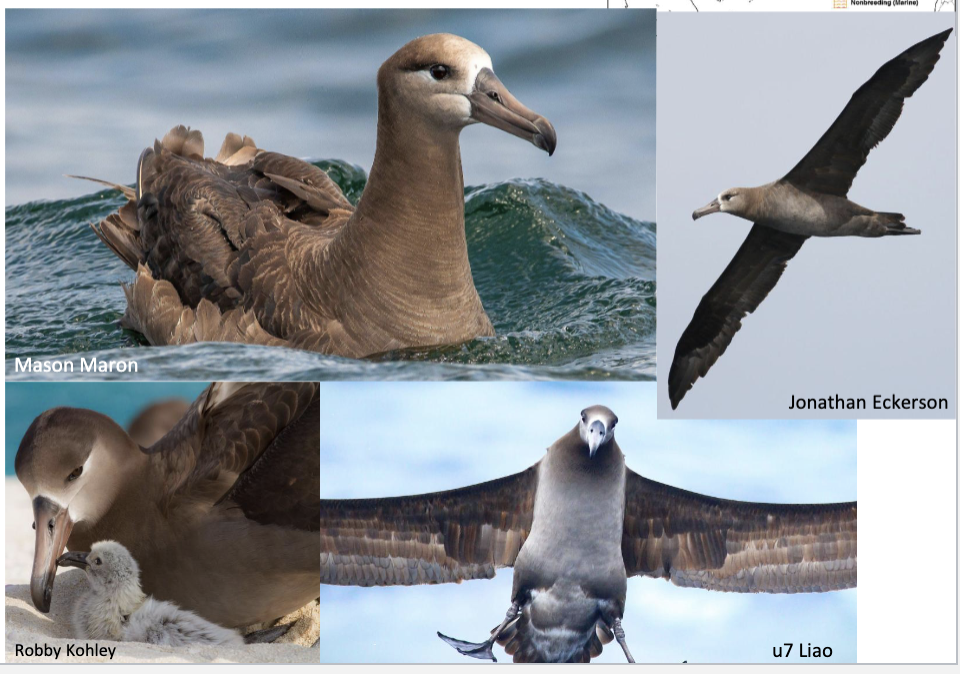
• Dusky brown overall, with dark bill and feet
• Whitish area at base of bill and under the eyes
• Rump and undertail coverts sometimes white
• Very large with 7ft wingspan
Order: Procellariiformes
Family: Diomedeidae
Black-footed Albatross

• Stocky, thick-necked with rounded wings and tail
• Thick yellowish bill
• Polymorphic, ranging from the lightest morphs with white underparts, head, and neck and slate gray upperparts to the darkest morphs that are slate gray overall
• Dark eye smudge
Order: Procellariiformes
Family: Procellariidae
Spray an unpleasant, musky liquid from mouths when threatened
Northern Fulmar

• Slender, and narrow-winged
• Dark bill
• Uniformly dark body
• Silvery underwing coverts visible in flight
Order: Procellariiformes
Family: Procellariidae
Sooty Shearwater
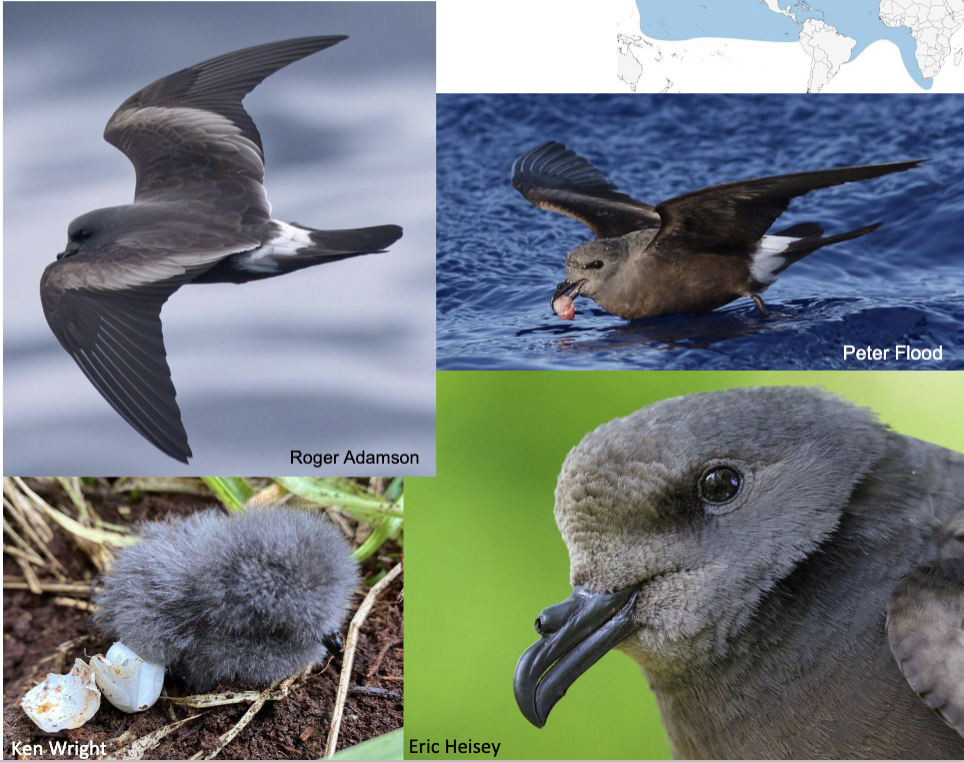
• Dark blackish-brown, with grayer upperparts
• White rump patch (except southern populations)
• Forked tail
• Long, pointed wings with broad, pale wing bar
Order: Procellariiformes
Family: Hydrobatidae
Leach’s Storm-Petrel

• Pale gray (dove-like!) plumage unlike any other storm-petrel. Dark eye smudge on pale gray head
• Dark underwing coverts
• Forked tail
• Pale wing bar
Order: Procellariiformes
Family: Hydrobatidae
Fork-tailed Storm-Petrel

• Large and dark overall
• Long wings with pale brown wing bar
• Long, forked tail
Order: Procellariiformes
Family: Hydrobatidae
Black Storm-Petrel
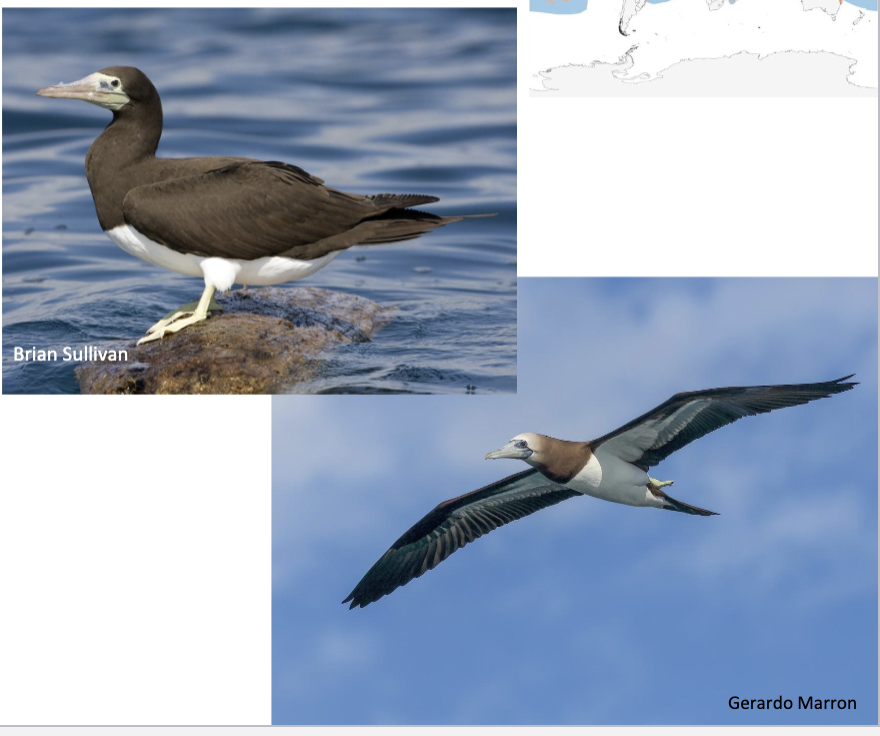
• Dark brown upperparts and breast, with clean white underparts
• Bill and feet generally yellow
Order: Suliformes
Family: Sulidae
Cocos Booby
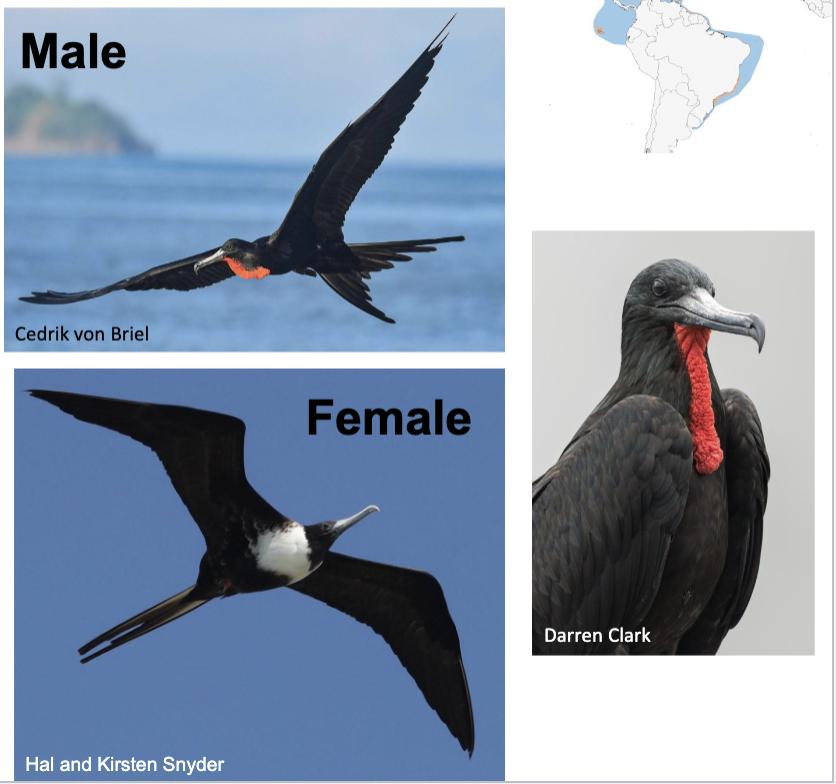
• Large and black to dark brownish overall
• Long, deeply forked tail
• Extremely short legs that preclude walking
Order: Suliformes
Family: Fregatidae
Magnificent Frigatebird
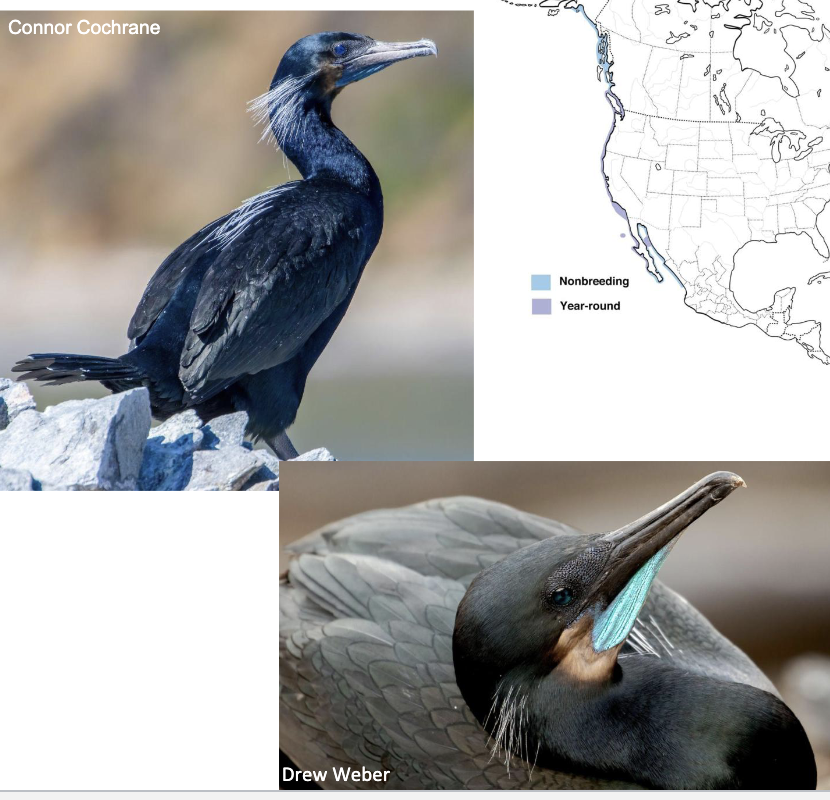
• Uniformly dark plumage with greenish tint
• Dark gular pouch has “W” or “M” shaped border
• Buffy to white feathers around base of gular pouch
• In alternate plumage, purple tint to head and neck with irregular tufts of white plumes; gular pouch becomes bright blue
Order: Suliformes
Family: Phalacrocoracidae
Brandt’s Cormorant

• Dark plumage with a greenish or bronze tint
• Orange-yellow gular pouch has rounded border
• In alternate plumage, develops two “crests” of white plumes
Order: Suliformes
Family: Phalacrocoracidae
Double-crested Cormorant

• Black plumage with greenish tint on body and purple tint on neck
• Face dark, bill dark and very thin
• Small and thin overall, with slender “broomstick” neck
• In alternate plumage, red skin at face of bill; tiny white plumes along neck; white flank patches
Pelagic Cormorant

• Large and white with black primaries and outer secondaries
• Enormous bill with extensible gular pouch
• In breeding season, bill and legs bright orange; horn on upper mandible; head with white to yellow plumes
Order: Pelecaniformes
Family: Pelecanidae
Cooperative feeding, scoop everyone up
American White Pelican

• Large with gray to gray-brown upperparts
• Large bill with extensible gular pouch
• Head pale yellow and neck white
• In breeding season, neck brown
• In western North America, gular pouch turns red during courtship
Order: Pelecaniformes
Family: Pelecanidae
Brown Pelican

• Medium-sized, stocky, with relatively short legs
• Brown smudgy upperparts with brown and white streaked underparts
• Dark malar stripe unique among herons
• Throat white
• Remiges dark, contrasting with pale coverts
Order: Pelecaniformes
Family: Ardeidae
American Bittern

• Very small
• Crown, back, and tail dark
• Neck, sides, and underparts bright buffy to brown and white
• Remiges dark, contrasting with buffy wing coverts
• Pale lines border scapular feathers
Order: Pelecaniformes
Family: Ardeidae
Least Bittern

• Largest heron in North America
• Upperparts gray with neck streaked white, black, or rusty-brown
• Long brownish or greenish legs
• Also a white morph, that is entirely white with buffy-gray legs (common in Florida keys)
Order: Pelecaniformes
Family: Ardeidae
Great Blue Heron

• Large and entirely white
• Long black legs and feet
• Bill yellow
• During courtship, bill becomes brighter orange-yellow, and lores may be lime green (color varies among populations); long white plumes grown on scapulars and extend beyond tail
Order: Pelecaniformes
Family: Ardeidae
Great Egret

• Medium-sized
• Entirely white plumage
• Black bill with yellow lores
• Black legs with yellow feet (backs of legs may be greenish in juveniles)
• In breeding season, lores and feet become brighter, more orange; long delicate plumes extend from breast and nape, and curve up off the back
Order: Pelecaniformes
Family: Ardeidae
Snowy Egret

• Medium-sized, stocky, and short-necked
• Entirely white plumage
• Yellow bill with yellow lores
• Dark green to black legs
• In breeding season, bill and legs bright orange-yellow, lores purple-pink; orange-buff plumes on head, breast, and lower back
Order: Pelecaniformes
Family: Ardeidae
Western Cattle-Egret

• Small and stocky, with relatively short legs and neck
• Greenish-black cap, back, and wings
• Underparts gray
• Dark rufous neck (streaked in juveniles)
• Legs orange and bill dark
Order: Pelecaniformes
Family: Ardeidae
Green Heron
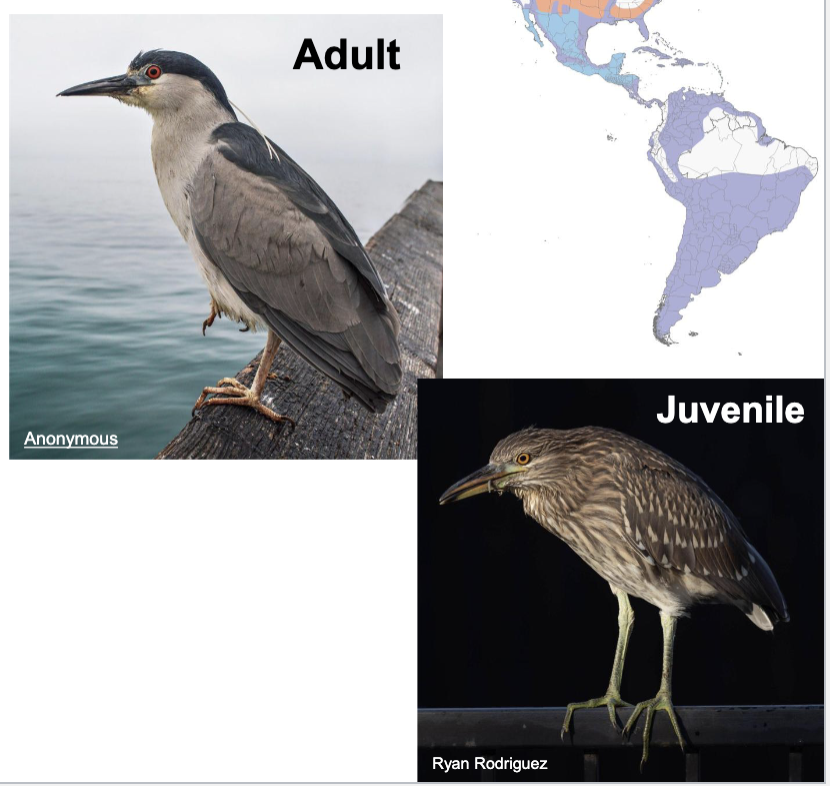
• Medium-sized and stocky, with relatively short neck and legs
• Black cap and back with gray wings and pale underparts
• Legs yellow-green and bill dark
• Red eyes
• In breeding season, legs become pinkish
Order: Pelecaniformes
Family: Ardeidae
Black-crowned Night Heron

• Medium-sized with long legs and neck
• Long, decurved, grayish bill
• Chestnut plumage with greenish wings
• In alternate plumage, head, neck and upper back dark chestnut-maroon; wings purplish; white feathers border reddish-purple face
Order: Pelecaniformes
Family: Threskiornithidae
White-faced Ibis
Anisogamy
females produce few large gametes, males produce many small gametes
Male fairy wren: holding 6 billion sperm at any given time
Default is polygyny
one male and many females
because males can inseminate many females
Parental care requirements cause variation in mating systems
81% of bird species have biparental care
9% are cooperative breeders
Uniparental care is rare
Monogamy
one male mated to one female (90% of birds)
Polygyny
one male mated to >1 female (10% of bird)
Polyandry
one female mated to >1 male
Promiscuity
indiscriminate mating
Social monogamy
behavioral pairing, but extra-pair paternity is possible/common
• 80-90% of birds are socially monogamous
• 80-90% of birds show extra-pair paternity
fairy-wren
~70% of superb fairy-wren offspring are sired by auxiliary males!
Tree swallows
Females select provisioner as social mate and seek genetics in extra-pair copulations
shes either super faithful or like not at all faithful

Social monogamy why?
• Seeking good genes
• Genetic diversity of offspring
• Insurance against infertility
Genetic monogamy
exclusive reproduction
some geese become better parents the longer they’re with one partner
Limitations: death or divorce (because of unsuccessful reproduction)
Polygyny – resource defense
• Key: valuable, defensible resource
• Female choice is tied to that resource
• Strong male-male competition for territories
• Top males can mate with multiple females
Ex: redwing blackbirds defend territories and are able to mate with multiple females
Polygyny – female defense
• Rare in birds, common in mammals
• Female mammals often gather together for non reproductive reasons, and can be monopolized by males
• Notable example: Ring-necked pheasants defend harems of females
• Ducks defend females, but can only defend one at a time = monogamy
Polygyny – leks
• Lek: a display place where males defend no resources and females choose on display alone
• No resources at lek site
• Often spatial clustering of males
• Females visit only to choose a mate
• Many grouse, manakins, birds of paradise
Polyandry and sex-role reversal
•Polyandry (one female mated to multiple males) reverses sex roles – against anisogamy
Found in <1% of all bird species!
• Emerges when ecological and biological factors shift the reproductive bottleneck from egg production to chick rearing
E.g., highly productive wetlands à enough energy to lay multiple clutches of eggs…so the bottleneck becomes time to raise them
E.g., where predation is high à spread risk among nests
Sequential polyandry
• Female lays clutches for successive males, each male incubates
Example: Spotted Sandpiper
Female arrive first, defend territories
Lays a clutch of 4 eggs, males incubate, and female moves on to next male
• Sex-role reversal, but males and females are monomorphic
Simultaneous polyandry
• Females defend super-territories containing multiple males at the same time
She goes around and lays eggs in any males nest
• Example: jacanas
Females 60% larger than males, defend large territories containing 4-5 males
Males build nest, incubate, brood chicks
Lots of uncertain paternity in a given nest

Full sex-role reversal: phalaropes
• Sequential polyandry, but sex-role reversal includes plumage and female-female competition
females compete for males
males do all the work
Choose your own adventure: Ruddy Ducks
• Mating system depends on pond size and density of conspecifics
• Monogamy on small ponds—not enough resources for multiple females
• Polygyny on medium ponds
• Promiscuity on large ponds—too much activity to defend females; most common in North America
Dunnocks – Passerine exception
all mating systems observed within a single population!
if you give them a bird feeder, you change their mating system
will lead to monogomy if lots of resources
Cooperative breeding - Helper system:
• one breeding pair + non-breeding helpers (usually grown offspring from prior years [siblings])
Classic example: Florida Scrub-Jay
Cooperative breeding - Joint breeding
• several birds of the same sex breed in the group
Classic example: Acorn Woodpecker
Cooperative breeding – Why stay home?
• Ecological constraints / habitat saturation
Every good territory is taken, so any bird that leaves becomes a floater with poor survival
• Current and future benefits of staying home
Enjoy good territory, chance to inherit it later
Cooperative breeding – Why help?
• Indirect fitness though kin selection
• Direct fitness
Inherit territory or breeding position
Gain breeding experience
Larger group = better survival
Example: Florida Scrub-Jay
• 40+ years study at Archbold Biological Station (Fitzpatrick)
• Habitat: low quality-oak scrub, fully saturated with territories
• Helpers are sons from prior years; waiting to inherit territory
• Removing helpers results in lower reproductive success
Example: Acorn Woodpecker
• 30+ years at Hastings Reserve, CA (Koenig)
• Groups center on granaries, which store thousands of acorns
• Several breeding males (often brothers) and up to 3 breeding females (often sisters), with non-breeding offspring as helpers
Co-breeding females destroy each other’s eggs until they lay in synchrony – chicks hatch at same time and same size
Who provides care?
Cooperative breeding – multiple helpers
Biparental care – two caregivers
Uniparental care – one caregiver
Brood parasitism – make someone else care
Brood parasitism - Facultative
• females lay some eggs in their own nest, some parasitically (can be a mix of strategies in a population)
200+ species, mostly waterfowl
Brood parasitism - Obligate
a bird never builds a nest or raises young (must be interspecific)
~100 species: cuckoos, honeyguides, cowbirds, whydahs, black-headed duck
Obligate brood parasitism – much more aggressive
• Generally relies on sneaking eggs into nest
Arms race in egg coloration
Egg removal common
•Nefarious chicks
Parasitic chicks outcompete hosts
More arms race