CTG interpretation
 Call Kai
 Learn
Learn Practice Test
 Spaced Repetition
 Match
Match Flashcards
 Knowt Play
1/28

There's no tags or description
Looks like no tags are added yet.
Name | Mastery | Learn | Test | Matching | Spaced | Call with Kai | Chat |
|---|
No analytics yet
Send a link to your students to track their progress
29 Terms
What is a cardiotocography? (2)
Used during pregnancy to monitor fatal heart rate and uterine contractions
Commonly used in the 3rd trimester and its purpose is to monitor fetal well-being and detect early fetal distress
What may an abnormal CTG indicate?
The need for further investigations and intervention
How does a CTG work? (3)
It involves the placement of 2 transducers onto the abdomen of a pregnant woman
One transducer records the fetal heart rate using ultrasound
The other transducer monitors the contractions of the uterus by measuring the tension of the maternal abdominal wall (indirect indication of intrauterine pressure)
Who is the CTG assessed? (2)
Midwife
Obstetric medical team
What is a popular acronym used to interpret all aspects of a CTG?
DR C BRAVADO
Dr - define risk, C- contractions
Bra- baseline rate, v- variability, a-accelerations, d- decelerations, o-overall impression
When performing CRT interpretations what is the first thing to do?
Determine if the pregnancy is high / low risk (give the CTG reading more context)
How should you analyse uterine contractions?
Duration
Intensity (using palpation)
*each big square ie equal to 1 minute
Define hyperstimulation
More than 5 contractions in 10 minutes

What is the baseline rate of the average heart rate of the fetus?
Within a 10 minute window
What is the normal fetal heart rate?
110-160 bpm
Define fetal tachycardia
Baseline heart rate greater than 160 bpm
Potential causes of fetal tachycardia? (5)
Fetal hypoxia
Chorioamnionitis
Hyperthyroidism
Fetal / maternal anemia
Fetal tachyarrthmia
Define fatal bradycardia
Baseline heart rate of less than 100 bpm
When is it common to have a baseline heart rate of 100-120 bpm? (3)
Postdate gestation
Occipiut posterior / transverse presentations
Severe prolonged bradycardia (<80 bpm for +3 mins) > indicates severe hypoxia
What are the causes of prolonged severe bradycardia?®
Prolonged cord compression
Cord prolapse
Epidural and spinal anaesthesia
Maternal seizures
Rapid fetal descent
What is the variability a result of? (4)
Interactions between:
Nervous system
Chemoreceptors
Baroreceptors
Cardiac responsiveness
*intact neurological system in fetus
What is the normal variability?
5-25 bpm
What are the categories of variability? (3)
Reassuring > 5- 25 bpm
Non-reassuring > less than 5bpm for 30-50 mins / +25 bpm for 15-25 mins
Abnormal > less than 5 bpm for +50 mins / +25bpm for +25 mins/ sinusoid
What are the causes of reduced variability?(6)
Fetal sleeping (no longer than or mins) > most common cause
Fetal acidosis (due to hypoxia)
Fetal tachycardia
Drugs> opiates, benzodiazepines, methlyodpa, MgSO4
Prematurity (<28 weeks)
Congenital heart abnormalities

Define accelerations
Abrupt increase in the baseline fetal heart rate of greater than 15 bpm for greater than 15 seconds, this is reassuring when occurring alongside uterine contractions

Define decelerations
Abrupt decrease in the baseline fatal heart of greater than 15 bpm for greater than 15 seconds
Which system is the fetal heart rate controlled by? (2)
Autonomic and somatic nervous system
Define early decelerations and the cause
Uterine contractions begins and recover then uterine contractions stop (Physiological)
Cause > fetal intracranial pressure causing increased vagal tone

Define variable deceleration and the cause
Rapid fall in baseline fetal heart rate with a variable recovery phase (no relationship to uterine contractions)
Cause - umbilical cord compression

Define late deceleration and the causes (3)
Begins ate the peak of the uterine contraction and recovers after the contraction ends due to reduced uteroplacental blood flow
Causes - maternal hypotension, pre-eclampsia, uterine hyperstimulation

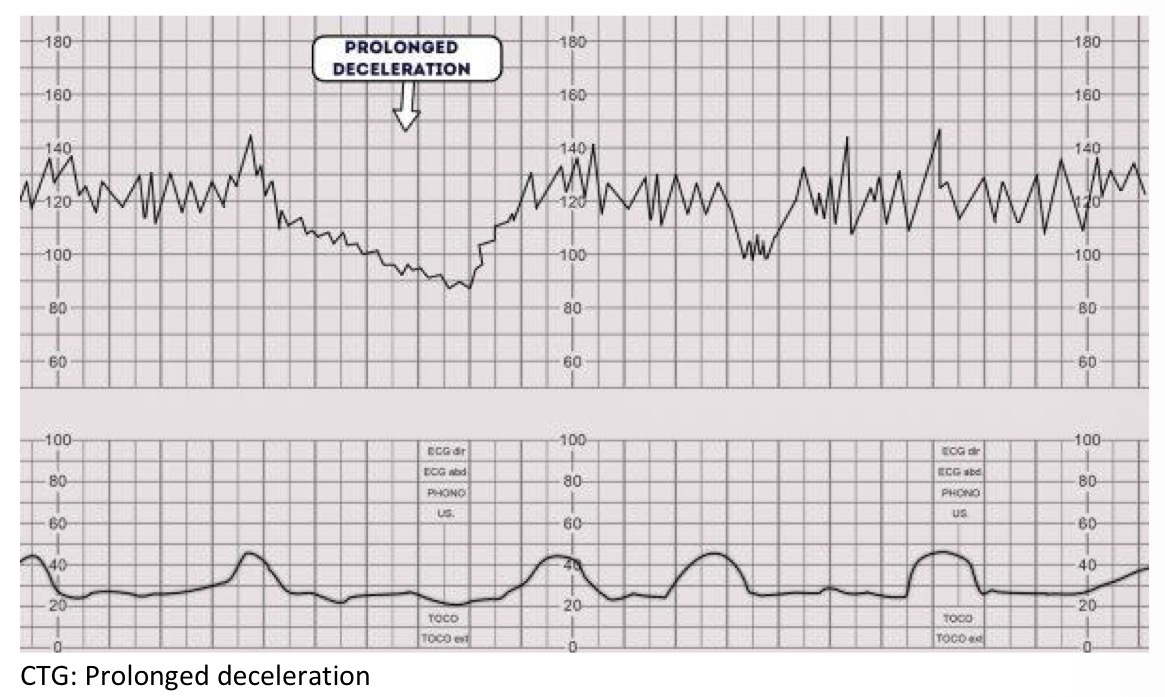
Define prolonged deceleration
Deceleration that lasts more than 2 minutes
Between 2-3 mins is non-reassuring
Longer than 3 minutes is abnormal
Which CTG pattern is rare and is associated with high rates of fetal morbidity & mortality?
Sinusoidal pattern
What are the characteristics of a sinusoidal pattern? (4)
Smooth, regular, wave-like pattern
Frequency of around 2-5 cycles in a minute
Stable baseline rate around 120-160 bpm
No neat to beat variability
What does a sinusoidal pattern usually indicate?(3)
Severe fetal hypoxia
Severe fetal anaemia
Fetal/ maternal haemorrhage
