Endocrine disorders
 Call Kai
 Learn
 Practice Test
 Spaced Repetition
 Match
 Flashcards
 Knowt Play
1/23

There's no tags or description
Looks like no tags are added yet.
24 Terms
When are the gonads formed?
The gonad forms when germ cells migrate from the dorsal endoderm of the yolk sac to populate the genital ridges. At the 5th to 6th week of gestation, these primitive bipotential gonads consist of both cortical (ovarian) and medullary (testicular) components.
What are some disorder of chromosomal sex
Turner syndrome (Instead of XX chromsomes, its 1 X and half or missing other X)
- The most common features are triangular facies with low-set ears, high-arched palate, low hairline, shield-like chest with wide spaced and hypoplastic areolae, and cubitus valgus. Skin findings include hemangiomas, cutis laxa, pigmented nevi, dysplastic nails, and tendency to keloid formation. Skeletal abnormalities include “beaking” of the medial tibial condyle, drumstick-shaped distal phalanges, vertebral anomalies, Madelung deformity, and short metacarpals (18). Dermatoglyphic findings include single palmar crease, distal axial triradius, and an increased number of digital ulnar whorls. Growth starts to decline early, and short stature is the most consistent feature in the older child
- screening for associated cardiac and renal defects is important
What does Disorders of Sexual Development mean?
It occurs when the anatomic development of the genitalia does not match the chromosomal and gonadal sex.
- The sex of the infant cannot be ascertained by physical examination. Alternatively, the phenotype may be normal male or female in morphology, but discordant with the genotype
What test or evaluation would you do for CAH diagnosis and why?
Serum 17-hydroxyprogesterone (17OHP)
- 17OHP is normally elevated after birth and should be measured after 36 hours of life. 17OHP should be interpreted based on normative data for gestational age, birth weight, and the infant's postnatal age.Testosterone, Renin, and electrolytes are useful initial screening tests for CAH
In salt-losing CAH, serum electrolytes are usually abnormal by day of life 4, so normal electrolytes in the first couple of days of life are not reassuring.
Serum testosterone can be elevated from the gonads or the adrenals and should be interpreted in the context of the examination and other laboratory studies.
Measurement of AMH may help determine the presence of testicular tissue.
Karyotype
Pelvic ultrasonography
Serum electrolytes
An algorithm for evaluating in infants with müllerian structures and a discordant genotype.

An algorithm for evaluating in infants without müllerian structures and a discordant genotype.

When are the hypothalamic and pituitary glands are functional and what hormones does it secrete?
The hypothalamic and pituitary glands are functional after week 12 of gestation.
Growth hormone–releasing hormone (GHRH), thyrotropin-releasing hormone (TRH), corticotropin-releasing hormone (CRH), and gonadotropin-releasing hormone (GnRH) stimulate the anterior pituitary gland to secrete GH, thyroid-stimulating hormone (TSH), adrenocorticotropic hormone (ACTH), and luteinizing hormone (LH) and follicle-stimulating hormone (FSH), respectively.
The main inhibitory hormones are somatostatin, which inhibits GH release, and prolactin inhibitory factor, which inhibits prolactin release.
The posterior pituitary secretes vasopressin and oxytocin.
What are the three dominant features of Anterior pituitary dysfunction?
Hypoglycemia
Micropenis
Cholestatic jaundice
What are some symptoms of the following deficiencies?
Growth Hormone Deficiency
- hypoglycemia and/or micropenis.
Gonadotropin Deficiency
- isolated hypogonadotropic hypogonadism or combined multiple pituitary hormone deficiency.
Adrenocorticotropic Hormone Deficiency
- hypoglycemia or hyponatremia without hyperkalemia and, occasionally, prolonged direct hyperbilirubinemia.
Thyroid-Stimulating Hormone Deficiency
- Low T4
- Elevated TSH
What tests do we do to diagnosis hypothalamic and pituitary deficiency?
ACH Stim test
What are some disorders of the Posterior Pituitary?
Vasopressin or antidiuretic hormone (ADH)
Oxytocin are the two major posterior pituitary endocrine hormones.
What are some functions of vasopressin/ ADH and what are the main disorders of ADH?
Helps to regulate intravascular volume and osmolality.
Increases the permeability of the collecting tubules of the kidney to water and urea. Its secretion is stimulated by hyperosmolar states and volume depletion and inhibited by volume overload.
The two main disorders of ADH secretion are DI and SIADH.
How does Diabetes Insipidus presents in neonates?
Failure to thrive, irritability, fever, vomiting, hypernatremia, and a history of polyhydramnios.
Polyuria is difficult to appreciate in newborn infants because healthy newborn infants can void up to 20 times a day
However, sustained urine output greater than 60% of fluid input and single-void volumes greater than 6 mL/kg suggest DI.
In a child with hyperosmolar serum, the diagnosis is confirmed by finding inappropriately dilute urine that becomes more concentrated after vasopressin administration.
Failure to respond to vasopressin is suggestive of renal DI.
What are some treatments of DI?
Strict management of fluid balance. (they require lots of free water)
What are the four things that needs to be in place for a neonate to produce their own glucose?
(1) Adequate glycogen stores
(2) sufficient supplies of endogenous gluconeogenic precursors (lactate, pyruvate, and glycerol)
(3) normally functioning hepatic gluconeogenic and glycogenolytic systems
(4) a normal endocrine system for modulating these processes.
What are some causes of transient hypoglycemia (2-4 days?)

What are some causes of Persistent or Recurrent Hypoglycemia?

What are some medications given to moms that would affect baby’s insulin level or cause hypoglycemia?
Glyburide (oral antidiabetic)
It crosses the placenta
Leads to large-for-gestational-age (LGA) infants
Leads to neonatal hypoglycemia.
2. Tolbutamide and Chlorpropamide (older antidiabetic drugs)Crosses the placenta and produce pancreatic beta-cell hyperplasia and increased insulin release.
3. Benzothiadiazide diuretics
Cause neonatal hypoglycemia by stimulation of fetal beta cells or secondary to an elevation in maternal glucose levels.
Salicylates may cause hypoglycemia by uncoupling mitochondrial oxidative phosphorylation.
Propranolol cross the mammalian placenta, affecting the fetus and interferes with the effects of the normal surge in
catecholamine levels at birth.
What is the pathway of events that leads to neonatal hypoglycemia?

What are some congenital Anomalies in Infants of Diabetic Mothers?
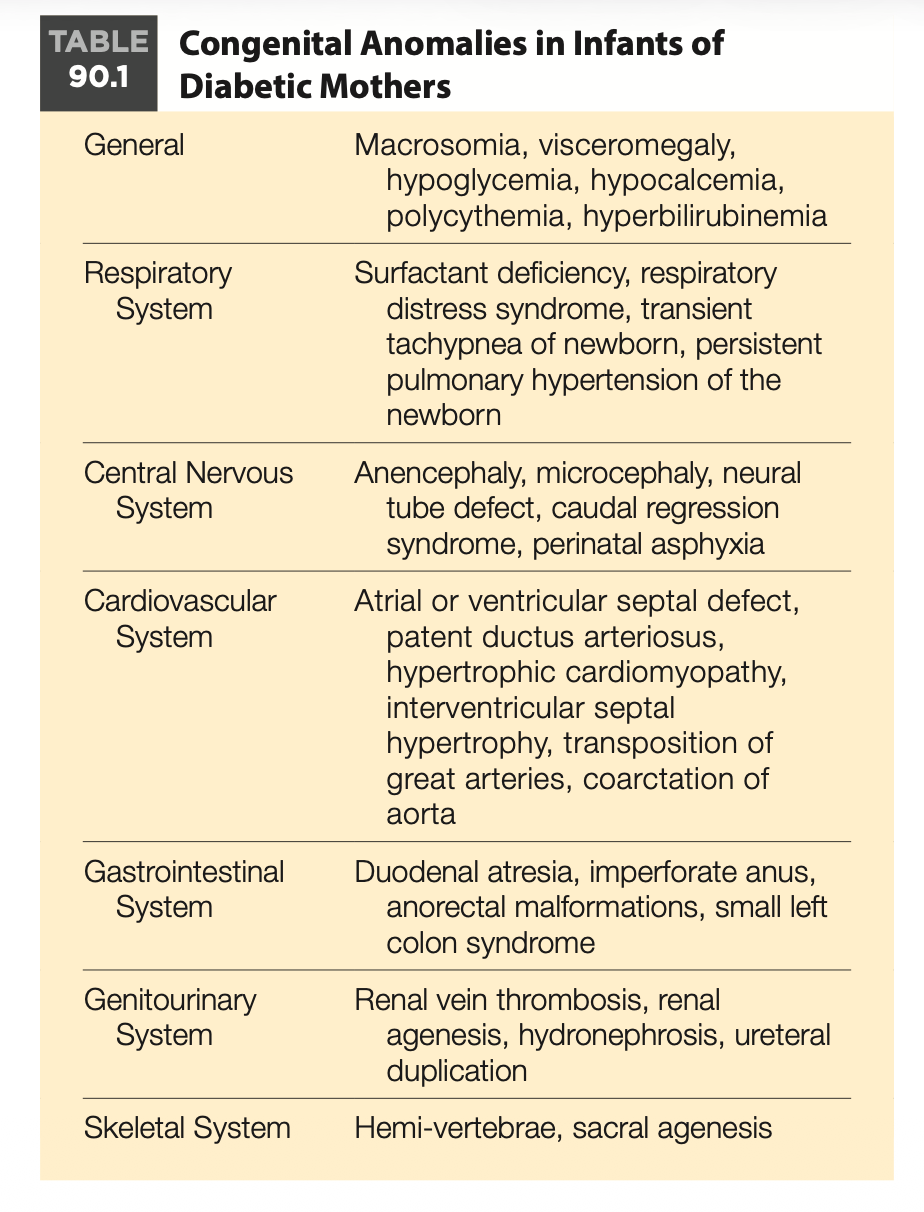
In macrosomia, why does the brain & kidney size remain normal and other organs are “bigger”?
Because the growth of the brain and possibly the kidney is not dependent on insulin, these two organs are normal in size. (Insulin in utero serves as a growth hormone sometimes)
What causes the congenital anomalies in infants with diabetic mothers?
Chronic hyperglycemia in the diabetic embryo,causing accumulation of advanced glycosylation end-products (AGE) and glycated protein and oxidative stress, have been suggested to induce malformations.
What is suggestive of the cause of septal hypertrophy in infants with diabetic mother (especially with obstructive left heart failure)?
We also see alterations in diastolic function and decreased passive compliance of the ventricular myocardium