PHYS 2110 - Physics Exam 5 Equations Quiz 5 - Barber
 Call Kai
 Learn
 Practice Test
 Spaced Repetition
 Match
 Flashcards
 Knowt Play
1/34

Earn XP
Description and Tags
Equations to know for Exam 5 for University Physics - PHYS 2110 - Harding University
35 Terms
Basic definition of a wave’s intensity
Intensity is the power per unit area, or energy per unit time per unit area, carried by a wave.
So in this equation, 𝑃 is the power (energy per second) striking or passing through area 𝐴.
We’re assuming 𝑃 is constant over the area. Also, 𝑃 technically varies with time for a wave,
but we typically just consider the average value.

Intensity as a function of distance from an isotropic point source.
Suppose a point source emits waves carrying equal amounts of energy in all directions (isotropic means “the same in all directions”).
The total time-averaged power emitted is 𝑃𝑠.
As the wavefronts propagate outward, that power is distributed over a sphere of increasing area 4𝜋𝑟2.

Definition of sound level or sound intensity level
Sound intensities vary over many orders of magnitude, and human hearing perceives changes in intensity on more of a logarithmic scale rather than linear.
So the sound level 𝛽, in decibels, is often used to describe loudness (𝛽 is Greek lowercase beta).
When the sound level increases by 10 dB, it means the intensity has increased by a factor of 10.

Allowed wavelengths for standing waves in a pipe open on both ends.


Allowed wavelengths for standing waves in a pipe open on both ends. Since 𝑓 = 𝑣/𝜆, you could also be asked for the pipe’s resonant frequencies:

Allowed wavelengths for standing waves in a pipe open on only one end.
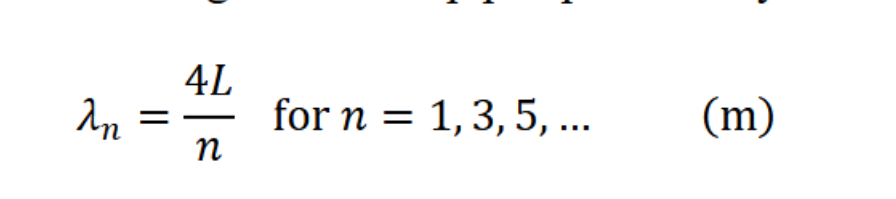

Allowed wavelengths for standing waves in a pipe open on only one end. Since 𝑓 = 𝑣/𝜆, you could also be asked for the pipe’s resonant frequencies:

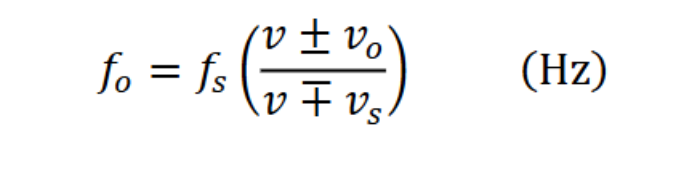
The Doppler effect equation for mechanical waves, in terms of frequency
The change in length of any linear dimension of an object, given its change in temperature.

The change in Area of any linear dimension of an object, given its change in temperature

The change in Volume of any linear dimension of an object, given its change in temperature

Relationships between the linear, area, and volume coefficients of thermal expansion

Heat required to change the temperature of a solid or liquid

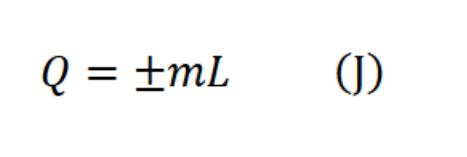
Heat required to change phase.
𝑄 should be positive when going from solid to liquid or liquid to gas because the substance has to absorb energy.
𝑄 should be negative when going from liquid to solid or gas to liquid because the substance has to release energy
Rate of thermal conduction through a series of materials.

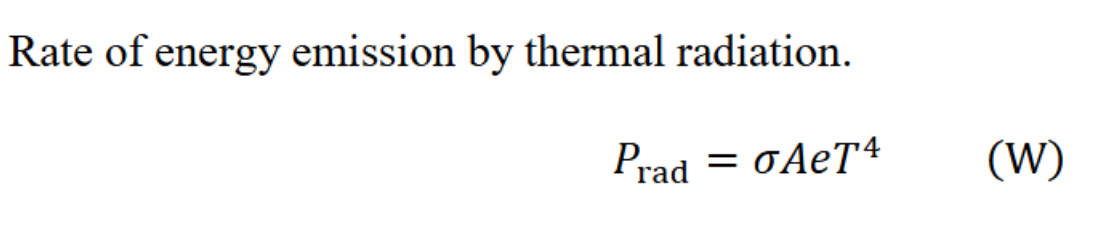
Rate of energy emission by thermal radiation
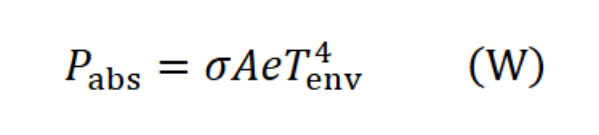
Rate of energy absorption from thermal radiation
The Ideal Gas Law in terms of the number of moles of gas 𝑛 and R the Gas Constant

The Ideal Gas Law in terms of the number of molecules of gas 𝑁 and the Boltzmann Constant

General equation for the work done by a gas during some thermodynamic process

If and only if the pressure is constant (“isobaric” process):

If it’s an ideal gas (𝑝𝑉 = 𝑛𝑅𝑇) and the temperature is constant (“isothermal” process):

The first law of thermodynamics

The heat required to change the temperature of a gas at constant volume

The change in the internal energy of a gas in terms of the change in temperature for any process

The heat required to change the temperature of a gas at constant pressure.

Relationship between a gas’s molar specific heats at constant volume and constant pressure.

General equation for a system’s change in entropy during some thermodynamic process.
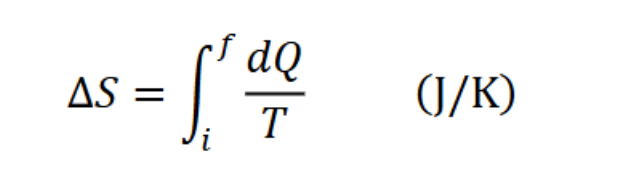
General equation for a system’s change in entropy during some thermodynamic process but the system’s temperature is changing

General equation for a system’s change in entropy during some thermodynamic process but the substance is changing phase, 𝑇 is constant, and 𝑄 = ±𝑚𝐿

The work done per cycle by a heat engine, in terms of the heats absorbed and exhausted

Definition of thermal efficiency for any heat engine

Formula for the efficiency of a Carnot engine from its operating temperatures, or the maximum possible efficiency of an unknown heat engine given its operating temperatures

Coefficient of Performance for a Refrigerator

Coefficient of Performance for a Carnot Refrigerator
