MIC 230 Exam 1 Lab UWL
 Call Kai
 Learn
Learn Practice Test
 Spaced Repetition
 Match
Match Flashcards
 Knowt Play
1/55

There's no tags or description
Looks like no tags are added yet.
Name | Mastery | Learn | Test | Matching | Spaced | Call with Kai | Chat |
|---|
No analytics yet
Send a link to your students to track their progress
56 Terms
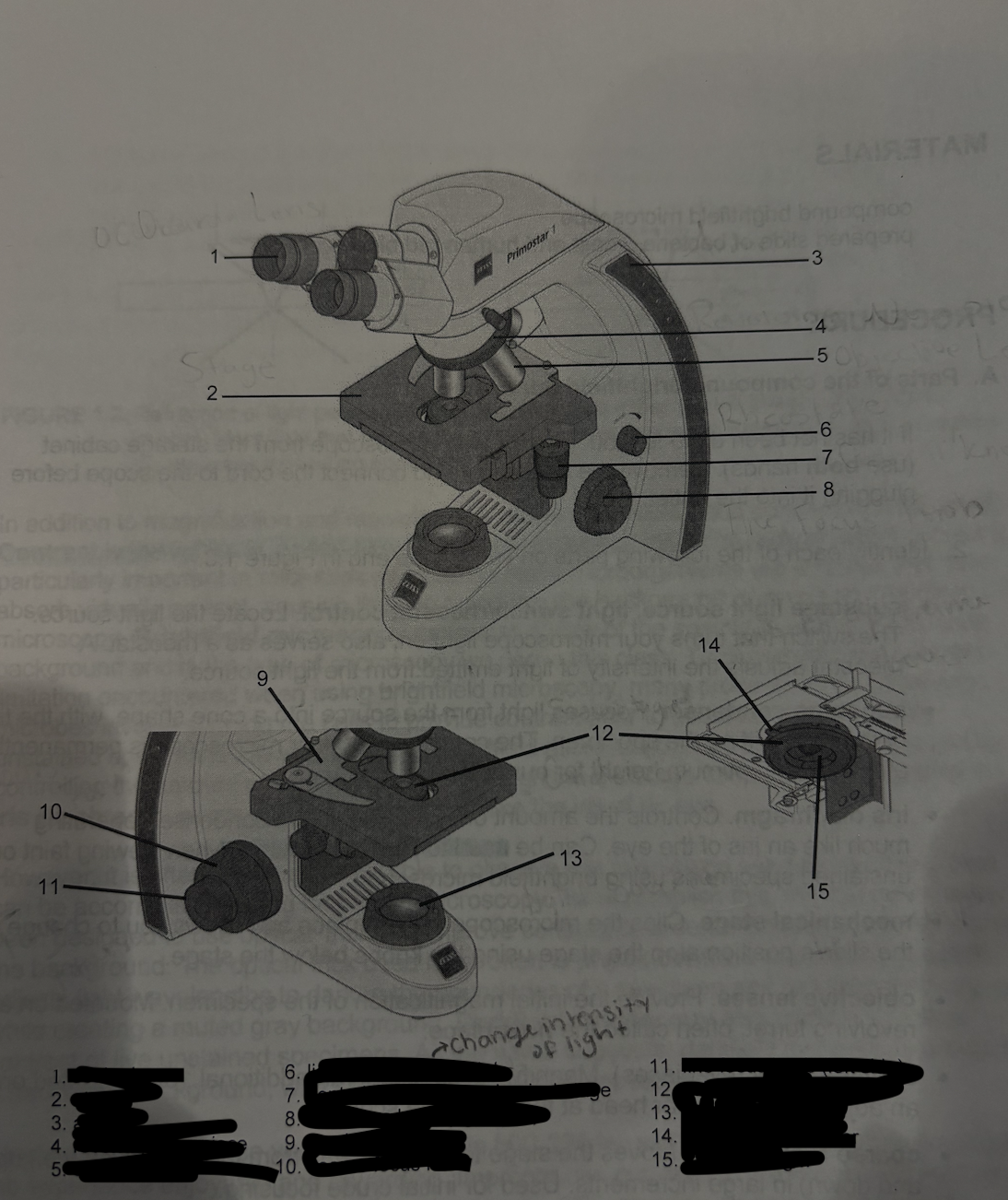
Scanning Objective lens
(4x): shortest objective lens, used for scanning large areas
Low Power Objective Lens
(10x) Rarely used for bacteria
High-Dry Objective
(40x)
Oil Immersion Objective
(100x) used to look at bacteria, must use immersion oil to see slide
How to calculate total magnification
products of the objective lens and ocular lens (always 10x)
ex: 4 × 10, 10 × 10, 40 × 10, and 100 × 10
What is working distance
distance between objective lens and slide when the specimen is focused
what is the field of view
amount of the slide you can view at once
what is the depth of field?
the vertical distance that can remain in focus at one time
what is the brightness of the field view
percent of light traveling from the specimen that enters the objective lens
What is resolution
how sharp and clear the image is
what is the resolving distance
shortest distance between 2 points in an image that may be distinguished as separate (shorter resolving distance means better resolution)
when do you use immersion oil and how does it help?
Immersion oil is used in the 100x lens; it allows more light to travel into the lens by creating a bridge between the lens and the slide, allowing less to light bend and scatter
What is contrast?
The lightness or darkness of the background compared to the specimen
How can you improve contrast? and why does this help?
adjusting the iris diaphragm, allows more light to pass through the substage condenser

Why do we start on the 10x and and make are way down?
Our microscopes are parfocal so once you focus on one setting, other focus setting will be almost in focus as well
what are in the cell walls of fungi?
chitin
what are multicellular fungi called? unicellular?
molds/mushrooms and yeast
how are yeast and mold differ
yeast: single cell, smaller colonies, whiteish
Molds: darker (green), fuzzy,
why are mycelium and spore layer structures hard to look at in the microscope?
The depth of the fungi makes it so you can’t focus the whole organism at once, but have to change your focus to view different layers
What are in the cell walls of photosynthetic protists? How about diatom algae?
Cellulose
Silica
How does a dead zone form and what is a dead zone?
dead zone happens when there is an increase in nutrients like Nitrogen and phosphorus, so the growth rate increases a lot, forming blooms of algae. When the algae die off because of nutrient depression, oxygen levels decrease, causing a dead zone.
What is it called when a Protozoa engulfs another organism?
phagocytosis
what are some characteristics of Protozoa? (3)
Unicellular (mostly)
Heterotrophic
Pseudopods, cilia, flagella
How are photosynthetic protists important to humans?
The waste product is O2
Primary producers for many animals in which we eat
What are some diseases that are caused by parasitic Protozoa, and there genus?
Diarrhea - Giardia (a lot more as well)
Malaria - Plasmodium
Trypanosomiasis - Trypanosoma
What grows on General Purpose media?
growth of almost anything
What is selective media used for? what did we use in class
can inhibit the growth of certain bacteria. In class we inhibits the growth of gram-positive
What is differential media used for? what did we use in class?
Allows screening of cells with different phenotypes (mostly metabolic). In class, we inhibited the growth of gram positive and differential for lactose fermenters
What is enriched media used for?
has used for if you need greater concentration of nutrients
Why is agar used in media plates?
Can be used in a wide range of temps
not degraded by most microbes
What is an autoclave used for? how?
sterilization, it heats up to 121C for around 15 minutes
what category are TSA plates and TSB?
general purpose media
What does it mean to culture a microorganism
facilitate their growth
what is inoculation
deliberately transferring microorganisms from one source to a growth medium
What are Aspect Techniques, Give some examples
Collection of practices to prevent microbial contamination
Burn the inoculation loop after use
Close media when not in us
What is the quadrant streak plating technique used for?
to try and get isolated colonies
What are the characteristics that imply a new species in colonies (5)
color
shape
size
elevation
texture
What are CNA select for plates?
Gram positive bacteria
What do MAC plates select for? Color?
Gram-positive and lactose fermentation. Bacteria that ferment Lactose will become magenta
what are the 4 type of organisms that deal with oxygen?
aerobe - only O2
strict anaerobe - no O2 or die
facultative anaerobe - can use and not use O2
aerotolerant anaerobe - doesn’t use O2 but won’t die in its presence
What is the GasPak system used for
to remove any O2 from a box
Why do we gram stain bacteria?
to increase the contrast
What are Cationic dyes, what do they bind to?
positively charged stain and bind to negatively charged molecules
what are the steps in creating a stain? (6)
smear
heat fixing
crystal violet
iodine
ethanol
safranin
What are some examples of cell morphology
rod, coccus, vibrio, spirillum, spirochete
What are some examples of cell arrangements
Single, pair, chain, irregular cluster. tetrad, secrina
Why does the color in Gram-negative bacteria disappear once you put ethanol on it
ethanol dissolves the outer membrane of the cells and easily rinse out the stain complexes
why do sometimes to cell of a stain have pink and purple colors? (name at least 2)
Uneven application
To think of a smear
Contamination of cells with the opposite gram reaction
inherent gram variability of some bacterial species
what does it mean when we say growth of bacteria?
we talk about the population growth
what are the 4 stages of bacterial growth
lag phase
log/exponential
stationary
death
what does it mean when a bacteria has a steeper log phase?
has a shorter generation/doubling time
why do we use a log scale instead of a linear scale when plotting bacterial growth
when we use log scales, we can see all the phases, including the lag and log phases
what does it mean when we say “indirect methods” in counting bacteria cells?
we estimate the growth instead of counting all the cells one by one
We can measure turbidity with a spectrophotometer using optical density. What is optical density?
measure both the light absorbed and the light scattered by the cells
Why do we have to start diluting after the optical density reaches 0.5?
light can start refracting from 2 or more cells, which leads to an underestimation of cell density