Intelligence 2
 Call Kai
 Learn
 Practice Test
 Spaced Repetition
 Match
 Flashcards
 Knowt Play
1/21

There's no tags or description
Looks like no tags are added yet.
22 Terms
Nature vs Nurture in intelligence
· Intelligence reflects both genetic influences (nature) and environmental influences (nurture)
- Difficult to separate because they interact
· Genes influence intellectual potential, while environments limit or enhance how that potential develops
Heritability
Proportion of variance in IQ within a population that is attributable to genetic differences
Environmental influences
Includes education, culture, upbringing and other life experiences
Twin studies
IQ similarity is generally higher for people who are more genetically related
Adoption studies
Children’s IQ is more strongly correlated with biological than adoptive parents (genetic influence)
Environmental effect
Children from deprived backgrounds adopted into academically enriched homes show substantial IQ gains
SES and environmental influences
· SES–IQ associations may reflect both genetic and environmental pathways: parental intelligence/occupation, access to educational resources, parental time, expectations, role models and opportunities
· Extreme deprivation can substantially impair development
· Lower IQ has been linked with poverty, malnutrition, lead/alcohol exposure, low birth weight and birth complications
- Early environmental enrichment can improve outcomes
· Genetic influence appears somewhat stronger overall, but environment modifies genetic tendencies
Intelligence theories
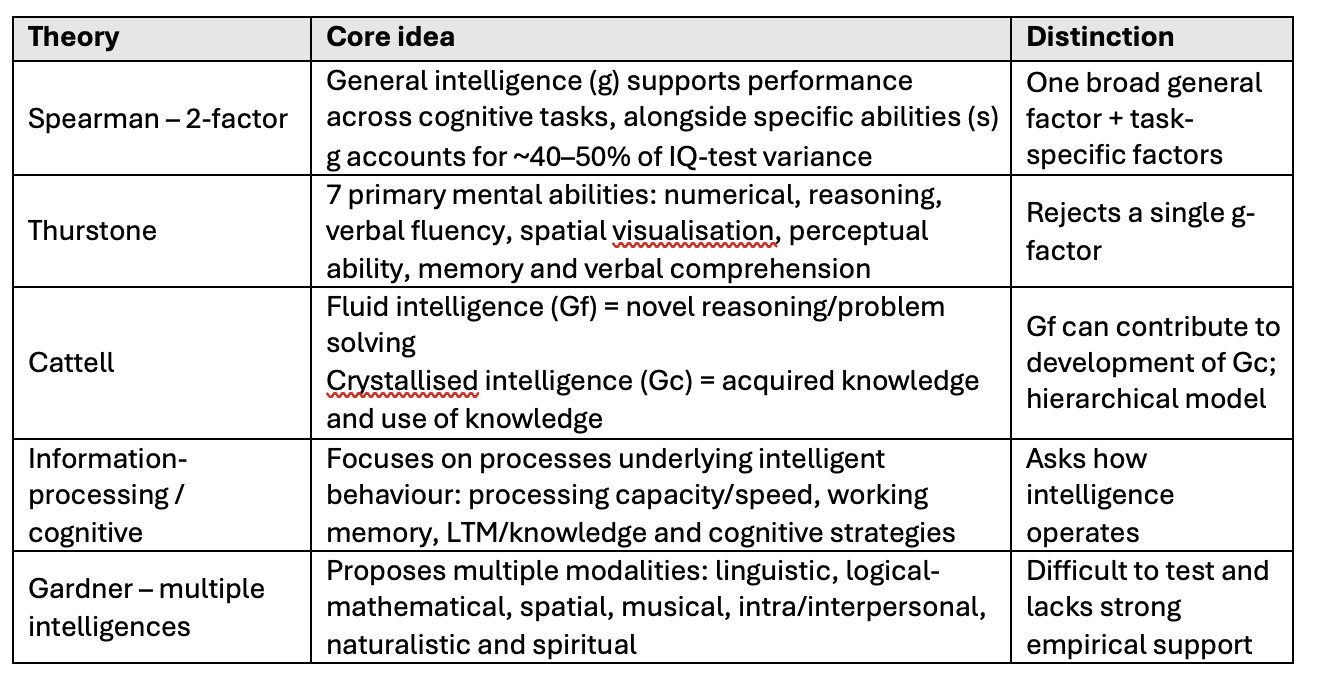
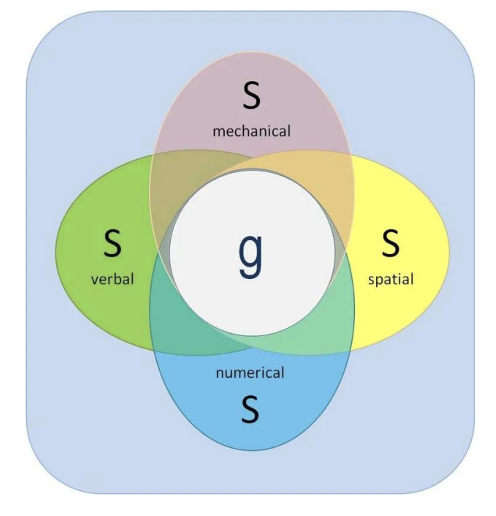
Spearman g-factor and s-factors diagram
Creativity
Positively correlated with IQ but difficult to measure reliably
· Emphasises divergent thinking as IQ tasks tend to emphasise convergent thinking
Intellectual disability
Involves deficits in intellectual functioning AND adaptive functioning
· Onset during the developmental period
· Prevalence 1-3%
· Causes: genetic conditions (e.g. down syndrome) prenatal/environmental factors (e.g. malnutrition) and unknown causes
Intellectual disability - intellectural functioning disability
Difficulties with reasoning, problem-solving, planning, verbal comprehension, abstract thinking, judgement and quantitative skills
· Usually full-scale IQ <70–75
Intellectual disability - adaptive functioning disability
Support is required in at least one domain: academic, social or practical
Specific Learning Disorder
Neurodevelopmental disorder involving persistent difficulty learning/using academic skills despite targeted intervention
· Affects: word reading, reading comprehension, spelling, written expression, number skills or mathematical reasoning
· Affected skills are substantially below age expectations, interfere with functioning
· Begins during school years
· Overall intellectual functioning can be normal - the difficulty is specific to particular academic skills
IQ testing in the classroom
· Test for a specific purpose: academic problems, behavioural issues or educational placement
· Do not test without reason because testing involves stress, cost and time
IQ testing in the classroom - benefits
· Can reveal hidden strengths/weaknesses
· Reduce placement errors
· Guide tailored support
· Facilitate access to resources
IQ testing in the classroom - risks
· Scores can label children
· Tests may contain bias
· Self-fulfilling prophecy: students viewed as ‘brighter’ may receive more enrichment from teachers
Entity perspective
Intelligence is fixed and difficult to change
Incremental perspective
Intelligence is malleable and can change/develop
Cultural bias in IQ testing
• IQ tests may assess learned info that is culture-specific
• People have unequal opportunities to acquire this cultural knowledge
• Language barriers also affect test performance
• So lower performance on a culture-specific test does NOT indicate lower intelligence
Problems with culture-fair tests
• Attempt to reduce the influence of cultural knowledge/language
- However this reduces predictive utility
• Some culturally influenced abilities are relevant to educational and occupational performance
• Greater culture-fairness may come at the cost of practical usefulness
Intelligence as a cultural construction
• "Intelligence" varies across cultures
- Reflects abilities/attributes valued for success within a particular culture - Definitions may not generalise across cultures