Ecology Exam 3
 Call Kai
 Learn
 Practice Test
 Spaced Repetition
 Match
 Flashcards
 Knowt Play
1/50

There's no tags or description
Looks like no tags are added yet.
51 Terms
Population
Group of interbreeding individuals of same species
Torpor
Physiological state of decreased activity and metabolism
Estivation
Summer torpor- avoid extreme heat and dry conditions, common to desert animals
Diapause
Period of suspended animation, common in insects (cocoon, chrysalis)
Extended torpor
Extended period of torpor punctuated by wakefulness and mild activity mid-winter. BEARS
Abundance
Population size (N)
Species range
Geographic distribution of a species
Endemic species
Have a specific range of geographic distribution, often found in restricted habitat conditions
Ubiquitous species
Have a broad range of geographic distribution, can inhabit a wide range of conditions
Dispersion
Pattern of spacing among individuals (clumped, random, uniform)
Emigration
Individual(s) leaving a subpopulation
Dispersal
Type of emigration where individuals move away from parent or habitat where they were born (might not leave population). Can be passive (via wind, water, animals) or active (walking, flying)
Immigration
Individual(s) moving into a subpopulation
Migration
Round-trip movement made by an animal population (daily, seasonal, short or long range)
Crude density
number of individuals per unit area or per unit volume
Ecological density
individuals per available unit of living space
Cohort
group of individuals born in the same period of time
x
Age class
nx
number of individuals that are alive at specified age (x)
lx
probability of surviving to any given age (x) from birth
dx
Age-specific mortality
Number of individuals dying in age class
qx
age-specific mortality rate (dx/nx)
Survivorship curve
Plots lx vs age (x)
Type 1 Survivorship
survival rate is high throughout life span with heavy mortality at end

Type 2 Survivorship
survival rates do not vary with age
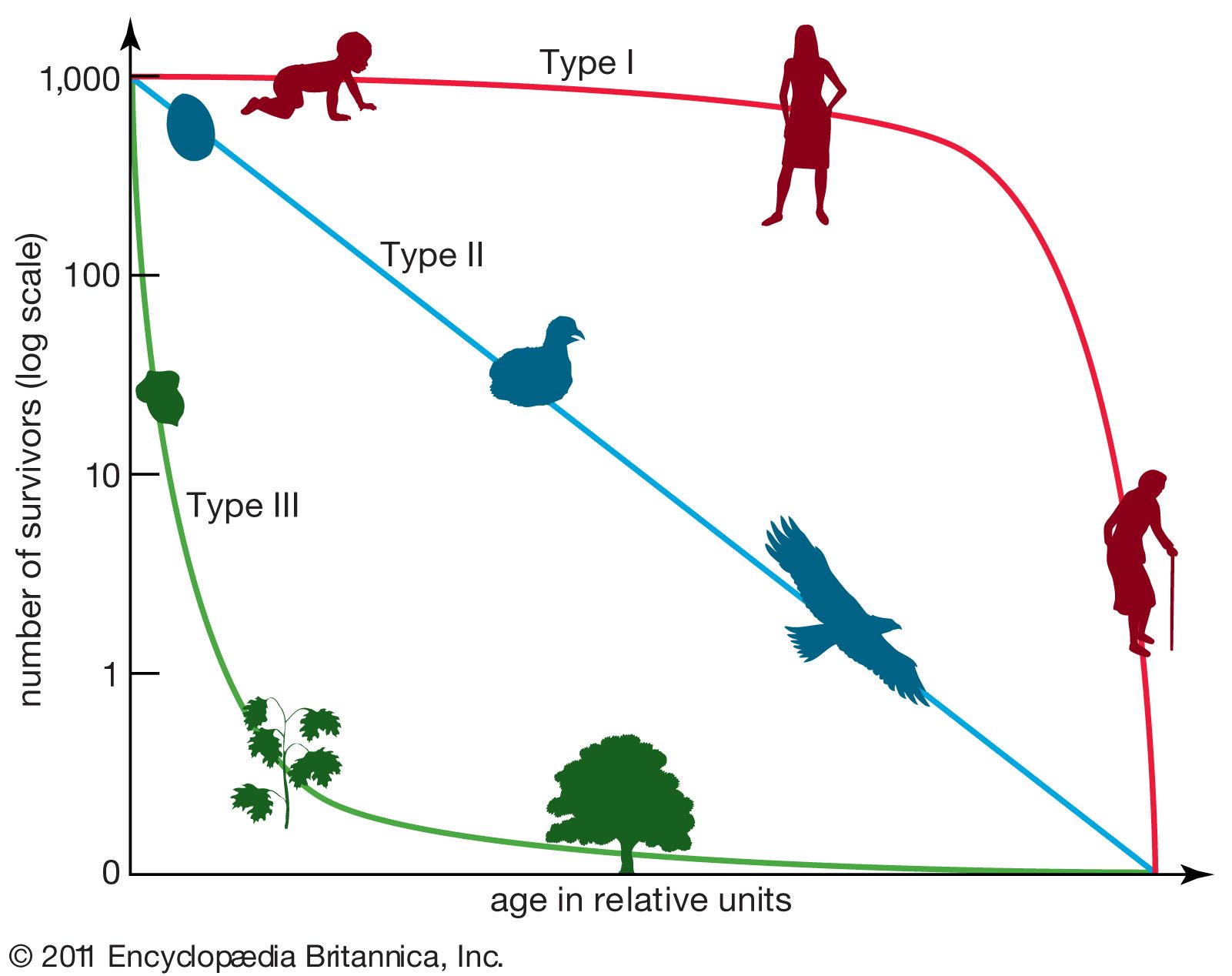
Type 3 Survivorship
mortality rates are extremely high in early life

bx
mean number of females born to female in each age group (x)
Gross reproductive rate
average number of female offspring born to female over her lifetime IF she lives to life expectancy. Sum of bx
Fecundity table
combines survivorship (lx) with age-specific birthrates (bx)
lxbx
mean number of females born in each age group, adjusted for survivorship
Net reproductive rate
R0- Sum of lxbx
Allee effect
decline in reproduction or survival under conditions of low population density
Carrying capacity (K)
maximum sustainable population size for prevailing habitat conditions
Logistic growth
dN/dt = rN(1 – N/K)
Inflection point
Point on curve where growth rate is highest, N=K/2. Growth rate decreases after inflection point.
Adventitious roots
Roots that emerge above flooded, saturated area where oxygen is available
Pneumatophores
Growths of root systems of plants where water table fluctuates. Hollow growths that function like a snorkel to provide oxygen to the roots
Vascular tissue
Transport nutrients within plant
Ventilation
Movement of respiratory medium over respiratory surface. Required to maintain pressure gradient for gas exchange
Gills
Folded body tissue suspended in water
Crop
food reservoir in granivores (seed-eating birds)
Proventriculus
Part of stomach in granivores. Secretes enzymes to begin digestion
Gizzard
Part of stomach in granivores. Hard grinding organ, traps pebbles and bones
Cellulose and lignin
Found in plants- indigestible. Microorganisms needed to help digest
Homeostasis
Maintaining steady state of internal conditions despite changing environmental conditions. Maintained by feedback control loops (stimulus → response)
Osmoregulation
Process of controlling solute concentrations and water balance
Endothermy
Heat mainly acquired through metabolism (internally)
Homeothermy
Generally results from endothermy.
Consistent body temperature over time
High metabolic rate
Ectothermy
Heat acquired primarily from external environment
Poikilothermy
Generally results from ectothermy.
Body temperature varies over time.
Low metabolic rate, narrow operative temperature range