Oral Anatomy Dental Anomalies 낱말 카드
 Call Kai
 Learn
 Practice Test
 Spaced Repetition
 Match
 Flashcards
 Knowt Play
1/108

There's no tags or description
Looks like no tags are added yet.
109 Terms
Permanent
Are dental anomalies more common on permanent or primary teeth?
Maxillary
Are dental anomalies more common on maxillary or mandibular teeth?
Anodontia
What describes the absence of teeth due to an anomaly?
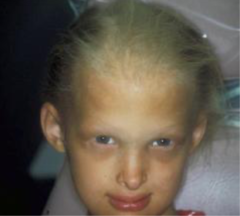
Ectodermal dysplasia
What describes a disorder effecting the development of the ectoderm leading to defects in hair, nails, and teeth?
Hypodontia
What is another term to describe partial anodontia?
Maxillary third molars
Which teeth are the most commonly missing adult teeth (35%)?
Maxillary lateral incisors
What is the second most commonly missing adult tooth (1-2%)?
Mandibular second premolars
What is the third most commonly missing adult tooth (1%)?
Mandibular central incisor
What is another permanent tooth might be missing but is rare?
Mandibular incisor
What primary tooth is sometimes missing (rare)?
Permanent
Is it more common for supernumerary teeth to be seen in permanent or primary dentitions?
Maxillary (90%)
Is it more common for supernumerary teeth to be seen in the maxillary or mandibular arch?
Maxillary incisor, third molar, and mandibular premolar
What areas in adult dentition is it likely to see supernumerary teeth?
Mesiodens
What is the most common supernumerary tooth called?
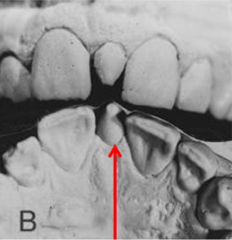
Between maxillary central incisors (midline)
Where is a mesiodens located?
Paramolar
What describes a supernumerary tooth lingual or buccal to a molar?
Distomolar or fourth molar
What describes a supernumerary tooth distal to a third molar?
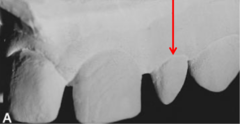
Peg lateral
What dental anomaly is shown here?
1
How many lobes do peg laterals form from?
Maxillary central incisors
What tooth, besides the maxillary laterals, can be peg shaped but is very rare?
Gemination (twinning)
What describes a tooth with a crown double in width but it has one root and one pulp chamber and canal?

Anterior
Is gemination more common with anterior or posterior teeth?
Primary
Is gemination more common with primary or permanent dentition?
Fusion
What describes when two adjacent crowns fuse and appear double in width but have two roots and two pulp chambers and canals?

Primary (5%)
Is fusion more likely to occur with primary or permanent dentition?
Mandibular anterior
Which teeth are more likely to experience fusion?
Gemination
Is gemination or fusion shown?

Fusion
Is gemination or fusion shown?

Fusion
What tooth anomaly is shown?

Hutchinson's incisors
What describes an anomaly with notched incisal edges on incisors and they sometimes look like a screwdriver?

Hutchinson's incisors
What tooth anomaly is present?

Mulberry molars
What tooth anomaly is present?

Congenital syphillis
What causes hutchinsons incisors and mulberry molars?
Accessory cusps
What is being shown here?

Unusually prominent ridge
What tooth anomaly is shown?

Facial of maxillary central incisor
Where is the most common location of unusually prominent ridges?
Molars
Which teeth are most likely to have extra cusps?
Tuberculum intermedium
What describes an extra third lingual cusp on mandibular molars?

Talon cusp
What describes an extra lingual cusp on anterior teeth?

True
T/F: talon cusps have their own pulp horn.
Talon cusp
What tooth anomaly is shown?

Macrodontia
What describes a tooth anomaly where teeth are larger than normal (pituitary giants)?

Microdontia
What describes a tooth anomaly where teeth are smaller than normal (pituitary dwarfism)?
Macrodontia
Is macrodontia or microdontia more generalized meaning it effects more teeth in the mouth?
Incisors and canines
What teeth are most effected by macrodontia (localized)?
Maxillary lateral incisors and third molars
Which teeth are most effected by microdontia?
Shovel-shaped maxillary incisors
What tooth variation is shown (not an anomaly) and is more common in american indians, asian, mongoloid, and inuits?
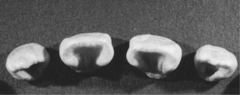
Dislaceration
What describes an anomaly where the tooth has a sharp bend in its root or crown?

Flexion
What describes an anomaly where the tooth has a gradual curve in its root or crown?

Enamel pearls
What tooth anomaly is shown?

Furcation of molars
Where are tooth pearls often found near?
Taurodontia
What tooth anomaly is shown and is seen in neanderthals, native americans, and inuits?

Molars
What teeth are effected by taurodontia?
Taurodontia
What tooth anomaly is shown?

Dens in dente (tooth within a tooth)
What tooth anomaly is shown?

1-5%
What percent of the population is effected by dens in dente?
Hypercementosis
What tooth anomaly has webbed roots because of thickening of cementum?
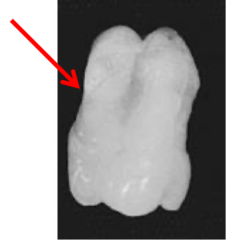
Trauma and metabolic dysfunction
What is hypercementosis caused by?
Concrescence of roots
What describes the joining of cementum of adjacent teeth after eruption (not a real anomaly)?

After
Concrescence of roots is the joining of cementum of adjacent teeth before or after eruption?
Dwarfed roots
What tooth anomaly is shown?

Generalized
Dwarfed roots are due to heredity if it is generalized or localized?
Localized
Dwarfed roots are due to fast orthodontic movement if it is generalized or localized?
Accessory (extra) roots
What tooth anomaly is shown?

Mandibular canine and premolar
Accessory (extra) roots are most common with which teeth?
Facial and lingual
Accessory (extra) roots are most common to located where on mandibular canines and premolars?
First premolar
What maxillary tooth can have accessory (extra) roots?
Maxillary canine
What primary tooth can have accessory (extra) roots but is rare?
Horizontally impacted
What tooth position anomaly occurs with third molars?

Unerupted canine
What is being shown here?

Ectopic eruption
What describes an eruption of a tooth NOT in the oral cavity?
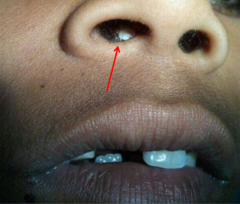
Transmigration
What describes the position of a tooth in the wrong spot in the oral cavity?

Rotation
What tooth position anomaly is shown?

Rotation
What tooth anomaly is shown?

Transposition (premolar and canine switched)
What tooth anomaly is shown?

Lateral incisors and canines
Which teeth are likely to be transpositioned?
Infraversion
What tooth anomaly occurs where a tooth does not fully erupt?

Supraversion
What tooth anomaly occurs where a tooth erupts too far in the oral cavity?

Opposing tooth is missing
Supraversion can occur because...
Labioversion
What describes a tooth that has assumed a position labial to normal?
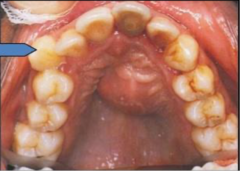
Lingoversion
What describes a tooth that has assumed a position lingual to normal?
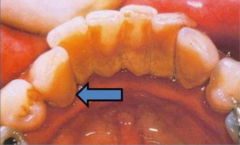
Ankylosis
What describes the failure of a tooth to complete eruption due to trauma or infection?

PDL
What attachment is lost in ankylosis?
Root fuses to bone
What occurs because of the loss of the PDL in ankylosis?
Enamel dysplasia
What tooth malformation is described as abnormal enamel formation?
Dentin dysplasia
What tooth malformation is described as abnormal dentin formation?
Amelogenesis imperfecta, fluorosis, enamel damage from high fever, and focal hypermaturation
What are examples of enamel dysplasia?
Dentinogenesis imperfecta and tetracycline staining
What are examples of dentin dysplasia?
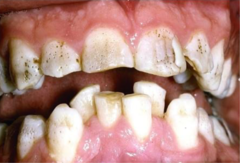
Amelogenesis imperfecta
What hereditary tooth anomaly causes total or partial lack of enamel?
Both
Does amelogenesis imperfecta effect primary, permanent, or both dentitions?
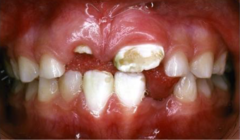
Fluorosis
What tooth anomaly occurs from too much fluoride during tooth formation?
Mottled enamel
What is mild fluorosis characterized by?

Pitted enamel
What is severe fluorosis characterized by?
Strong (caries prone)
Are teeth effected by fluorosis weak or strong?
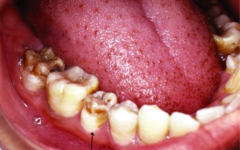
Enamel damage due to high fever (pitted enamel)
What tooth anomaly is shown?
Tooth formation
When does enamel damage due to high fever occur?
Focal enamel hypoplasia (Turner's Tooth)
What tooth anomaly is shown?

Local trauma or infection like an abscess on primary teeth
What is focal enamel hypoplasia caused by?
Turner tooth
What tooth anomaly is shown?

Dentinogenesis imperfecta
What hereditary tooth anomaly is due to faulty dentin (opalescent/shiny enamel)?
