Neural Structure of Language - 1.1
 Call Kai
 Learn
Learn Practice Test
 Spaced Repetition
 Match
Match Flashcards
 Knowt Play
1/49

There's no tags or description
Looks like no tags are added yet.
Name | Mastery | Learn | Test | Matching | Spaced | Call with Kai | Chat |
|---|
No analytics yet
Send a link to your students to track their progress
50 Terms
Why do we have langugage
to reason about things and make arguments
Structure - has a built in, formal, logical structure
mathematics/logic built upon langauge
definition of language
a discrete combinatorial system with an infinitive generative capacity
Computational representation theory - collapsing computational & algorithmic levels to one level
There is a utility to combining 2 levels because it gets fuzzy in linguistics
Algorithmic level - a lot of freedom
Highly constrained representational type - numbers
How Markov Model works
Add up probabilities involved 0 sum gives probability of entire sentence
Score
|
Fodor - what is language
mentalese - logical form + means something
innate, non spoken internal code called mentalese
has a syntactic structure that separates it from meaning - think in a systematic way & build things
What you know when you know a language
What sequences of sounds can be strung together to make a valid word
Ex: sequence like “blick” is a valid word in English, but “bnick” is not. |
What words and sentences mean
Basically what sequences of words make a valid sentence
Ex: The cat slept on the mat *The cat mat slept on *Cat the mat the on slept *Cat mat slept on the the |
Theory of Language
Claude Shannon - 1st time you could translate language into something that can be implemented by a computer
Whatever model you come up w for language should be able to be implemented by a computer
Chomsky - “Colorless green ideas sleep furiously”
lets treat sentences as strings
probability (statistic percentage of word coming next) fails to make a logical, grammatical sentence - no meaning
Chomsky, Pinkert - basically same argument AGAINST probability
support internal structures - universal grammar
Language as strings
Sentence = string of words - sequences
Markov Model of Language
knowing the probability of one word following another word is linguistic knowledge
model seems like it could describe language,
produces sequences but not language like humans
What is the goal of linguistics
make a model that describes how language works
Local probability
(prob of a word following after another)
Global probability
(prob of whole sentence occurring)
Local vs global probability - The house to ask for is to earn our living.
this sentence has a low probability - its not even grammatical
every transition between words is moderate- but the probability of the whole sentence is very low
Ex:
the → house - kinda high prob
house → to - ok amount of prob
Probability does not determine gramaticality
The things are separated
Generative Grammar
human language is shaped by a set of basic principles that are part of the human brain
Chomsky’s alternative to language as strings
Linguistic knowledge - knowing the abstract rules that generate the grammatical sentences in your language
Use rules and united to have structure that you gain - to model human language
Mental grammar made up of
Phonology
Lexicon
Syntax
Phonology
- store of sounds and rules to combine them
Lexicon
Mental store of words and meanings
Syntax
- Rules that combine words into structures
Parts of a language
All languages rely on notion of structure
Make infinite use of finite meanings
Can generate unbounded amount/length of sentence
Language as structure - meaning chases snytax up the tree
basically meaning is in every part of the tree from the bottom - defines the syntax of it in a way - how the sentence is perceived and understood
How are LLM (large language models, AI) counter evidence to Chomsy’s generative grammar
It doesn’t have hierarchical structure but its still grammatically correct
Natural Language Processing (NLP) has largely abandoned generative linguistics.
Modern advances in language understanding systems look more like probabilistic models than Chomsky’s generative grammar.
Levels of analysis
The mind is a complex information processing system
The mind performs computations
Language is a complex system computed in the mind
Computational level
Algorithmic level
Implementational level
Computations
operations performed on representations
Computational level
goals of system
what will be accomplished after system has run its course
output of computation
Algorithmic level
steps taken to accomplish goal/solve problem
2nd step
Types of Representations created
Operations performed
Ex: brain recognizing speech sounds by keeping a table with sound waves matched to appropriate sounds - can match/look up when it hears sound
Implementational level
How neurons/physical system carry out algorithm that solves a problem
the 3rd and final step
What brain regions are active
What are the physical processes/system that executes things
example of computational level
Abstract description of computation
Includes formal properties of language
Rules and constraints
Ex: Past Tense = Verb + “-ed”
Example of algorithmic level
- Sequence of the steps to perform the computation
Form of representations
How language is processed
Ex:
1. kick
2. kick + ed
3. Kicked
Vs
1. kicked
Example of implementation level
- Physical system that executes steps
Where language is processed in the brain
Which brain region does what?
Ex: parts of brain where language are at
Example of “operations” in computational models
Wh- questions
In wh- questions, the wh- word appears in a fronted position, but is interpreted in a different position
This is described as a movement process
Does this mean that the mind executes a “move” operation?
How Wh- questions show that there is less diversity in language than it seems
Wh- questions
Goes in front of sentences
Can go at end of a sentence - to replace what you are talking about
You ate what (for lunch)?
What did you eat (for lunch)?
CR theories
(Computational representation theories) - theories about the computations and representations used in language.
models focus on the abstract rules, symbols, mental grammar, and algorithmic steps the mind uses to process language (linguistic competence)
NB
(Neurobiological models) - the study of the structure and function of the brain.
: models focus on the actual physical structures, neurons, pathways, and anatomy of the brain (e.g., the auditory cortex or Broca's area) used during language tasks
Epistemological priority
needing to know A before you can know B.
Granularity
- how detailed a model is.
Pinpointing differences in a model/language are different because of mismatch modularity
Mismatch modularity - they think each model works different
GMP
(Granularity Mismatch Problem)
CR language models are more fine-grained than NB language models.
Competence
- Linguistic knowledge; mental grammar.
We all have perfect knowledge of the language that we know
Making speech errors doesn’t mean that you know any less - types of speech errors ppl make reveal allot about their language competence on a basic level
Performance
The execution of linguistic knowledge via cognitive/biological systems.
Neural Circuit
A small population of connected neurons that execute a single function
What is the mapping problem
difference between linguistics and neuroscience in mapping brain processes
mapping does not directly translate between the 2 systems - because they have different operations and object its hard to directly shift it
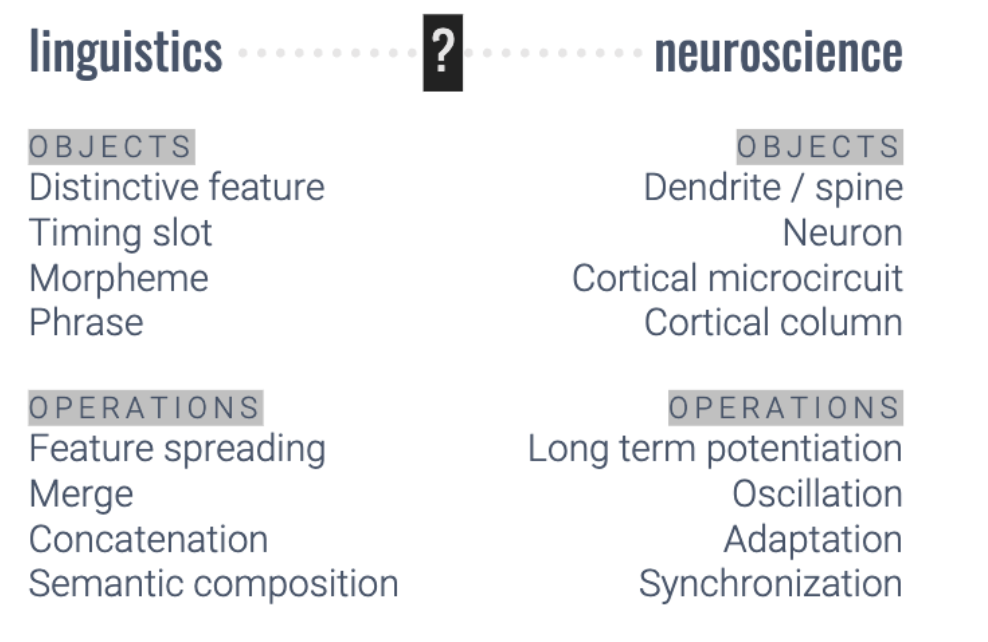
Ontology
core essence of something - cant be changed
What is true of the nature of what it is
things that ontologically true can’t be separated from object
Ex: Morpheme
Ontological status - theoretical concepts - diff from the ontology of something being a neuron
Linking theories
Computational - define model you want
You need a theory
Ex: Language - speech sounds
Processing model - how do you process these things
What are you representing
What info is contained in representations
How do you do it?
Nuerobiological model - biological stuff happening in brain - where is the task
Might want to test brain directly
Behavioral model
Once the process happens - how do you make a decision - make decision to push button
What’s the purpose of a linking theory?
Link a computational level of description → algorithm → behavioral point
So that you can make testable prediction about thing you can actually measure
So that you can evaluate it
What was the Karen Stromswold study
2 sentences given
1 - The juice that the child spilled__ stained the rug
2 - The child spilled juice that ___stained the rug
can actually be broken down into 2 sentence
The child spilled juice. The juice stained the rug.
Sentences were presented to people to see which ones they processed better

Results of Karen Stromswold study
Results:
On average ppl find sentence 1 harder to process than sentence 2
center embedded sentences - slower reaction time/ less understandable -
right embedded sentences - quicker reaction time/more understandable -
What changed between the 2 conditions
distance
internal structure

PET study
PET - positron emission tomography - mostly been replaced by FMRI
1st cortical study on Language
Used functional micro imaging to show how ppl process lang
Brain activation at different levels of complexity
Center embedded sentences show greater activation in pars opercularis than right branching sentences - What does this tell us?
pars opercularis - rear section of the brain's inferior frontal gyrus - understands hierarchy in brain
More time
More discrete operations
What does Broca’s area do
speech production - what studies have amounted to showing
We’re not entirely sure - depends on algorithmic level theory and linking theory
Understand what process is it so you can understand functional operation