Coding and Documentation
 Call Kai
 Learn
Learn Practice Test
 Spaced Repetition
 Match
Match Flashcards
 Knowt Play
1/18

There's no tags or description
Looks like no tags are added yet.
Name | Mastery | Learn | Test | Matching | Spaced | Call with Kai | Chat |
|---|
No analytics yet
Send a link to your students to track their progress
19 Terms
codes
-each dental procedure has an associated code
-codes used to communicate with or bill insurance companies, document visits, and collect data
-codes align especially well with a fee-for-service reimbursement system
CDT (current dental terminology) codes
-developed and maintained by the ADA council on dental benefit programs’ code maintenance committee- includes representatives from the ADA, dental specialty organizations, and dental payers
-codes that are used to report the services performed for pts; one element of properly documenting a procedure
-CDT codes reviewed and updated annually due to technology and methods of procedures continuously changing
-anyone can suggest a change to the CDT code set
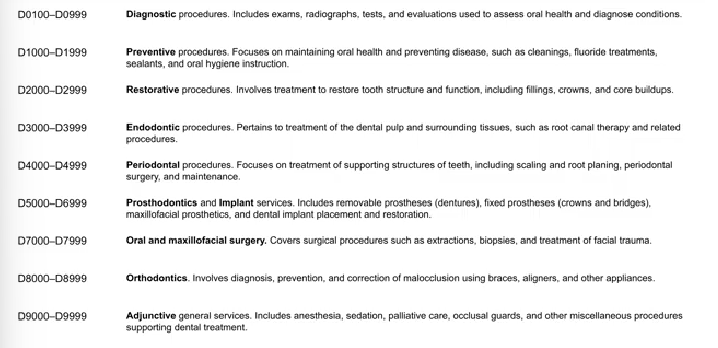
groupings of CDT codes
submitting a claim for dental services
-CDT codes are recorded on a dental claim form along with patient, provider, and payer-specific information
-claim forms may be submitted electronically or by mail
-many modern practice management systems have integrated electronic claim submission, allowing for more streamlined and efficient workflows
-some practices still use paper charts and film radiographs, so fax and traditional mail may still be used for documentation and claims processing
anatomy of a claim form

preauthorizations/pretreatment estimates
-a process where a dentist submits a treatment plan to the payer before treatment begins
-payer reviews the treatment plan
-payer notifies the patient and dentist about one or more of the following: eligibility, covered services, amounts payable, co-payment, deductibles, and plan maximums
-not a guarantee of payment; final reimbursement depends on eligibility, remaining benefits, plan rules, and the services actually provided
-most PPO plans do not require preauthorization but many HMO or Managed Care plans do mandate preauthorization for non-preventive treatment
advantages to submitting preauthos
-clarify what the dental plan is expected to cover before treatment begins
-give the pt estimated out-of-pocket cost and reduce financial surprises
-may improve treatment acceptance by giving pts greater cost certainty
-help pt and provider plan treatment timing, sequencing, and payment arrangements
-reduce misunderstanding and improve informed financial consent
disadvantages to submitting preauths
-more paperwork for front office
-potential delay in treatment while patient waits for insurance to reply
-patients may mistakenly believe approval guarantees coverage or clinical necessity
anatomy of a claim form- middle section

ICD-10 diagnosis coding in dentistry
-unlike in medical billing and coding, diagnostic codes are not mandatory yet
-Epic and other integrated dental-medical EHRs prompt for this so it is becoming more common and seamless
-some plans are beginning to require
groupings of ICD-10 diagnosis codes

advantages of diagnostic coding in dentistry
-improves documentation and record-sharing
-may improve communication with insurers and treatment justification process
-supports quality improvement and value-based care
-facilitates medical/dental integration
-enhances public health surveillance and data collection
disadvantages of diagnostic coding in dentistry
-learning curve to using correct codes
-because not widely used, potential for inconsistency between providers
-adds an additional step to documentation, particularly in non-integrated EHRs
-ICD diagnostic code set is not yet as specific as some dentists would like
anatomy of a claim form- bottom section

examples of “enclosures” or supporting documentation
-x-rays (PAs, BWs, pan)
-intraoral photos
-detailed narrative describing diagnosis, history, why a procedure was necessary
-chart notes
-perio chart
-comprehensive treatment plan
-reports from specialist
-appeal letter (if treatment was previously denied)
-proof of insurance payment (EOB) from pt’s primary insurance company (if there is more than one) = coordination of benefits
possible reasons for claim delay or denial- administrative
-pt does not have an active plan
-waiting period applies
-frequency limitation applies
-annual maximum met
-missing or incomplete patient, provider, or insurance information
-incorrect CDT code, tooth number, or date of service
possible reasons for claim delay or denial- clinical
-no documentation of clinical necessity
-radiographs are not diagnostic or incorrect x-ray is submitted
-if a more conservative restoration is acceptable
-if there is no new decay or missing tooth structure and the existing restoration is clinically acceptable
-poor prognosis (advanced periodontal disease or inadequate endodontic treatment)
-narrative does not corroborate radiographic findings
AI in claims review
-same AI systems used chairside to support clinical diagnosis and pt education increasingly being used to assist with dental insurance claims review
-AI can analyze radiographs and clinical documentation to identify findings such as missing tooth structure, bone loss, and caries
-determine whether submitted procedures align with payer guidelines and documentation requirements
-reduce administrative burden for insurers and help providers receive reimbursement faster when claims and documentation are complete and high-quality
-potential denials identified by AI are routed to licensed dental consultants for human review and decision-making
appealing denial claims
-a claim denial is not necessarily a final decision about payment for a claim
-an appeal is a formal request for insurer’s review of denied or unpaid claims
-a proper appeal involves sending the plan a written request to reconsider the claim
-additional documentation should be included to give the plan a clearer picture of why you recommended the treatment
-may help to ask to request to discuss the case with the dental consultant on a professional level (“peer-to-peer”)
