TERMS TEST
 Call Kai
 Learn
Learn Practice Test
 Spaced Repetition
 Match
Match Flashcards
 Knowt Play
1/63

There's no tags or description
Looks like no tags are added yet.
Name | Mastery | Learn | Test | Matching | Spaced | Call with Kai | Chat |
|---|
No analytics yet
Send a link to your students to track their progress
64 Terms
Deus Ex Machina
A sudden, unexpected solution to a seemingly impossible problem that resolves the story.
Example: A character is about to die, but a completely unexpected person suddenly appears and saves them.
Discriminated Occasion
A specific situation or circumstance that helps explain why a character behaves a certain way at a particular moment.
Epilogue
A section after the main ending that tells what happens to the characters afterward.
Flashback
A scene that goes backward in time to show something that happened earlier.
Flashforward
A scene that jumps forward in time to show something that will happen later.
Foreshadowing
Hints or clues about something that will happen later.
Example: A character notices that the brakes on their car aren't working properly → this may foreshadow an accident.
In Medias Res
Latin for “in the middle of things.”
A story begins in the middle of the action rather than at the chronological beginning.
Pacing
The speed at which a story's events unfold.
Fast pacing: short sentences, action, urgency
Slow pacing: description, reflection, dialogue, detailed scenes
Freytag's Pyramid
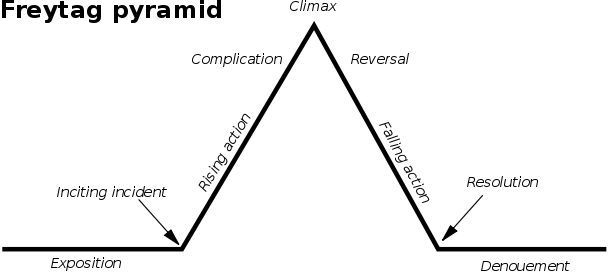
Exposition
The beginning of the story where we learn about:
characters
setting
situation
background information
2. Inciting Incident
The event that starts the main conflict.
Think: “What happens that gets the story going?”
Quest
A journey undertaken by a character to accomplish an important goal.
A quest usually involves:
A goal
Obstacles
Challenges
Transformation or discovery
Tragedy
A serious story in which a protagonist experiences suffering or downfall, often because of a flaw, mistake, or unavoidable circumstances.
Auditor
The person or audience who is being addressed by a narrator.
Think of the auditor as “the person the narrator is telling the story to.”
First-Person Narration
The narrator uses I, me, my, we, our.
The narrator is usually a character in the story.
“I walked into the house.”
Second-Person Narration
The narrator addresses the reader using you.
“You walk into the house and hear a strange noise.”
Less common in traditional fiction.
Third-Person Narration
The narrator refers to characters as he, she, they, or by their names.
“Maria walked into the house.”
Implied Author
The version of the author that the reader infers from the text.
It is not necessarily the same as the actual, real-life author.
Internal Narrator
A narrator who is a character within the story's world.
Objective Narrator
A narrator who reports events without giving us characters' private thoughts or judgments.
Think of it like a camera recording what happens.
Omniscient Narrator
A narrator who knows everything about the story and its characters, including their thoughts and feelings.
Omniscient = all-knowing.
Limited Narrator
A narrator who gives us information from a restricted perspective, usually knowing the thoughts of only one character.
Verbal Irony
Someone says something different from what they actually mean.
Example: During a hurricane, someone says, “What beautiful weather!”
Situational Irony
What actually happens is different from what we expect.
Example: A fire station burns down.
Dramatic Irony
The audience knows something the characters don't know.
Example: We know the murderer is hiding in the house, but the character doesn't.
Point of View
The perspective from which a story is told.
Example: first-person vs. third-person.
Focus
Whose experience or perspective receives the most attention?
Even in third-person narration, the story may focus primarily on one character.
Voice
The distinctive personality or identity expressed by the narrator's language.
Style
The author's particular way of writing.
Includes:
word choice
sentence structure
imagery
diction
syntax
literary techniques
Tone
The narrator's or author's attitude toward the subject.
Examples:
serious
sarcastic
humorous
angry
hopeful
gloomy
nostalgic
Unreliable Narrator
A narrator whose version of events cannot be completely trusted.
Reasons might include:
lying
ignorance
insanity
misunderstanding
bias
limited knowledge
Test question: Ask, “Does the narrator's account match what the reader can determine is actually happening?”
Antihero
A protagonist who lacks traditional heroic qualities.
They might be:
selfish
morally questionable
cowardly
cynical
dishonest
But they are still the central character.
Direct Characterization
The narrator directly tells us what a character is like.
“John was extremely selfish.”
Indirect Characterization
We figure out what a character is like from:
actions
dialogue
thoughts
appearance
relationships
reactions
Easy trick: Direct = author tells you. Indirect = you figure it out.
foil
A character whose qualities contrast with another character, highlighting the other character's traits.
Example: A brave character paired with a cowardly character makes the bravery more obvious.
hero/heroine
A character who possesses traditionally admirable qualities and/or acts as the central heroic figure.
Villain
A character who deliberately opposes the protagonist and often causes harm.
Major Character
A character who is important to the story and appears frequently.
Minor Character
A less important character who supports the story or major characters.
Protagonist
The central character whose goals and struggles drive the story.
Round Character
A complex character with multiple qualities, emotions, and motivations.
Flat Character
A relatively simple character built around a small number of traits.
Static Character
Does not significantly change during the story.
Dynamic Character
Experiences a significant internal change.
Stock Character
A stereotypical character whose traits are immediately recognizable.
Examples:
the wise old mentor
the evil villain
the clueless sidekick
the damsel in distress
particular and general setting
Particular setting: Specific and detailed.
“A two-story Victorian house on Elm Street in Boston.”
General setting: Broad or nonspecific.
“A small town.”
Symbol
A person, object, place, action, or image that represents a meaning beyond its literal meaning.
Example: A dove → peace.
A symbol can have multiple meanings depending on context.
Allegory
A story in which characters, events, and/or settings consistently represent larger abstract ideas.
An allegory operates on both:
a literal level
a symbolic level
Think: The entire story is functioning as a metaphor for something else.
Archetype
A recurring, recognizable pattern in literature.
Character Archetype
Examples:
Hero
Mentor
Trickster
Villain
Innocent
Setting Archetype
Examples:
Garden/paradise
Wilderness
Underworld
Journey
Plot Archetype
Examples:
Quest
Fall
Rebirth
Death and resurrection
Symbol Archetype
Examples:
Light = knowledge/goodness
Darkness = ignorance/evil
Water = rebirth/renewal
Myth
A traditional story that explains something significant about:
the world
human existence
nature
gods
culture
Myths often involve supernatural beings or events.
Traditional vs. Archetypal
Traditional = associated with a particular culture, historical tradition, or established story.
Archetypal = a recurring pattern that appears across many cultures and stories.
Allusion
A brief reference to a well-known:
person
place
event
text
myth
historical event
Example: “He met his Waterloo.”
This alludes to Napoleon's defeat at Waterloo.
Metonymy
Replacing something with something closely associated with it.
“The White House announced...”
“The White House” means the U.S. presidential administration.
Synecdoche
Using a part to represent the whole or the whole to represent a part.
“All hands on deck.”
“Hands” means sailors.
Key distinction:
Metonymy: association
Synecdoche: part ↔ whole
Oxymoron
Two contradictory terms placed together.
Examples:
“deafening silence”
“bittersweet”
“jumbo shrimp”
Fable
A short story, often involving animals, that teaches a moral lesson.
Theme
The larger idea or message about life, humanity, or society that a work explores.
A theme is usually not just one word.
❌ “Love”
✅ “Love can cause people to make irrational decisions.
Moral vs. Theme
Moral: What you should learn/do.
Theme: What the story suggests about life or human experience.