Cell Cycle Control - 11
 Call Kai
 Learn
 Practice Test
 Spaced Repetition
 Match
 Flashcards
 Knowt Play
1/17

There's no tags or description
Looks like no tags are added yet.
18 Terms
Cell cycle control system
A cyclically operating set of molecules in the eukaryotic cell that both triggers and coordinates key events in the cell cycle.
What does cell cycle control ensure?
That:
each phase of the cell cycle is completed before next one begun
progression through each phase is correct
what is this control system based on?
cyclically activated protein kinases
(phospho multiple proteins involved in DNA replication, mitosis, cytokinesis)
What can rapidly reverse the cell-cycle machineries to stop them?
protein phosphatases
Does the concentration of kinase change during the cell cycle?
No, stays constant
The activity of each kinase rises and falls in a _________________ fashion
cyclical. The kinases are only activated at the appropriate time.
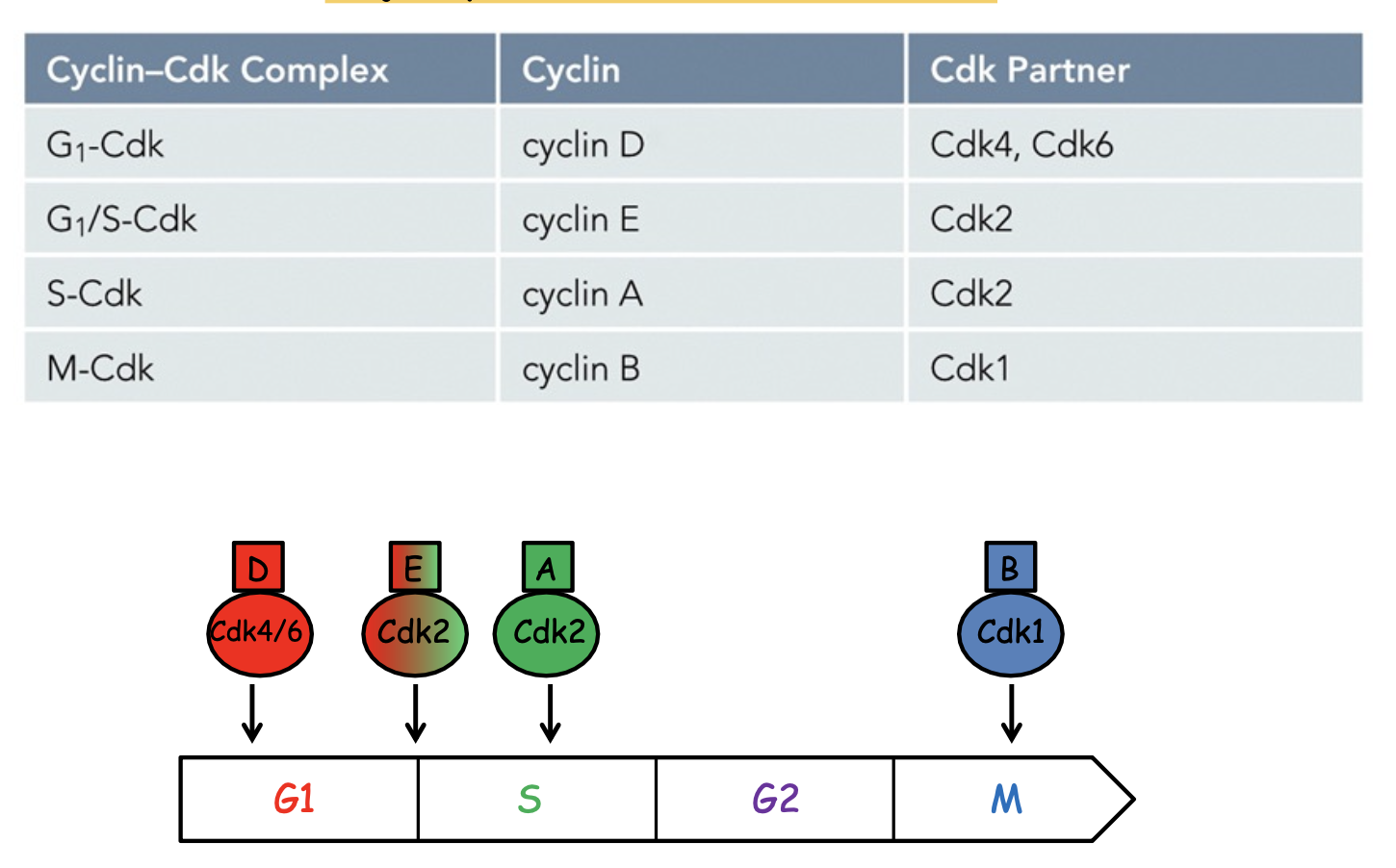
Cyclins
proteins that regulate the timing of the cell cycle in eukaryotic cells. They need to bind to the kinases to make them enzymatically active.
Cyclin-dependent kinases (Cdks)
i.e. Cdk1 activates target proteins that regulate mitosis through phosphorylation
M-Cdk complex
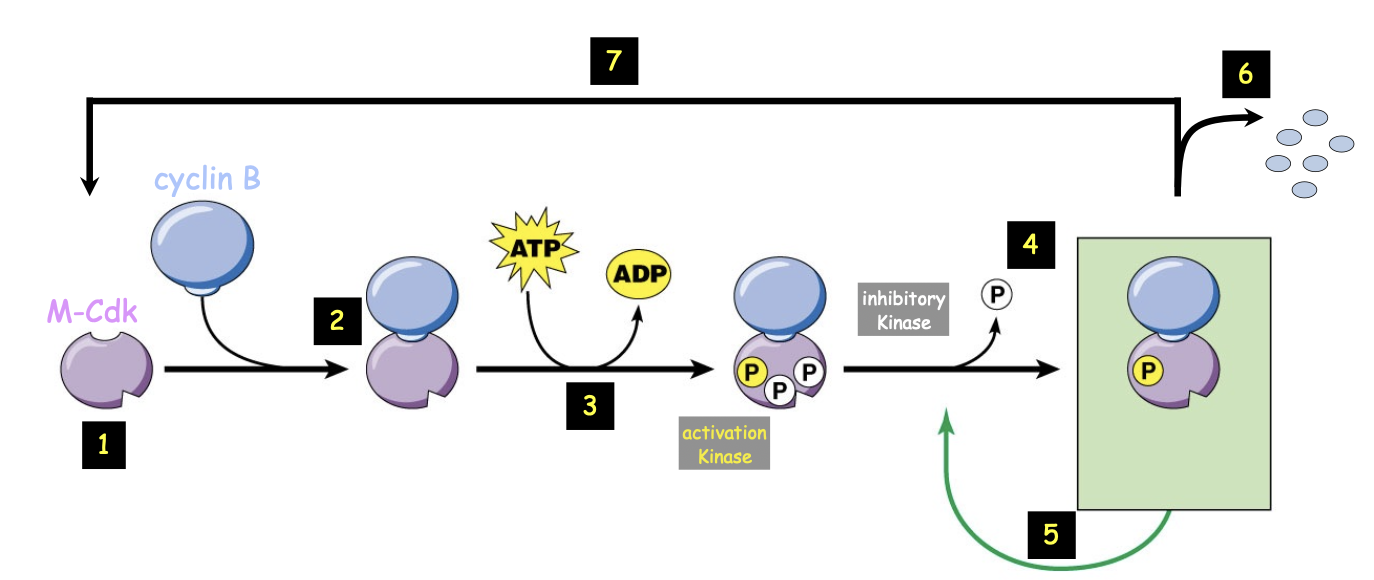
Cyclin B binding to Cdk1 is necessary, but not sufficient to show kinase activity. Phosphorylation (& removal of inhibitory phosphates) activates M-Cdk site required for activity
Cyclin B action (S phase)
— Cyclin B synthesis begins in S phase → accumulates and forms a complex with M-Cdk during the S and G2 phases
— As the Cyclin B-Cdk1 complex forms, M-phase Cdk phosphorylated by activating & inhibitory kinases
✧ M-Cdk stays enzymatically inactive
Cyclin B at end of interphase (G2)
— M-CdK activated by protein phosphatase Cdc25
- now ACTIVE, M-Cdk phosphorylates many targets, including Cdc25
Before being activated, how many phosphates does the cyclin B-Cdk1 complex carry?
3 → one activating kinase and 2 inhibitory kinases
The complex is activated when Cdc25 cleaves the inhibitory phosphate group
Cdc25 positive feedback loop
Cdc25 ‘s phosphorylation is further activates the phosphatase activity → active Cyclin B-Cdk1 will further activate itself
Cyclin B (end of M-phase)
— M-Cdk inactivated by proteolytic degradation of Cyclin B
— Cell exits mitosis to undergo cytokinesis and return to interphase (G1)
— At the end of G1 phase, inactivated M-Cdk is dephosphorylated
Why is the inactive M-Cdk dephosphorylated during G1 phase, even when it is already inactive?
So it can reform a complex with Cyclin B
Targets of Cyclin B/M-Cdk complex
chromatin condensation → condensins
mitotic spindle formation → MT-associated proteins
nuclear envelope breakdown → lamins
M-Cdk targets during prophase
☆ condensin activated by phosphorylation → chromatin condensation
☆ microtubule associated proteins phosphorylated → promotes cross linkage of the microtubules growing from opposite spindle poles → mitotic spindle formation
M-CDK targets during prometaphase
☆ phosphorylation of lamin proteins → disassembly of the nuclear lamina → nuclear envelope breaks up into vesicles