Quiz 4 PSYC 311
 Call Kai
 Learn
 Practice Test
 Spaced Repetition
 Match
 Flashcards
 Knowt Play
1/53

There's no tags or description
Looks like no tags are added yet.
54 Terms
Levels of Categories
superordinate - tool, basic - screwdriver, subordinate - phillips screwdriver
Defining features
Necessary to the meaning of the concept
Characteristic features
Not necessary to the meaning of the concept, but describe the concept in typical terms
Development of characteristic features
Children witch from focusing on characteristic to realization of defining features as critical to an object - generally occurs sometime in elementary school
Stereotypes
Concepts acquired through social channels
often include emotional or evaluative dimension
Reliance on them can lead to bias and prejudice
Outgroup homogeneity effect
People within the “in” group believe their group is quite varied while “out” groups are quite homogenous
Jane Elliot’s Experiment
Separated groups of people based on eye color
Brown - superior, smarter, more christian, etc. while blue opposite
Brown-eyed people began to act superior
Pigeon experiment
A pigeon pecks rapidlyat a small photograph containing trees. When scene changes to a treeless street, it stops pecking. Resumes once trees come back
Importance of pigeon experiment
Demonstrates that pigeons possess an ability that transcends discrimination of simple stimulus dimensions such as wavelength. Suggests that pigeon’s classification behavior is mediated by abstract, or conceptual, rules and therefore resembles the cognitive solution accomplished by humans.
Exemplar model for categorization
Sets of stimuli are unified, not by a rule, a common feature, or an abstract representation, but by a common psychologically significant consequence
Feature learning model for categorization
Attend to the fixed property of a stimulus, which are the most primitive or the lowest building blocks of object recognition and categorization
Prototype matching for categorization
Categorization is accomplished by the acquisition of a prototypical representation of a category via a form of abstraction process
Characteristics of prototypes
Are supplied of a category, “this is a chair”
Serve as reference points “it’s like a chair…”
Are judged more quickly after priming
Family resemblance
No single attribute is found in all examples of a concept, but each example has at least one attribute n common with one other example of the concepts
Grammar
Sum of knowledge a person has about the structure of his/her own language
Discourse
Coherent group of written or spoken sentences
Propositions
Assertions made in sentence clauses (noun phrases, verb phrases)
Syntax
Specified relations made between types of words in a sentence (e.g., nouns and verbs)
Lexicon
The vocabulary of a person, language, or branch of knowlege P
Phrase structure tree
Standard way of representing the syntax of a sentence

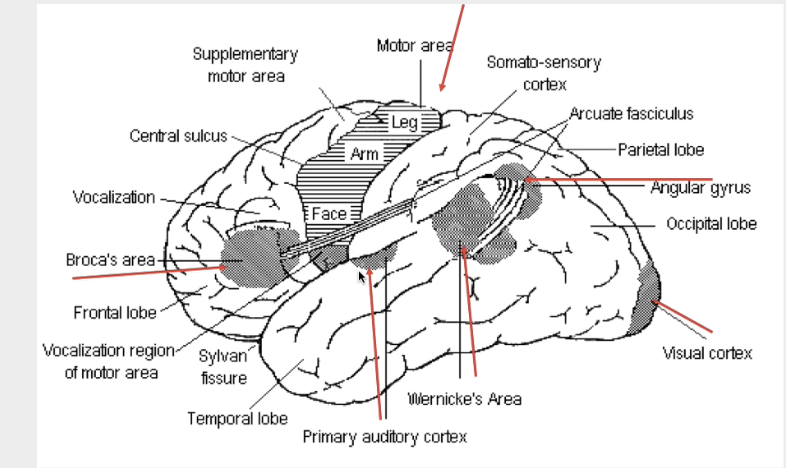
Motor area
For actual production, ventral portion of the motor strip in M1
Broca’s Area
Speech production
Auditory perception area
Ventral and posterior to Broca’s area
Wernicke’s area
Speech comprehension
Angular gyrus
Organize language and thoughts V
Visual cortext
Perception of mouth movement
Key brain areas for language
What does the McGurk effect reveal?
it is a perceptual phenomenon, revealing an interaction between hearing and vision in speech perception
Speech perception is multimodal
McGurk effect inverted
Bad lip reading - we see the mouth as saying something other than what is actually said
Why? we speak rather fast and it’s not as easy to parse the sounds visually as when we parse the sounds
Thomas Demand - Rain
We see what we think is rain and audio complementing, but it is really wrappers falling onto a surface and bacong frying
Ambiguity
Property of language that permits more than one interpretation of a sound, word, phrase, or sentence
Solving ambiguity
Occurs via integration of bottom-up and top-down information (surrounding letters, sentences - perceptually based info// attention, memory)
Stage of language production
Mesage- speaker formulates the message to be conveyed
Grammatical encoding - choosing words to convey the message, developing syntactic structure of the sentence to be uttered
Phonological encoding - phonological representation of the utterance is developed
Articulation - message is articulated
Tip of Tongue phenomenon
The person can think of the word but cannot access its pronunciation
Language and colors
Language influences how we categorize, discriminate, and remember colors. Although people may possess similar basic visual capacities, the linguistic categories available to them can influence how they organize and remember perceptual experiences
Sapid-Whorf Hypothesis
Language influences cognition rather than strictly determining what people can perceive.
Brain activation while swearing
Right hemisphere, activates more to negative than the left side
Basal Ganglia, active during swearing production
Amygdala, active during swearing perception
Five different types of words that are taboo
The supernatural, invokes awe or fear
Body effluvia/organs, invokes disgust
Death/disease, invokes dread
Sexuality, invokes revulsion
Disfavored groups, invokes hatred, contempt
Five reasons we use taboo words
Dysphemism - to force the listener to think about how awful something is, and the time for politeness has passed
Abusive swearing - in order to invoke intimidation or humiliation
Idiomatic swearing - use words that hit the emotional buttons
Emphatic swearing - in order to emphasize
Cathartic swearing use of words to release tension; this may be a learned response
Alerting people that this is a casual/ safe place
Gentle genius of bonobos TED talk
Bonobos in human scenarios act like how humans would
Blade-like tools very similar to early man
was able to draw lexigrams that she learned to communicate
Savage-Rumbaugh Bonobo work
Bipedal locomotion allows for joint attention (episode of shared attention that is not usually linguistic)
Children who engage in joint attn. speak sooner
Using language w bonobos, not just to “teach” them language
Meeting the bonobo halfway
In babies — crying and whining were fount to be replaced w/ signing
Reaction time and interference paradigm
Generate an image and complete a stimulus transformation - time needed to do so indicated spatial properties of the mental stimulus
Interference paradigm
Active interference (complete 2 tasks things at once)
Passive interference (at-rest postures while imagining)
Measuring Contents of mind - brain imaging
Functional activation of brain as a result of contents of mind
Measuring contents of mind - subjective report, introspection
Report on what you see in your mind’s eye; contemplation of one’s own thoughts, desires, opinions
Experiment - participants instructed to imagine object in specific size
Smaller objects tend to be activating lower parts of visual cortex
The role of area 17
Used TMS to invoke a temporary lesion - people had trouble visualizing things
Blind people while reading braille
Activation of visual cortex despite blind
Oliver sacks
For a year John Hull could imagine few things visually after losing eyesight, but then that disappeared
other blind people had different experiences
Esrec Armagon - The blind painter
Draws very well
Plans painting in his head, and recreates on paper
Often feels objects and can redraw them
Has visual cortex activation
Neglect patient
Information all stored, but they only give you half the information (omit info on neglected side)
Figure 11.10
Greater activation of visual cortex
Eidetic imagery
Vastly more detailed than ordinary imagery - kind of like photographic memory
Top down vs. bottom up
Neutral images- could be one thing or another, when participants asked to recall, they draw the thing they identified image as instead of the neutral image
Daniel Kish - echolocation
Bilateral retinal blastoma
Flash sonar - clicks tongue to "see” the space around him
actually activates visual cortex and creates images in his mind