Exam 3 Alkene, Alkyne, and Radical Reactions
 Call Kai
 Learn
 Practice Test
 Spaced Repetition
 Match
 Flashcards
 Knowt Play
1/23

There's no tags or description
Looks like no tags are added yet.
24 Terms
HCl, HBr, and HI
get rid of double bond and place halide on most substituted
Mechanism -
Seperate H and halide
Shift if needed
Place halide ion on positive charge

H2SO4 (sulfuric acid) and H3O
break double bond and place OH on more substituted side
Mechanism -
Make H30 by stealing H from sulfuric acid and place on water
Get rid of double bond and make water
attach O to the positive carbon
deprotonate with water

Hg(OAC)2 and NaBH4
OH attacked to the carbon of the alkene that is most substituted

BH3, THF, H2O2, NaOH
OH adds to least sub carbon and H to most
same bonds for both

OSO4, NaHSO3, KMnO4, NMO
OH added to both carbons
same bond

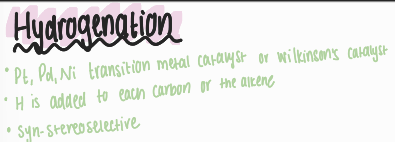
Pt, Pd, Ni
H added to wach carbon
same bond
DCM and Cl/Br
halide to each carbon
different bonds
Mechanism -
Send double bond to one halogen but take electrons from same halogen and send to alkene carbon (loop)
break halide bond to make solo halide
a epoxide will form
break an epoxide bond and send halogen to where bond used to be

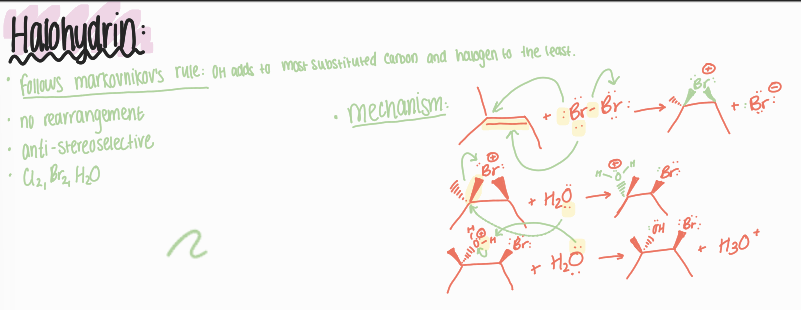
Cl2, Br2, and H20
OH to most substituted and halogen to least
different bonds
Mechanism -
Loop thing to isolate Br and create epoxide (halogen and send to alkene carbon)
Break one epoxide bone and attach water to replace it
deprotonate to create OH and H30
mCBPA or RCO3H
CHAIN - Create a triangle with an O and attach the rest of the chain to the corresponding carbon #
RING - create O coming off of ring where alkene was and attach other groups to corresponding carbons

H20 and Acid (HCl)
Comes with an epoxide
breaks epoxide into 2 OHs with different bonds

Ozone (O3) and DMS (CH3)2S
CHAIN - split alkene in middle and replace it with doubly bonded O and attached groups to corresponding side
RING - number carbon from one alkene carbon to the 2nd and draw that many carbon chain with a doubly bonded O on each side and attach groups as attached on rings to each O

Pt, Pd, Ni, and H2
hydrogenation for alkynes
triple —> single bond
Na and NH3
Dissolving metal
triple bond —> trans double bond
If terminal, will be monosubstitutes (double bond attached to carbon that’s attached to R)
Lindlar’s catalyst and H2
triple bond —> cis double bond
Cl/Br and DCM (alkynes)
Halogenation of Alkynes
1 mol then add one halogen to each carbon and becomes double bond
2 mol then add 2 halogens to each carbon and becomes single bond
H(HA)
Hydrohalogenation in ALkynes
1 mol then add halogen to more substitutes and H to the other side (should already have H) —> becomes double bond
2 mol then add 2 halogens to the more subs and 2 H to the other side (should already have H) —> becomes single bond
R2BH and (Sia)2BH
Hydroboration for Alkynes
O attaches to less substituted carbon
HgSO4 and H2SO4
Oxymercuration in Alkynes
2 products with O doubly bonded to each carbon
O3 and H20
Ozonolysis for Alkynes
2 products where you attach doubly bonded o to each carbon and then OH at the end making it into a carboxylcylic acid
LiAlHu
Lithium Aluminum Hydrude reduction
aldeyhyde and corboxcylice acid becomes primary alcohol
ketone becomes 3nd alcohol
ester - split and primary alcohol on each
MBr
Gringard reaction
Ketone - ring jsut attaches to alpha carbon and hent===xagon turns into OH
aldehyde - h attached to o and ring attaches to where h used to be
ester - both of them are correct
PBr/SOCL2, TsCL/NaN3,
primary and secondary alochols undergo SN2 where OH is replaced by Br or cl or CN
H2SO4, and heat
forms satzev product
Cr or PCC
add an H bond