Biology Paper 1
 Call Kai
 Learn
Learn Practice Test
 Spaced Repetition
 Match
Match Flashcards
 Knowt Play
1/12

There's no tags or description
Looks like no tags are added yet.
Name | Mastery | Learn | Test | Matching | Spaced | Call with Kai | Chat |
|---|
No analytics yet
Send a link to your students to track their progress
13 Terms
Explain the importance of emulsification in the digestion of lipids. (2)
(Small droplets) increase surface area
(So) faster/increased (rate of) lipase/enzyme hydrolysis/activity
Explain the importance of the role of micelles in the absorption of lipids. (2)
Carry fatty acids to cell
(So) fatty acid diffuses (into cell)
Describe and explain the adaptations of leaves that maximise gas exchange. Do not refer to organelles in your answer. [4 marks]
Many stomata
Stomata allow (gas) diffusion
Air spaces in mesophyll
Large surface area of cells/cell membranes for (rapid) diffusion
Large (leaf) surface area to volume ratio so high/increases diffusion (rate)
Thin (leaves) so short diffusion distance/ pathway;
Define the quaternary structure of a protein. [1 mark]
More than 1 polypeptide
Explain how two enzymes with different amino acid sequences can catalyse the same reaction. [2 marks]
active sites have similar tertiary structures/amino acid sequences
form enzyme-substrate complexes
Describe the complete digestion of starch by a mammal. [4 marks]
Hydrolysis
(Of) glycosidic bonds;
(Starch) to maltose by amylase
(Maltose) to glucose by disaccharidase/maltase
Membrane-bound (disaccharidase/maltase);
Name the bond formed between a fatty acid and glycerol in a triglyceride molecule. [1 mark]
Ester

On Figure 1, draw a circle around the part of the fatty acid molecule and the part of the glycerol molecule that is removed to form a bond in a triglyceride molecule.
Circle drawn around H in one of the HO groups of the glycerol
AND the OH group of the fatty acid
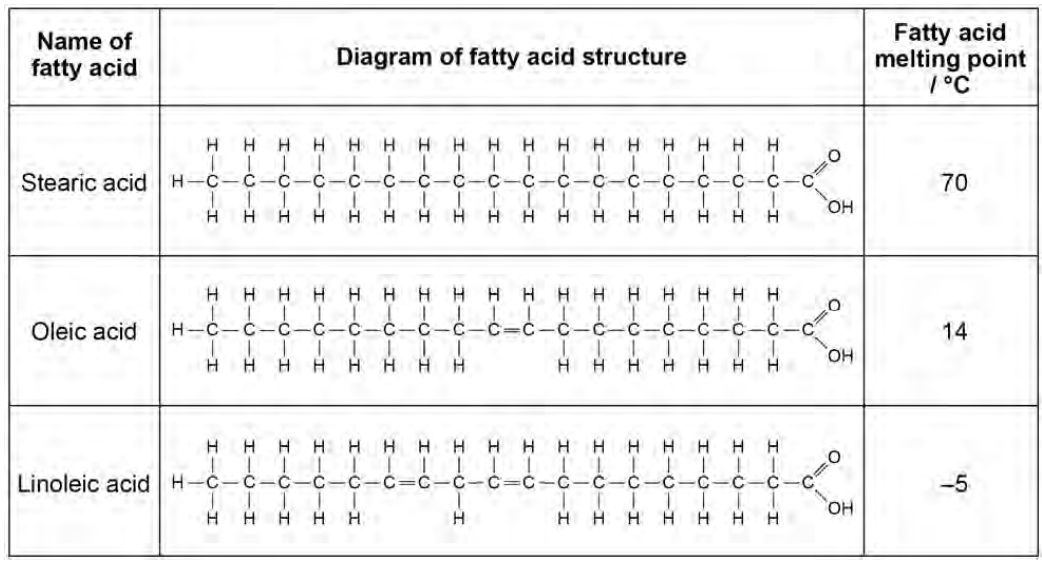
Use Table 1 to describe the relationship between fatty acid structure and fatty acid melting point. [1 mark]
As (number of C) double bonds increases, melting point decreases
Vitamin A is a fat-soluble substance.
Micelles are involved in the process of vitamin A absorption.
Describe the process of vitamin A absorption into cells lining the ileum. [3 marks]
Combine/mix/join with bile salts
Make (more) soluble
(Micelles) breakdown close to cells OR Transport to cells/lining
Diffuses (into cells/ileum)
Describe how we breathe in. [3 marks]
Diaphragm contracts pulling diaphragm down
External intercostal muscles contract pulling/moving ribs upwards/outwards
Volume increase and pressure decrease in thorax/lungs
Explain why the scientist used very thin slices of alveolar tissue with the optical microscope. [2 marks]
Single/few layer(s) of cells/tissue
Light can pass through
Small tears may occur in the layers of tissue in an aorta wall. These tears weaken the wall without bursting the aorta. Scientists:
• measured the aorta diameter (d) in a large population of people over 60 years of age
• calculated the risk of an aorta wall developing a tear
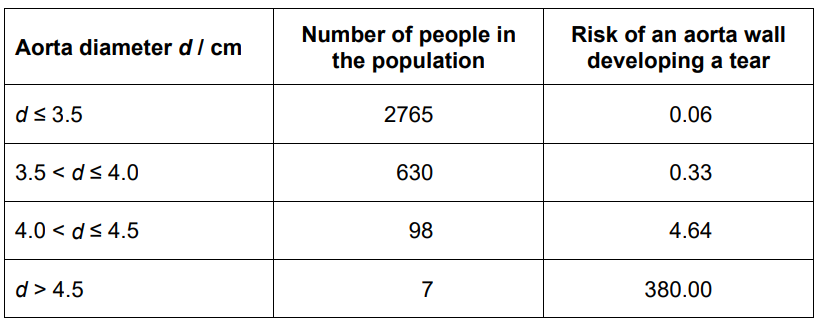
Blood may push through the tears in the aorta wall. This produces a balloon-like swelling called an aneurysm and increases the aorta diameter. Aneurysms can cause the aorta to burst.
Using all the information, what can you conclude about aorta diameter and the risk of developing an aneurysm? [3 marks]
Small diameters are low risk of tears so unlikely to/do not have aneurysms
OR As diameter increases, risk of tears increases and (risk of developing) aneurysms increase
Few people have/at high risk of tear
OR Few people have/at high risk of aneurysms
Diameters > / above 4.5 (cm) at high risk (of tears) so may have aneurysms
(High risk of) tear does not mean aneurysm will/has occurred