Chapter 13 - Urogenital system (Urinary)
 Call Kai
 Learn
 Practice Test
 Spaced Repetition
 Match
 Flashcards
 Knowt Play
1/82

There's no tags or description
Looks like no tags are added yet.
83 Terms
Urogenital ridge gives rise to
URINARY & GENITAL SYSTEMS
Intermediate mesenchyme along the dorsal body wall →
Urogenital ridge
Urogenital ridge divides into
Nephrogenic cord
Gonadal ridge
Nephrogenic cord →
Urinary system

Gonadal ridge →
Reproductive system
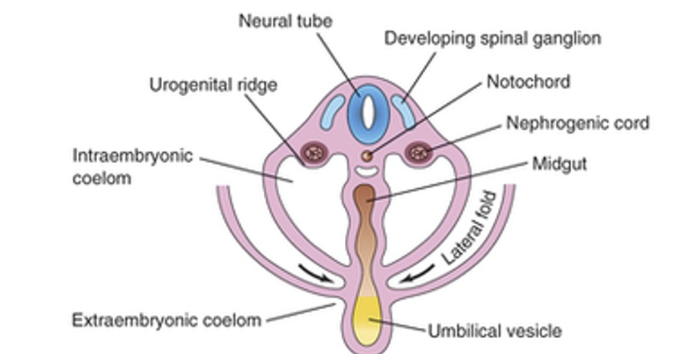
One embryonic region →
Two closely related systems
Does the urinary or genital system develop first?
Urinary system develops first
Major components of urinary system
Kidneys
Ureters
Bladder
Urethra

Early, nonfunctional kidney system
Pronephros

Temporary excretory organ /kidney system
Mesonephros

Permanent kidney system
Metanephros

Urinary and Reproductive ducts develop separate or together?
Together
Early urinary and reproductive strutures are
Closely associated
Some embryonic urinary ducts are __ in the reproductive system
Repurposed

Pronephros: Early and Nonfunctional (Timing)
4th week
Pronephros: Early and Nonfunctional (Location)
Cervical region
Pronephros: Early and Nonfunctional details
Rudimentary, nonfunctional
What happens to the ducts that persist in the proneprhos
They are reused by mesonephros
Mesonephros
TEMPORARY KIDNEY WITH LASTING DERIVATIVES
Mesonephros: Timing
Late 4th to 10th week
Metanephros Function
Temporarily as excretory organ
Mesonephric tubules
Some persist as efferent ductules in males

Mesonephric duct
Opens into the cloaca
Later contributes to the male reproductive tract

Afferent
Coming in
Efferent
Going out
Ureteric Bud forms
Collecting system
When does the metanephros appear?
Week 5
When does the metanephros start functioning?
Week 9
Ureteric bud arises from
Mesonephric duct
Uteric bud forms
Ureter
Renal pelvis
Calyces
Collecting tubules

Metanephric blastema forms
The nephrons
Nephron
Functional part of the kidney
Kidney development requires _______ between uteric bud and metanephric blastema
Reciprocal induction
Reciprocal induction produces the
Nephron

Collecting tubules induces
Metanephric vesicle formation
Metanephric vesicle to Nephron pathway
Vesicle → S-shaped tubule → nephron
Do any new nephrons form after birth?
No
Epithelial-mesenchymal interaction drives __
Nephron formation

Medulla
Pith / middle
Kidneys ___ during development
Ascend and rotate

Where do the kidneys begin?
In the pelvis
Kidneys ascend to the lumbar region by which week?
Week 9
The kidneys rotate how?
~90º medially
Hilum becomes anteromedial
During kidney ascent, what also shifts upwards?
Blood supply
Lower arteries normall regress
Persisten renal arteries create __
Vascular variations
During ascent, kidneys receive
Successively higher arterial branches
Some lower renal vessels may persist →
Accessory renal arteries
Polar arteries
May cross/compress the urether
Can contribute to hydronephrosis
Hydronephrosis
Build up of pressure leading to dysfunction of the kidneys and neuron damage

Kidney malrotation / Ectopia
Abnormal rotation or failed ascent
Crossed fused ectopia
Kidney fused on one side
Horseshoe kidney
Fusion of lower poles; ascent limited by IMA (Inferior Mesenteric Artery)
Cystic kidney disease
Abnormal cyst formation within the kidneys
Duplications of the kidney
Abnormal division of ureteric bud → bifid ureter or duplicated collecting system
Bifid
Splits into 2
The urogenital sinus has what 3 regions
Vesical part
Pelvic part
Phallic part

Vesical part of urogenital sinus
Most of the bladder
Pelvic part of urogenital sinus
Prostatic urethra in males
entire urethra in females
Phallic part of urogenital sinus
Distal urethra in males
Pathway to urethra
Kidney → urether → bladder → urethra
Pelvic diaphragm
Keeps gut from falling out bottom of pelvis

The bladder has multiple ___ contributions
Embryonc
Trigone →
Mesonephric ducts
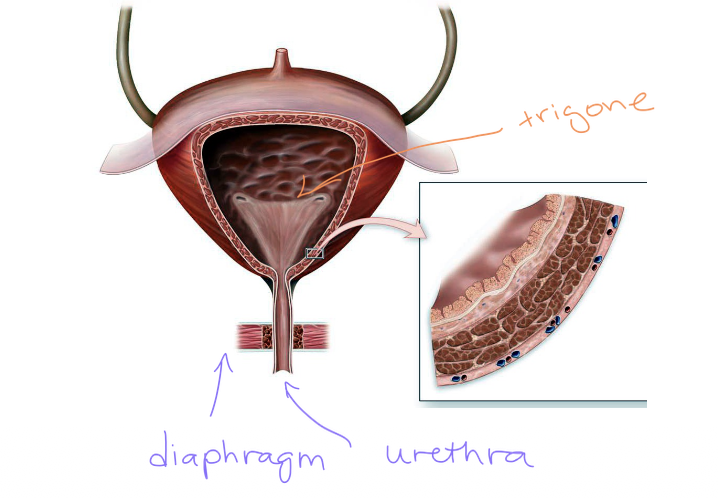
Allantois → Urachus →
Median umbilical ligament
Bladder lining
Endoderm
Muscle and stroma
Splanchnic mesoderm
Persistence of the urachus produces
Urachal anomalies
Middle portion of urachus remains open (closed ends)
Cyst

Urachus open to bladder or umbilicus
Sinus

Urachus wher entire tract remains patent →
Urine at umbilicus: Fistula

Normal urachus pathway
Allantois → Urachus → Obliterates
Bladder exstrophy
Leaves the bladder mucosa exposed
Bladder exstrophy
Defective development of the ventral abdominal wall
Bladder exstrophy is often associated with
Epispadias
Top of penis

What tissue forms most of the urethra in males and females?
Endoderm
What forms the distal urethra in males?
Ectoderm in glans
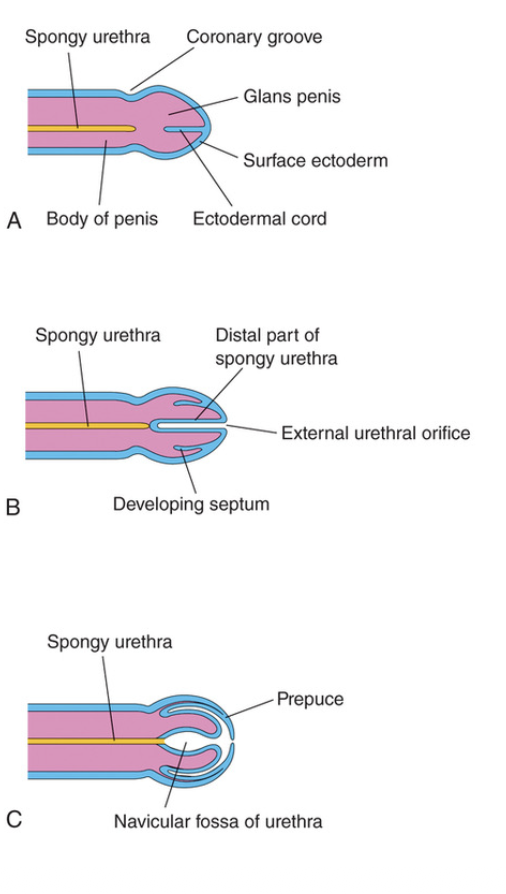
Connective tissue and smooth muscle of urethra derives from
Splanchnic mesoderm

Adrenal cortex origin
Mesoderm (Urogenital ridge)

Medulla origin
Neural crest cells

Suprarenal
On top of kidney
Suprarenal also means
Adrenal → Produces adrenaline/epinephrine
Fetal cortex of adrenal gland
Large + Active → Regresses after birth
Adult cortex zones
Fully established by ~ 4 years old
