Neurons
 Call Kai
 Learn
 Practice Test
 Spaced Repetition
 Match
 Flashcards
 Knowt Play
1/82

There's no tags or description
Looks like no tags are added yet.
83 Terms
What is the nervous system?
The body's master controlling and communicating system.

How do cells in the nervous system communicate?
Through rapid electrical signals that cause immediate responses.
What is the nervous system responsible for?
Movements, reflexes, thoughts, and emotions.
What are the two main divisions of the nervous system?
The central nervous system (CNS) and peripheral nervous system (PNS).
What makes up the central nervous system (CNS)?
The brain and spinal cord.
What is the peripheral nervous system (PNS)?
All nervous tissue outside the CNS.
What does the PNS include?
Nerves that extend from the brain and spinal cord.
What are the three main functional steps in nervous system activity?
Sensory input, integration, and motor output.
What does the sensory (afferent) division do?
Carries sensory information from receptors to the CNS.
What is integration?
Processing sensory input and deciding what should be done in response.
Where does integration occur?
Only in the CNS.
What does the motor (efferent) division do?
Sends responses from the CNS to effector organs.
What are effector organs?
Muscles and glands that respond to motor commands.
What are the two principal cell types of nervous tissue?
Neurons and neuroglia (supporting cells).
What are the four types of CNS neuroglia?
Astrocytes, microglia, ependymal cells, and oligodendrocytes.
What are the two types of PNS neuroglia?
Schwann cells and satellite cells.
What is a neuron?
A cell that transmits electrical impulses.

What does the cell body of a neuron contain?
The nucleus and organelles.
What do dendrites do?
Branching extensions that carry impulses toward the cell body.

What does an axon do?
A single process that carries impulses away from the cell body.

What are neuroglial cells?
Supporting cells that surround, protect, and support neurons.
What are the main functions of astrocytes?
Support and anchor neurons to their nutrient supplies, help form the blood-brain barrier, and control the chemical environment.

What do astrocytes wrap around in the brain?
Brain capillaries.
What is the blood-brain barrier?
A protective barrier associated with brain capillaries that helps regulate which substances enter brain tissue.
What are the characteristics of microglia?
Small, oval-shaped cells with thorny processes.
What is the function of microglia?
They act as phagocytes and provide immune defense in the CNS.

What is phagocytosis?
The process of engulfing and removing foreign material, damaged cells, and debris.
What is a key immune-defense role of microglia?
They help defend the CNS because many immune cells cannot readily enter brain tissue.
What are the characteristics of ependymal cells?
They range from squamous to columnar, and many have cilia.
Where are ependymal cells located?
They line the central cavities of the brain and spinal cord where cerebrospinal fluid (CSF) is found.

What do the cilia of ependymal cells do?
Their coordinated beating helps circulate CSF.
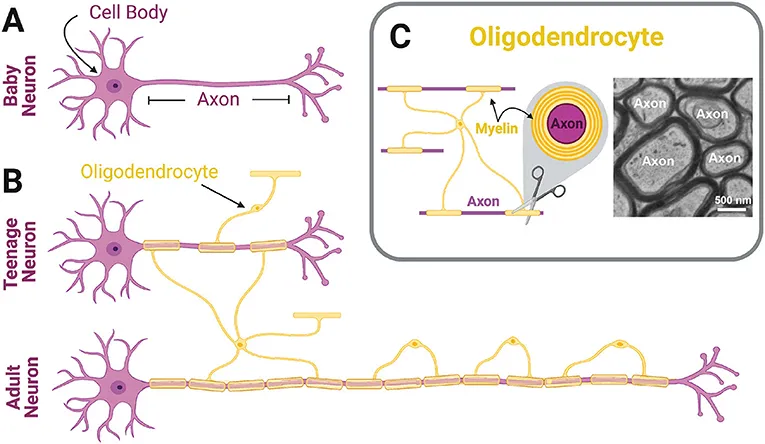
What are the characteristics of oligodendrocytes?
They have few processes.
What do oligodendrocytes do?
Wrap around CNS nerve fibers to create the myelin sheath.
Which two types of cells make up PNS neuroglia?
Schwann cells and satellite cells.
What are Schwann cells also called?
Neurolemmocytes.
What do Schwann cells do?
Surround PNS axons and form the myelin sheath.
What do satellite cells do?
Surround and support neuron cell bodies within ganglia.
What is the function of satellite cells similar to?
Astrocytes.
What is the myelin sheath?
An insulating covering formed by oligodendrocytes in the CNS and Schwann cells in the PNS.

What are the functions of the myelin sheath?
It insulates axons and increases the speed of nerve impulse conduction.
What are Nodes of Ranvier?
Gaps between sections of the myelin sheath along an axon.

What is voltage?
A measurement of the electrical potential difference created by charge separation.
What is the resting membrane potential of a typical neuron?
Approximately -70 mV.
What are chemically gated ion channels?
Channels that open when a chemical, such as a neurotransmitter, binds to them.
What are voltage-gated ion channels?
Channels that open or close in response to changes in membrane potential.
What is depolarization?
When the inside of the neuron becomes less negative.

What happens when a neuron is initially stimulated and chemically gated Na+ channels open?
Na+ rushes into the cell down its electrochemical gradient, making the inside less negative.
What is the threshold potential of a typical neuron?
Approximately -55 mV.
What is threshold potential?
The critical membrane potential that must be reached to trigger the opening of voltage-gated Na+ channels and produce an action potential.
What is an action potential?
A brief reversal of the membrane potential.
How does an action potential propagate along an axon?
It travels away from the cell body along the axon without diminishing in size once triggered.
What is repolarization?
The process in which the inside of the neuron becomes more negative again after depolarization.
What happens to voltage-gated Na+ channels during repolarization?
They inactivate or close.
What happens to voltage-gated K+ channels during repolarization?
They open, allowing K+ to flow out of the neuron.
What is hyperpolarization?
When the membrane potential becomes more negative than the resting potential, often below -70 mV.
Why does hyperpolarization occur?
Voltage-gated K+ channels close slowly, allowing extra K+ to leave the neuron.

How is the resting state restored after an action potential?
The sodium-potassium pump helps restore the resting Na+ and K+ concentration gradients.
What is a synapse?
A junction where one neuron communicates with another cell.
Why can a synapse function as a control or decision point?
It can excite or inhibit the next neuron.
What is the presynaptic neuron?
The neuron that transmits an impulse toward the synapse and has an axon terminal containing neurotransmitter-filled vesicles.

What is the synaptic cleft?
The fluid-filled space between the presynaptic and postsynaptic cells.

What is the postsynaptic neuron?
The receiving neuron that contains receptors for neurotransmitters.

What happens when an action potential reaches the axon terminal?
Synaptic vesicles fuse with the plasma membrane and release neurotransmitters into the synaptic cleft.
What happens to neurotransmitters after they are released?
They diffuse across the synaptic cleft and bind to receptors on the postsynaptic membrane.
What are excitatory postsynaptic potentials?
Changes caused by neurotransmitter binding that depolarize the postsynaptic membrane and make an action potential more likely.
What are inhibitory postsynaptic potentials?
Changes that make the postsynaptic neuron less likely to reach threshold, often through hyperpolarization.

What does the axon hillock do?
It integrates incoming excitatory and inhibitory potentials; an action potential begins if threshold is reached.
How does axon diameter affect nerve impulse speed?
Larger axon diameter reduces resistance to current flow, allowing impulses to travel faster.
Why does a larger axon conduct impulses faster?
Lower resistance allows adjacent membrane regions to depolarize more quickly.
How can alcohol, sedatives, and anesthetics affect nerve impulses?
They can slow or block nerve impulses by affecting ion channels and membrane excitability.

How can reduced blood flow affect nerve impulses?
It can slow or impair nerve function by reducing the delivery of oxygen and nutrients.
What can cause insufficient blood flow to nervous tissue?
Reduced circulation or pressure that restricts blood flow.

What is myelination?
The formation of a myelin sheath around an axon, increasing the rate of impulse conduction.
What is saltatory conduction?
In myelinated axons, electrical impulses appear to jump from one Node of Ranvier to the next.
Why does saltatory conduction occur?
Voltage-gated channels are concentrated at the Nodes of Ranvier, allowing action potentials to be regenerated at these gaps.

Why is saltatory conduction faster than continuous conduction?
Myelin insulates the axon, so action potentials are regenerated mainly at the Nodes of Ranvier rather than along every section of membrane.
What is continuous conduction?
The propagation of an action potential along successive sections of an unmyelinated axon membrane.

What is the difference between saltatory and continuous conduction?
Saltatory conduction occurs in myelinated axons and jumps from node to node; continuous conduction travels along the entire unmyelinated axon membrane.