Air Law - Exam Revision
 Call Kai
 Learn
 Practice Test
 Spaced Repetition
 Match
 Flashcards
 Knowt Play
1/50

There's no tags or description
Looks like no tags are added yet.
51 Terms
VFR Visibility:
Differences: above 10,000ft
Below 10,000ft
Below 3,000 - different airspace clases.
Above 10,000ft
Vis 8km, cloud 1,500m horizontally 1,000ft vertically
Below 10,000ft
Vis 5k, cloud same.
Below 3,000ft AMSL or 1,000ft above terrain
A to E: same
F/G: 5km clear of cloud in sight of surface
1st Freedom
Right to overfly without landing
2nd Freedom
Right to land for refuelling or technical
3rd Freedom
A to B
4th Freedom
B to A
5th Freedom
A - C - B, fly from home to foreign, stopping in a foreign to take on and drop passengers.
Banner and Mountain Rating:
banner towing= 5 in 24months
least 100 hours of flight time and 200 take-offs and landings as PIC
mountain rating=6 in 24months
Basic Regulation
(B)inding Rule
It is the main piece of EU legislation
establishes EASA
Signals Aerodrome to Traffic in flight - Green Flash
Return To Land
Signals Aerodrome to Traffic in flight - Green Steady
Cleared to Land
Signals Aerodrome to Traffic in flight - Red Flash
Unsafe Do Not Land (Flashing = bad, flash =unsafe)
Signals Aerodrome to Traffic in flight - Red Steady
Giveway Keep Circling
Signals Aerodrome to Traffic in flight - White Flash
Land - proceed to apron.
Signals Aerodrome to Traffic in flight - Red Flare
Do not land (not withstanding)
Signals for Aircraft on Ground - Steady Green
Cleared for Takeoff
Signals for Aircraft on Ground - Flashing Green
Cleared to Taxi
Signals for Aircraft on Ground - Steady Red
Stop
Signals for Aircraft on Ground - Flashing Red
Taxi clear of Landing Area
Signals for Aircraft on Ground - White Flash
Return to starting point
Mayday: Nipple
Nature
Intentions
PP Present Position
L Level
E hEading
Fix Tolerance DME / TAR / RSR:
DME 0.25 Move line on E to get 5
TAR 0.8 line on R to get 8 (Terminal Area Radar)
RSR 1,7 S=Seven (enroute Surv Radar)
AIP Parts:
GEN:
- Location Indicators,
- SIGMET/Meteo,
- Differences from ICAO standards,
- Aircraft Equipment/Documents/Instruments (anti-collision lights)
- Search And Rescue
ENR:
- Holding/Arrival/Departure,
- Dangerous/Restricted/Prohibited Areas,
- Transition Altitude,
- Unlawful interference
- Air Traffic Services Airspace
AD:
- Refueling,
- airport lights
Circling vs Holding Bank Angle
Holding 25 degree
Circling 20 degree (20 has a 0circle in it)
Light Intensity:
minecraft torches as an analogy to remember this. redstone torches are low intensity and regular torches (white) are high
Fix Tolerance:
Effected by ground system tolerance
AND
Airbourne receiver tolerance
AND
Flight Technical
Transition:
Transition Level:
Transition Layer
Transition Altitude
on way down, change at the level
on way up change at the altitude
the name Level / Altitude, you change at the one you are on.
TRANSITION LEVEL= BYE FLIGHT LEVEL
TRANSITION ALTITUDE= BYE ALTITUDE
Aircraft Performance Category
A = Jet
B = Small Prop
C = Big Prop
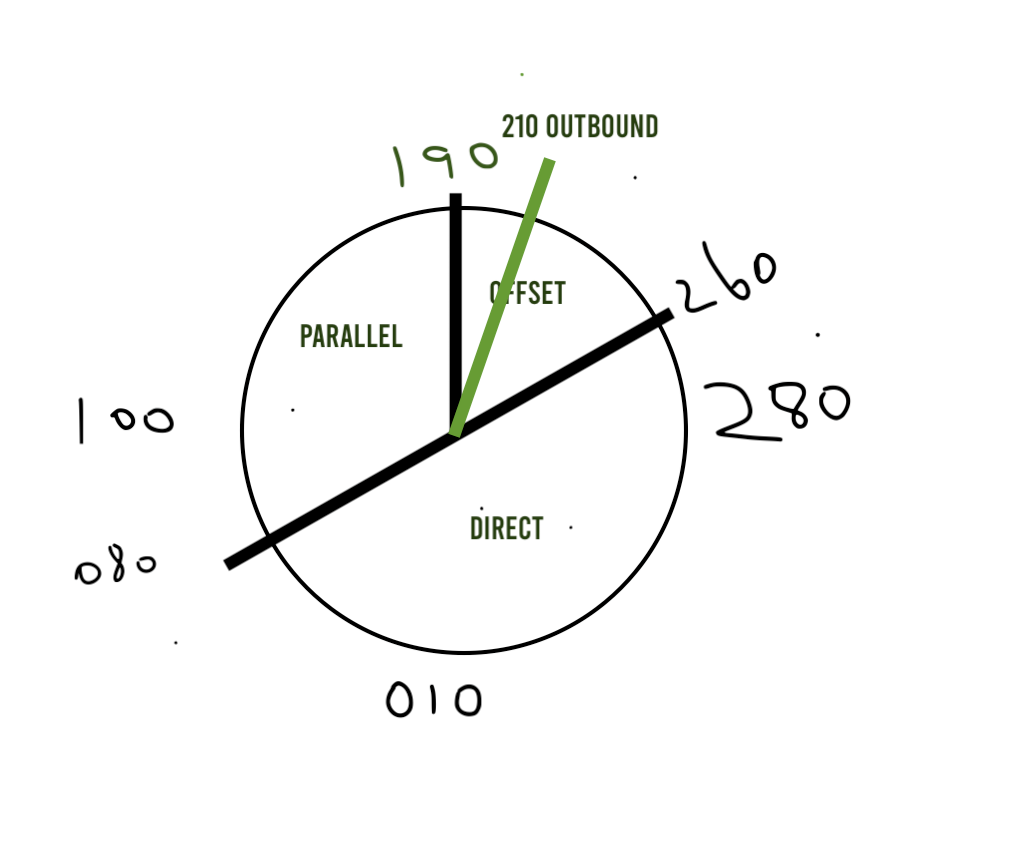
How to find the entry (Question)
For standard right hand holds:
You need:
our heading/track towards the fix
The OUTBOUND track.
E.g approach Heading 190°, outbound 210°
Draw a DI with approach heading at the top
Draw a line from the heading to the centre
90° to the right, then count back 20° (imagine covering with your thumb to move back 20°
draw line from that point to the reciprocal
name the sections POD. Small = O, Med = P , big = direct.
Draw in the OUTBOUND
This shows you it is in the offset section.
For left hand do the sane, but use left thumb on left side (so it will be +20 instead).
Flight Plan Letters
SS = distreSS
DD = DDurgency
FF = Flight Fafety
GG = meteoroloGGical / reGGularity
KK = ''kk just gimme a break with this admin stuff pls''
Independent Parallel Approach and Departures:
Approach min 30°
Departure 15°
NTZ is 610M
the min distance between two runway centre lines is 760m
Independent is better than dependents
Dependent Parallel Approach and Departures:
Departure is 30°
760m min runway
What Airspace is IFR Seperated from other IFR and VFR?
IFR is separated from other IFR in A to E and sometimes F.
IFR is separated from VFR: A to C
What Airspace is VFR Separated from other
VFR to VFR = B
VFR to IFR B & C
Airspace Speed Limits
A to C no limit
C+ 250kt below 10,000
What airspace has which AirTraffic Service?
A to D = ATC Service for all
E = IFR = ATC, VFR = Information
F = IFR = Advisory
Others - information
Security (security check, control, screening)
aircraft security check= check if the interior of the aircraft
security control = prevent
screening= detect
Longitudinal Seperation
depart at specificed time
arrive over a geographical location at specified time
hold over geographic location until a specified time
Transponder Code
2000 --> in the absence of ATS instructions
7000 --> when not receiving air traffic services
Flight Time:
The time from when an aircraft first moves for the purpose of taking off, until the moment it comes to rest and the end of flight.
But Tokyo also adds, from time doors are closed to when they are opened.
Main point it has nothing to do with the time being airborne.
Hijacked Aircraft Stand Position
Isolated , +100m
It is serious not severe
You can’t be serious
Cabin Pressure, before take of an on landing
Before take off, the cabin pressure is higher than ambient.
This means on landing, the cabin altitude will be lower than landing altitude (because the pressure is higher, so it is lower altitude)
Temp and Resistance: Conductor and Semi Conductors
Conductor (metal) (opposite of battery)
Temperature increases, resistances increases
why? think atoms moving about more making it difficult for electricity to find a path
Semi Conductor - the opposite (think same as battery)
temp increases, resistance decreases.
why? semi conductors have less atoms with free electrons to move, but when they are hot, they move about more, so electricity can move with them.
Sailplane rating:
30 hours PIC - 60 T/O and Landings in the relevent type. plane / TMG
a training course, with 10 instructional flights towing, with 5 dual instructions.
FF =
Flight Safety
Think flight fafety
SS = DistreSS
Urgency = DDurgency
Transition Altitude / Level - where are they published
Altitude is a fixed value, so it is on charts and AIP
Level is operational so published on ATIS.
Nationality Mark chosen from:
National Symbols allocated to state of registry, by the Telecoms Union!
Right of way
The aircraft that has the other on its right shall give way
You have right of way if you on the right, you have right of way
(if you see a green light, your right)
Wake Turbulence - Radar
RadAr = Distance
Super Heavy M
578 456 5
HML HML L
Airspace Table
SEP | SERVICE | |
A | ALL | ATC |
B | ALL | ATC |
C | I TO ALL, V TO I | ATC |
D | I TO I | ATC |
E | I TO I | I =ATC / V= FIS |
F | I TO I WHERE POS | I = ADV / V = FIS |
G | NONE | FIS |
OCH / OCA & relationship with PA and N-PA
OCH/A is the lowest height or altitude above X that obstacle clearance is provided.
For Precision Approaches, the datum for height is the threshold of that runway,
for Non-PA it is the airfield elevation
To get OCA from OCH
PA: OCH + Runway Threshold Elevation = OCA
NPA: OCH + Airfield elevation = OCA.
OR if the Runway is 7ft below the aerodrome, then OCH + RW Threshold.
Circling appoach is OCH + Aerodrome elevation = OCA.