Ideal Gas Laws Diagram
 Call Kai
 Learn
Learn Practice Test
 Spaced Repetition
 Match
Match Flashcards
 Knowt Play
1/36

There's no tags or description
Looks like no tags are added yet.
Name | Mastery | Learn | Test | Matching | Spaced | Call with Kai | Chat |
|---|
No analytics yet
Send a link to your students to track their progress
37 Terms
Units for gas pressure
atm, mm Hg, Torr, kPa

STP
Standard Temperature and Pressure

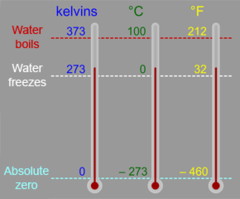
temperature unit for gases
Kelvin
Compressibility
the measure of how much a given volume of matter decreases when placed under pressure

Dalton's Law
The total pressure of a mixture of gases is the sum of the individual pressures

Boyle's Law
for a fixed amount of gas at constant temperature, the volume of the gas varies inversely with pressure

Charles' Law
for a fixed amount of gas at a constant pressure, the volume of the gas is directly proportional to the temperature

Gay-Lussac's Law
for a fixed amount of gas at constant volume, the pressure is directly proportional to the Kelvin temperature

Combined Gas Law
for a fixed amount of gas, the relationship between the pressure, volume, and temperature

Ideal Gas Law
the relationship between pressure, volume, moles and temperature of an ideal gas at a fixed set of conditions

ideal gas
a hypothetical gas that does not exist but its' characteristics fits all the assumptions of the kinetic-molecular theory

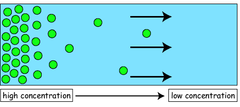
Diffusion
Movement of molecules from an area of higher concentration to an area of lower concentration.
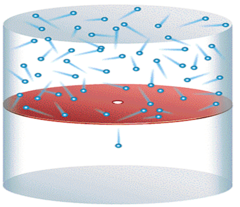
effusion
A process by which gas particles pass through a tiny opening
Kelvin
SI unit for temperature
atmosphere (atm)
a unit equal to the pressure exerted by a column of mercury 760 mm high
pressure
the force exerted by a gas on the inside surface area of it's container

Volume
measure of the volume of the container filled wth a gas

moles
the number of moles of gas particles

absolute zero
The coldest temperature, 0 Kelvin, that can be reached. It is the hypothetical temperature at which all molecular motion stops.

IMFs of Ideal Gases
we consider Ideal Gases to have NO Intermolecular Forces since the gas particles do not interact

elastic collision
objects bounce off one another, a collision in which no kinetic energy is lost or transferred

barometer
An instrument that measures atmospheric pressure

manometer
A device used to measure the pressure of a sample of gas in a container.

vacuum
A space where no particles of matter exist, has no particles and no pressure

Avogadro's Law
equal volumes of gases at the same temperature and pressure contain equal numbers of molecules

1 mole of any gas at STP
occupies 22.4 Liters of space

Density
Mass per unit volume

Graham's Law
the rate of diffusion of a gas is inversely proportional to the square root of its molar mass

Gas Stoichiometry
The method of predicting or analyzing the quantity of a gas involved in a chemical reaction

Ideal Gas Constant
relationship between pressure, volume, moles and temperature of an ideal gas

temperature
a measure of the average kinetic energy of all the particles of a substance

standard temperature
0 degrees Celsius or 273 Kelvin

standard pressure
101.3 kPa or 1 atm or 760 Torr or 760 mm Hg or 14.7 psi

Molar Mass equation of an Ideal Gas
MM = (dRT)/P

Real vs. Ideal Gases
*Real*
- gas particles have volume
- some attraction
*Ideal*
- volume of gas particles compared to distances is insignificant
- no attractions

ideal gas conditions
- high temperature
- low pressure
- particles size small compared to space in between particles
- interactions between particles are insignificant

Kinetic Molecular Theory
the theory that all matter is composed of particles (atoms and molecules) moving constantly in random directions
