MELC 10 Midterm ID
 Call Kai
 Learn
Learn Practice Test
 Spaced Repetition
 Match
Match Flashcards
 Knowt Play
1/31

There's no tags or description
Looks like no tags are added yet.
Name | Mastery | Learn | Test | Matching | Spaced | Call with Kai | Chat |
|---|
No analytics yet
Send a link to your students to track their progress
32 Terms

Lamassu: A mythical creature from ancient Mesopotamian mythology, depicted as having the body of a bull or lion, the wings of an eagle, and a human head. Lamassus were often placed at the entrances of palaces and temples as protective deities to warn off enemies.
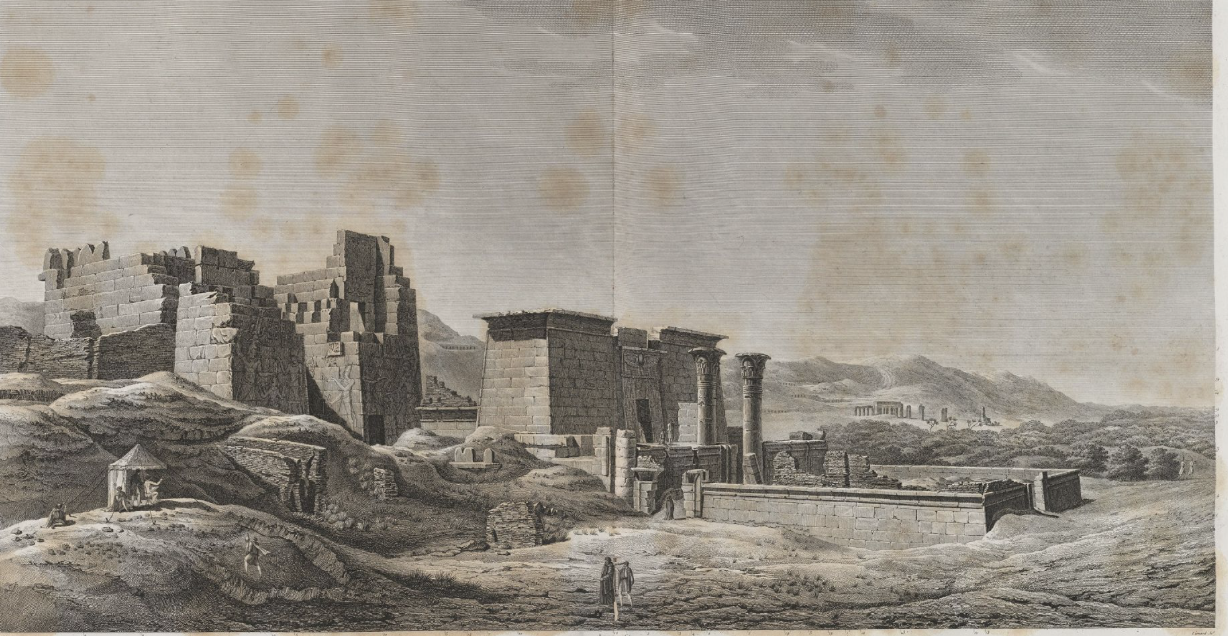
Description de L'Egypte: A comprehensive series of volumes documenting the history, culture, and geography of ancient Egypt, published in the early 19th century as part of Napoleon's Egyptian campaign (provides insight into Egyptians society)

Ubeidiya: Archaeologists found this campsite with stone tools. Stone tools were used to hit things hard, and hunt. Homo-erectus settled here and practiced being mobile hunter-gatherers, living in a lush, middle-eastern environment, filled with animals, wild plants, & abundance.

The “Incantation Against the toothache”: a dialogue story. It depicts a worm’s complaint to Ea, the god of creation, and his desire to infest teeth to find food. The incantation is important as evidence for Mesopotamian medial practices. This test illustrates how philology can be used to rediscover the ways account Sumerians understood disease.

The Seated Scribe: A famous 4,500-year-old ancient Egyptian painted limestone sculpture from the Old Kingdom. Pharaohs & high-ranking officials would have their servants depicted in an image or sculpture so that when they went to the afterlife they would be able to utilize their skills to help them in their second life. The scribes were some of the very few who knew how to read and write, and were highly regarded and well-paid (high intellect).

The Royal Standard of Ur: 4,500-year-old Sumerian artifact. The "War" Side displays a hierarchical narrative across three horizontal registers read from bottom to top. The "Peace" Side portrays a grand royal banquet and a celebration of economic prosperity. The contrasting panels symbolize the fundamental duties of an Early Dynastic Sumerian ruler: to wage successful military campaigns to protect and expand the state, and to manage civic order, religious ritual, and agricultural abundance.

Rosetta Stone: Composed in 196 BCE in honor of an old Egyptian leader, Ptolemy V. Found by the French in the town of Rosetta; it had been reused by the Egyptian army as a stone for building a fort. Written in 3 different scripts: hieroglyphs, demotic, & greek. Greek and Demotic was used to work backwards and decipher Egyptian hieroglyphs

Kadesh Relief of the Ramesseum: Despite walking into a massive Hittite ambush, Ramesses II used the Ramesseum reliefs to project an image of triumph. The carvings depict the pharaoh as a larger-than-life, divine warrior single-handedly turning the tide of battle when his troops abandoned him. Linked his military prowess with the gods. It reinforced his role as the protector of Ma'at (cosmic order) crushing foreign chaos

The Bulletin of Ramesses: Egyptian textual accounts documenting the famous Battle of Kadesh (1274 BCE) fought between Pharaoh Ramesses II and the Hittite Empire. The Bulletin was utilized as massive state propaganda. Ramesses II framed his survival and personal bravery in the face betrayal from Hittite spies as a divinely-sanctioned victory. This helped enforce his legitimacy and authority early in his reign.

Instruction of Ptahhotep: Ptahhotep, a high-ranking vizier and prime minister, wrote this as an ethical guide for his son, Akhethetep, who was designated to succeed him in office. The teachings are deeply anchored in Ma'at (the ancient Egyptian concept of cosmic truth, balance, justice, and social harmony)
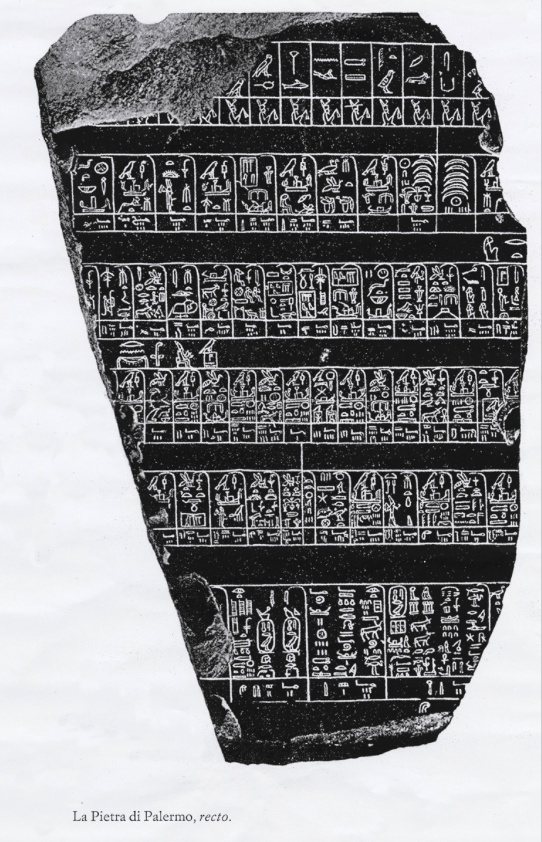
Palermo Stone: It preserves a year-by-year chronological account of Egyptian rulers alongside the events that occurred during their reign. Each square is telling you an event from the year of the king’s reign. It describes the depth of the Nile, which determines how fruitful the agricultural year will be. It lists early rulers of Lower Egypt (identified by the Red Crown) and mythical/god-like rulers.

Ramses III's Mortuary Complex: A temple Ramesses built for people to worship his essence. The temple walls feature extensive, vivid relief carvings and inscriptions detailing Ramesses III's military campaigns against foreign invaders. Integrated a ceremonial royal palace directly into the temple architecture. Built primarily to honor the god Amun.
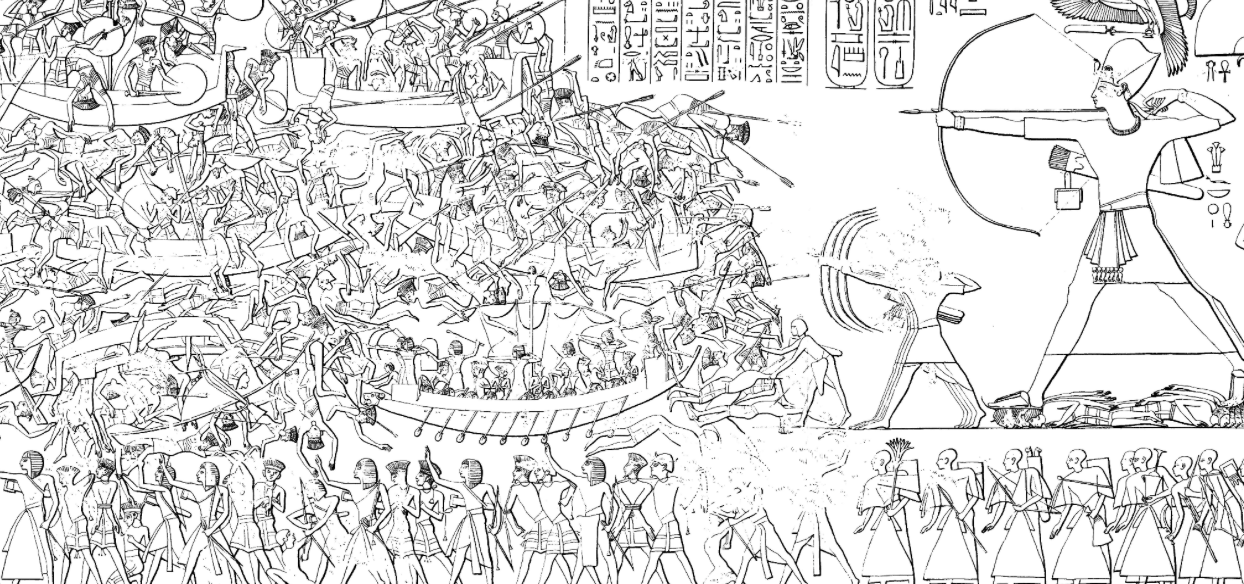
Sea Peoples Battle Wall Reliefs: Ramses went to battle w/ the sea people (foreigners trying to invade Egypt) Ramses is the largest. long boats of the sea people create horizontal registers; this is a maritime battle taking place on the nile.
Ramses III claimed he won and conquered/settled the sea people the pharaoh wanted to put this achievement on his Mortuary Temple because this was a major achievement in his career, and one of the ways he upheld the principles of ma’at
Biography of Pepynakht Heqaib

Cyrus Cylinder: Records the Persian conquest of Babylon by Cyrus the Great. Cyrus reports his good deeds in Babylon and emphasizes his power over kings & duty to the gods and cities (e.g. “...all kings who sit on thrones, from every quarter brought their weighty tribute [...] and kissed my feet [...] I collected together all of their people and returned them to their settlements…”)
presents him as a benevolent ruler chosen by the Babylonian god Marduk to bring peace and reverse the harsh policies of the previous king, Nabonidus (biased)

Til-Tuba Relief: It is an important piece of ancient Assyrian propaganda, documenting the battle between Assyrians vs. Elamite; this relief is inscribed inside the Ashurbanipal palace. The Assyrian king’s army humiliates the opposing army (+ severed heads of the Elam army and the Elam king). This relief is fragmented, with some fragments being lost.

Enuma Anu Enlil: this tablet has diary entries with the diagnosis of Venus’ disappearance and reappearance: the water springs will open, the Thunder God will bring rain (great for agriculture) ; the Water God’s floods will bring, kings will get along with each other w/ no war,... etc.
tells us how they thought about history & historical consciousness; for them, deities drive the direction of history

Sumerian Kings List: As it gets closer in time to the most recent king, the year gets quite accurate; doesn’t mean the Sumerians were bad at math, but thought of these kings are more "mythical" than real. It lists Sumerian cities, the kings that ruled there, and the lengths of their reigns.
Line 40: the flood that different middle eastern societies adopt is a key historical event to where the world "starts over”...
Teaching of King Amenemhat I: Amenhemhat I offers advice to his successor, Senwosret I, on how to be a successful leader. Letter instructs Senwosret I to be weary of everyone who might attempt to steal his throne
theme of the text: advice from father to the son after he’s been assassinated (from ‘beyond the grave’)
other passages describe priorities of the pharaoh in ritual, military, & charitable duties
a text was a way for the literate scribes of the court to understand the motivations of the Pharaoh
the text does the same manufactured consent function that the Narmer steele also does
Code of Hammurabi
A two-meter high black diorite stele w/ cuneiform inscription, treated as the oldest legal law code (although it isn't). Contains a prologue (typical royal propaganda) & epilogue describes how stele was to be used. Code presents an idealized view of Babylonian social structure; this is a royal investiture scene: when the gods (Shamash) turn an ordinary person (Hammurabi) into a king and gives them the right to be a king
Rod & the Ring: a symbol of justice in Ancient Mesopotamia; being handed the right to govern, rule, enforce laws, etc.

Ur-Nanshe Plaque
Sumerian plaque displays the king as a builder
a circle in the center used to attach to a wall it was meant to be displayed in the very building they are building
Prominent figures are kings; chairs were a privilege to sit on due to scarcity of resources
kings are very proud of their building activities b/c it is a gift to the gods, a spectacle to the people, and shows his legitimacy, capacity, and ability to oversee materials

Narmer Palette: An Egyptian relief; major theme is the unification of lower and upper Egypt (white and red crown from left and right side respectively). It shows King farmer performing a smiting scene of his enemies, as witnessed by Horus the Falcon (divine protector of the pharaoh) and a sandal-bearer.
shows the legitimacy of Narmer’s role as a king and his ma’at.
Palette possibly used to grind minerals for eye makeup for scared statues + priests (circle center on the right)

Ashurnasirpal II's Palace: The Assyrian capital (ancient Mesopotamia). Shows the distinction between private and public spaces. Contains storage rooms (more to the right) and a treasury room that close access to the king (room 75). A throne room (room B); amount of entrances/exits matter.

Apadana Staircase of Persepolis: The shallow stairs force the individual to inch and process slowly towards the king, who stands on a more wider space (the king has more controls). Reliefs of the nation’s many state delegates/elites (Satrapals) show them as voluntary or orderly participants in a unified imperial system based on mutual order.

Behistun Relief and Inscription: a mountain relief displaying the victory of Darius the Great; displays three different types of cuneiform — Babylonian (Akkadian), old Persian, & Elamite.
the king is the largest figure
the figures are reaching their arms up; the prisoners are stuck in place by rope, whereas the king is showing his power over who he defeated
It is extremely similar to Naram-Sin; a king physically overpowers enemies

Ishtar Gate: It was built in 575 BCE by Babylonian emperors, 50 feet high & 45 feet deep foundation
composed of mudbrick (baked bricks) core + wrapped w/ glazed mudbricks (early form of glazing/glass production)
animals representing Babylonian deities composed in low-relief using glazed brick; they were multi-beast representing a Babylonian deity.
When the sun would hit the blue bricks, it would be blinding/almost glowing

Uruk Vase: alabaster , 1 meter tall. Is early evidence of religious worship and offerings in Ancient Mesopotamia.
It is found inside the Temple of Imana, the patron goddess of Uruk
The vase divided into four distinct registers each w/ a relief scene; vase should be ‘read’ from bottom to top
Gifts of food are presented from Patron Uruk King to Ianna Priest
→ The Uruk vase tells us that the urban society of Uruk (and Sumerian society) prioritizes priests (who had much more control over the population; able to command wealth to enter the Ziggurat & the temple)
humans bring good (food=wealth) to the temple

Cylinder seal: A part of Mesopotamian bureaucracy was being able to certify the contents/authority of the materials
Seal impressions emerged (rolling a stone on the left-hand side, with a reversed stamp) to make an impression to sign your name in ancient Mesopotamia
cylinder seals acted as "signatures" communicating authority

Beveled rim bowl: A standard volume for solid and liquid payments all across southern Mesopotamia; the capacity is strikingly similar to each bevel bowl found. This bowl becomes the Sumerian symbol/sign for ‘food ration’
Thousands of bowls found in sumerian settlement
volume varied from .5 to 1.5
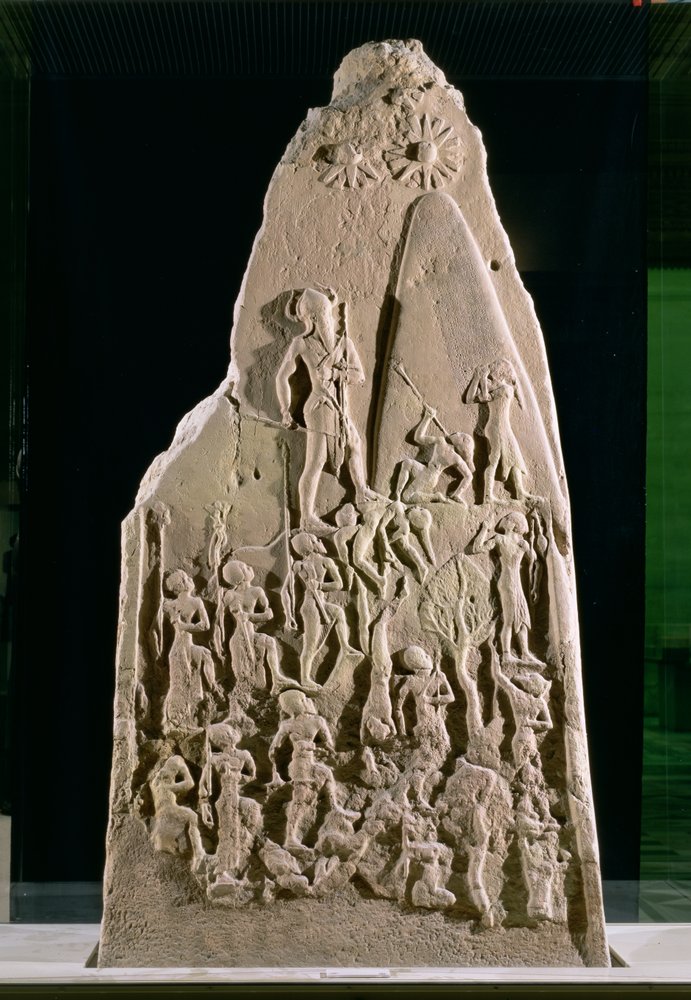
Victory stele of Naram-Sin: (MESOPOTAMIAN) A Two-meter high stone monument created in c. 2260 BCE. It records the victory over King Satuni of the Lullubi tribe in western Iran
the stone itself is signalling to viewers that this is a mountain; the shape of the stone itself is a spectacle
the stone used for this object is from where the event actually happened
encountering this would convey that the king is a warrior
Naram-Sin is depicted wearing a horned helmet, an emblem previously reserved strictly for the gods, marking the first time an Akkadian ruler claimed living divinity and styled himself as an Akkadian God.
Autobiography of Pepynakht Heqaib: