FA-R-P-P2

0.0(0)
Studied by 0 people
call kaiCall Kai
learnLearn
examPractice Test
spaced repetitionSpaced Repetition
heart puzzleMatch
flashcardsFlashcards
GameKnowt Play
Card Sorting

1/354

encourage image

There's no tags or description

Looks like no tags are added yet.

355 Terms

1
New cards
What is the most common mechanism of genitourinary trauma?
Blunt trauma, eg, motor vehicle collision
2
New cards
Renal injury - Typical presentation
Bruising + flank pain + hematuria
3
New cards
What commonly causes renal injury in blunt trauma?
Direct blows or lower rib fractures
4
New cards
Bladder injury - Typical presentation
  • Hematuria

  • Suprapubic pain

  • Difficulty voiding


<ul><li><p>Hematuria</p></li><li><p>Suprapubic pain</p></li><li><p>Difficulty voiding</p></li></ul><p></p>
5
New cards
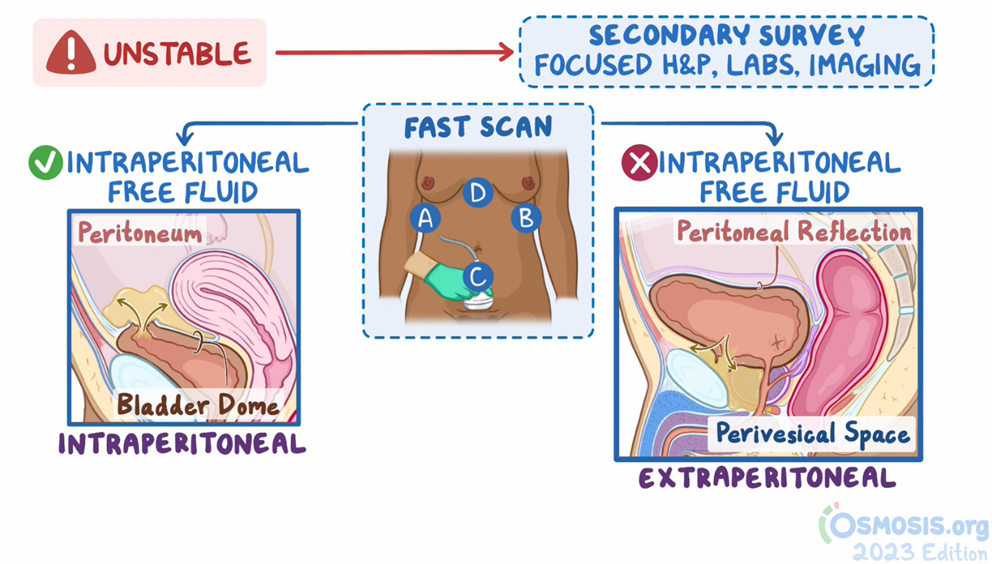
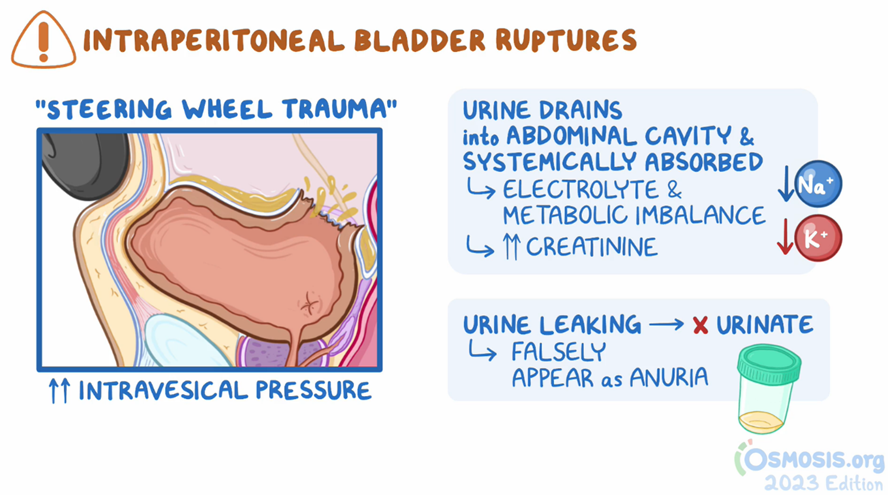
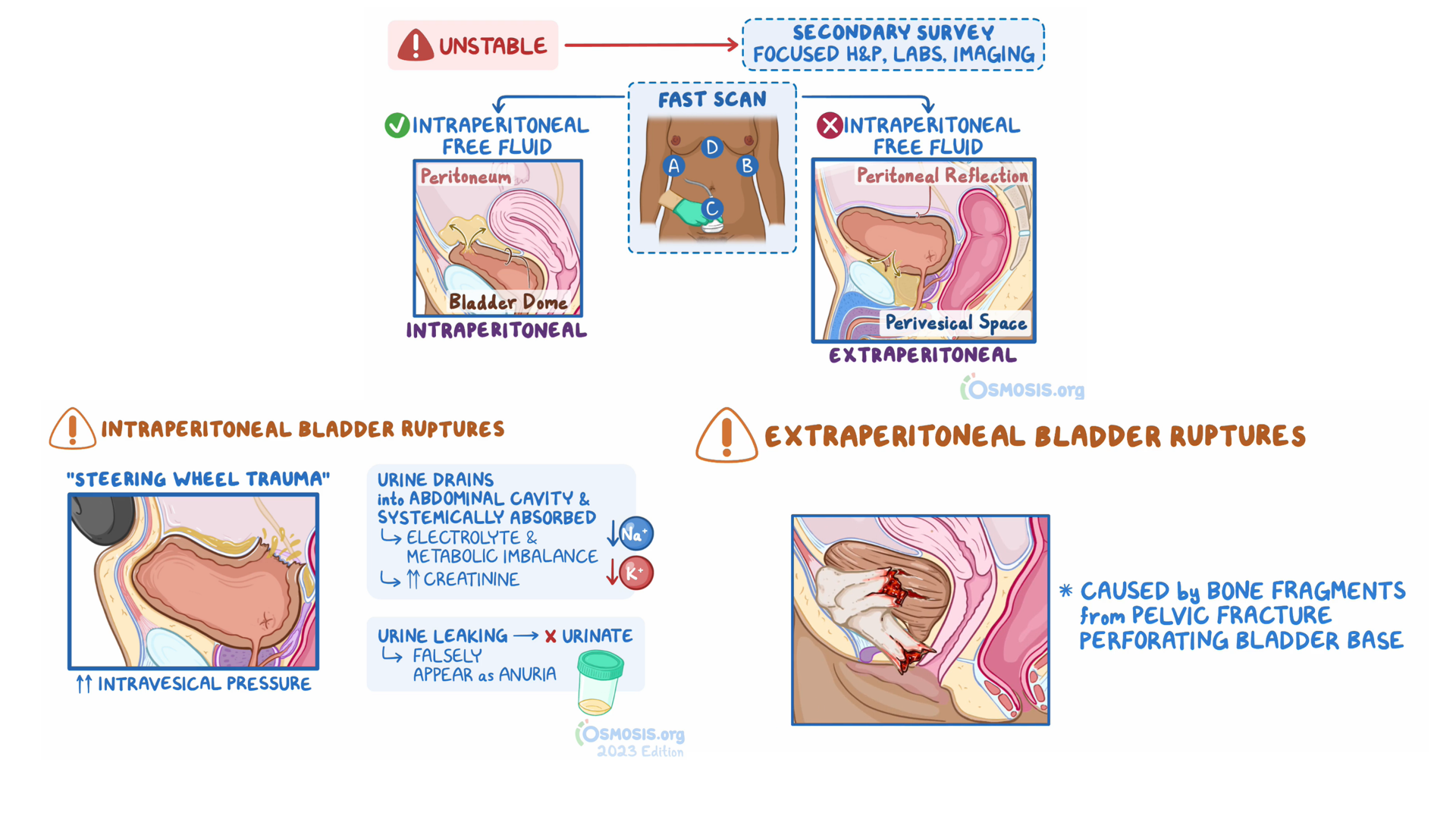
How does an intraperitoneal bladder rupture usually occur?
Direct trauma to a full bladder → abrupt ↑ intravesical pressure → rupture of the weakest part, usually the bladder dome
6
New cards
Where does urine accumulate after intraperitoneal bladder rupture?
Peritoneal cavity
Peritoneal cavity
7
New cards
Why can intraperitoneal bladder rupture cause ↑ BUN and creatinine?
Urinary solutes are reabsorbed across the peritoneum → ↑ BUN + creatinine
8
New cards
How does an extraperitoneal bladder rupture usually occur?
Pelvic fracture → bony spicules injure anterior bladder wall or bladder neck → extraperitoneal urine leakage into the retropubic space
9
New cards
A patient with a pelvic fracture develops hematuria and difficulty voiding. Urine is confined to the retropubic space. What injury is most likely?
Extraperitoneal bladder rupture
10
New cards
Intraperitoneal vs extraperitoneal bladder rupture - Key discriminator
Intraperitoneal → dome rupture, usually trauma to full bladder, urine in peritoneal cavity<br>Extraperitoneal → pelvic fracture, anterior wall/neck injury, urine in retropubic space
11
New cards
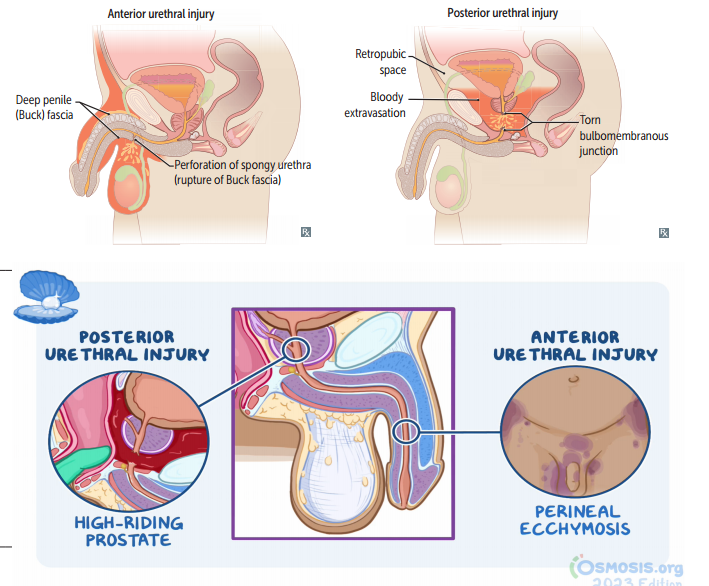
Urethral injury - Typical presentation
Blood at urethral meatus<br>Hematuria<br>Difficulty voiding
12
New cards
What should be avoided or used cautiously when urethral injury is suspected?
Urethral catheterization is relatively contraindicated
13
New cards
Anterior urethral injury - Typical mechanism
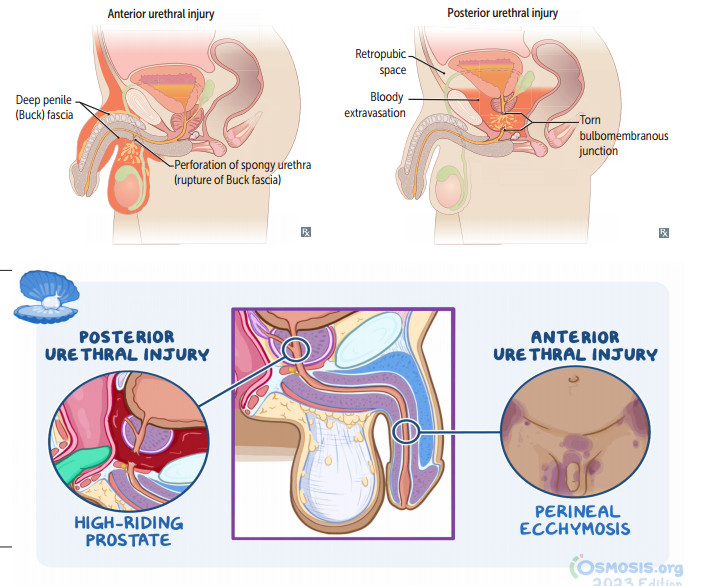
Perineal straddle injury → disruption of bulbar (spongy) urethra
14
New cards
What finding is classically associated with anterior urethral injury?
Scrotal hematoma
Scrotal hematoma
15
New cards
Where can urine collect if Buck fascia is torn in an anterior urethral injury?
Perineal space
Perineal space
16
New cards
Posterior urethral injury - Typical mechanism
Pelvic fracture → disruption at the bulbomembranous junction
17
New cards
What findings suggest posterior urethral injury?
Urine leakage into retropubic space + high-riding prostate
18
New cards
A male patient falls astride a hard object and develops blood at the urethral meatus with a scrotal hematoma. What is the most likely injury?
Anterior urethral injury
19
New cards
A male patient has a pelvic fracture after an MVC. He has blood at the urethral meatus, difficulty voiding, and a high-riding prostate. What is the most likely injury?
Posterior urethral injury
20
New cards
Anterior vs posterior urethral injury - Key discriminator

Anterior → straddle injury, bulbar urethra, scrotal hematoma
Posterior → pelvic fracture, bulbomembranous junction, high-riding prostate + retropubic urine

<p><strong><u>Anterior </u></strong>→ straddle injury, bulbar urethra, scrotal hematoma<br><strong><u>Posterior </u></strong>→ pelvic fracture, bulbomembranous junction, high-riding prostate + retropubic urine</p>
21
New cards
What is mittelschmerz?
Mid-cycle pain associated with ovulation ("middle hurts")
22
New cards
What causes mittelschmerz?
Follicular rupture during ovulation → small amount of normal bleeding → peritoneal irritation → pain
23
New cards
What is the typical character of mittelschmerz pain?
Usually mild + unilateral
24
New cards
When in the menstrual cycle does mittelschmerz occur?
Around ovulation
25
New cards
Why can mittelschmerz mimic acute appendicitis?
Ovulatory follicular rupture can cause unilateral lower abdominal pain from peritoneal irritation, which may resemble appendicitis
26
New cards
A patient presents with sudden mild unilateral lower abdominal pain around the middle of her menstrual cycle. She is afebrile and otherwise well. What is the most likely diagnosis?
Mittelschmerz
27
New cards
A patient has right-sided lower abdominal pain. What finding would favor mittelschmerz over appendicitis?
Pain occurring around ovulation with mild/self-limited symptoms and no systemic inflammatory features
28
New cards
What is abnormal uterine bleeding (AUB)?
Deviation from normal menstruation in volume, duration, frequency, regularity, or intermenstrual bleeding
29
New cards

What are the causes of Intrauterine bleeding?

Structural:

  • P = Polyp

  • A = Adenomyosis

  • L = Leiomyoma

  • M = Malignancy/hyperplasia

Non-structural:

  • C = Coagulopathy

  • O = Ovulatory

  • E = Endometrial

  • I = Iatrogenic

  • N = Not yet classified

PALM-COEIN

30
New cards

What are the structural causes of Abdominal Uterine Bleeding

  • P = Polyp

  • A = Adenomyosis

  • L = Leiomyoma

  • M = Malignancy/hyperplasia


31
New cards

What are the non-structural causes of Abnormal Uterine Bleeding?

  • C = Coagulopathy

  • O = Ovulatory

  • E = Endometrial

  • I = Iatrogenic

  • N = Not yet classified


32
New cards
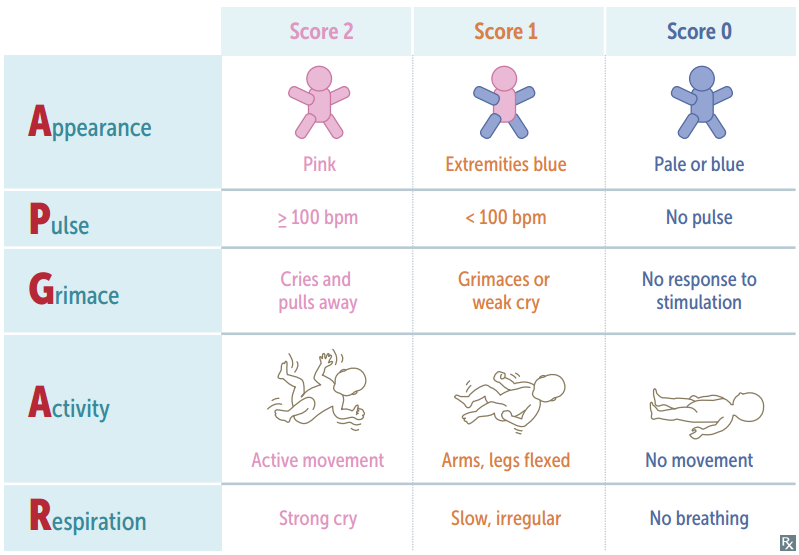
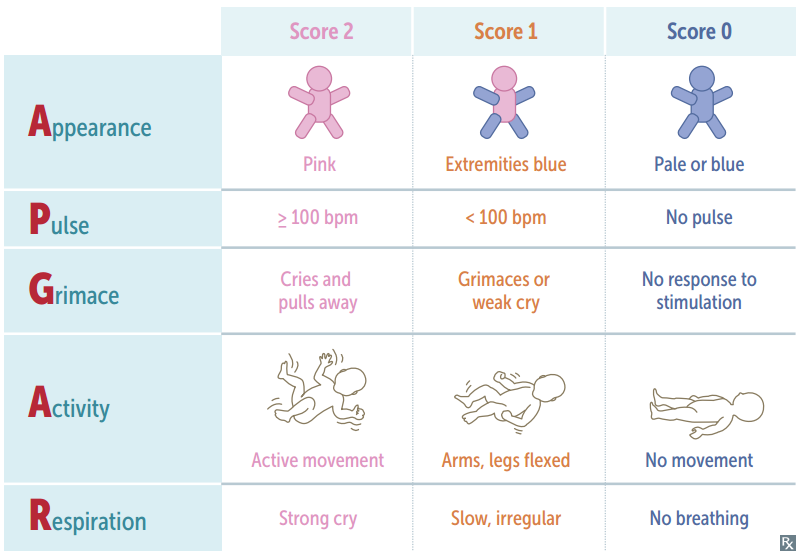
What does APGAR stand for?
  • Appearance

  • Pulse

  • Grimace

  • Activity

  • Respiration


<ul><li><p>Appearance</p></li><li><p>Pulse</p></li><li><p>Grimace</p></li><li><p>Activity</p></li><li><p>Respiration</p></li></ul><p></p>
33
New cards

When is the APGAR score routinely assessed?

At 1 minute and 5 minutes after delivery
34
New cards

What is the maximum APGAR score?

10 points (5 categories × maximum 2 points each)
35
New cards
Apgar - Appearance scoring
2 = pink<br>1 = pink body with blue extremities<br>0 = pale or blue
36
New cards
Apgar - Pulse scoring
2 = ≥100 bpm<br>1 = <100 bpm<br>0 = absent pulse
37
New cards
Apgar - Grimace scoring
2 = cries/pulls away with stimulation<br>1 = grimace or weak cry<br>0 = no response to stimulation
38
New cards
Apgar - Activity scoring
2 = active movement<br>1 = some flexion of arms/legs<br>0 = no movement
39
New cards
Apgar - Respiration scoring
2 = strong cry<br>1 = slow/irregular respiration<br>0 = no breathing
40
New cards
What does an Apgar score <7 suggest?
The newborn may require further evaluation/intervention
41
New cards
Why is a persistently low Apgar score at later time points concerning?
Persistent physiologic compromise → ↑ risk of long-term neurologic damage
42
New cards
A newborn is pink, has a pulse of 120/min, cries with stimulation, actively moves all extremities, and has a strong cry. What is the Apgar score?
10
10
43
New cards
A newborn has a pink trunk with blue extremities, HR 80/min, grimaces to stimulation, has some limb flexion, and slow irregular breathing. What is the Apgar score?
5
5
44
New cards
A newborn is pale, has no detectable pulse, shows no response to stimulation, has no spontaneous movement, and is apneic. What is the Apgar score?
0
0
45
New cards
How is menopause diagnosed?
Amenorrhea for 12 months
46
New cards
What causes menopause physiologically?
Age-related depletion of ovarian follicles → ↓ ovarian estrogen production
47
New cards
What is the average age of menopause?
~51 years
48
New cards
How does smoking affect the timing of menopause?
Smoking is associated with earlier menopause
49
New cards
What menstrual pattern commonly precedes menopause?
~4–5 years of increasingly abnormal/irregular menstrual cycles
50
New cards
What is the hormonal pattern in menopause?
  • ↓ Estrogen

  • ↑↑ FSH

  • ↑ LH (no surge)

  • ↑ GnRH


51
New cards
Which gonadotropin rises more prominently in menopause?
FSH
52
New cards
Why is there no LH surge in menopause despite ↑ LH?
Loss of normal cyclic ovarian estrogen production → no sustained high-estrogen positive feedback → no midcycle LH surge
53
New cards
What becomes the main source of estrogen after menopause?
Peripheral conversion of androgens → estrone
54
New cards
Why can hirsutism become more noticeable after menopause?
↓ Estrogen + relatively greater androgen effect → ↑ relative androgenicity → hirsutism
55
New cards
What are the major clinical consequences of menopause?
  • Hot flashes

  • Atrophy of the Vagina

  • Osteoporosis

  • ↑ Coronary artery disease risk
    Sleep disturbances


56
New cards
What is the most common symptom of menopause?
Hot flashes
57
New cards
Why does menopause increase osteoporosis risk?
↓ Estrogen → ↑ osteoclast activity → ↑ bone resorption → osteoporosis
58
New cards
A 53-year-old woman has had no menstrual periods for 13 months and reports hot flashes and vaginal dryness. Labs show markedly ↑ FSH and ↑ LH. What is the most likely diagnosis?
Menopause
59
New cards
A woman with amenorrhea has ↑↑ FSH, ↑ LH, and ↓ estrogen. What finding would favor menopause/ovarian failure over hypothalamic or pituitary dysfunction?
Markedly elevated FSH/LH due to loss of ovarian negative feedback
60
New cards
What is hormone replacement therapy used for in menopause?
Treatment of menopausal symptoms
61
New cards
What major risks are associated with hormone replacement therapy?
  • ↑ Breast cancer risk

  • ↑ Endometrial cancer risk

  • ↑ CVD

  • ↑ Stroke

  • ↑ Thromboembolism


62
New cards
What does menopause before age 40 suggest?
Primary ovarian insufficiency (premature ovarian failure)
63
New cards
What exposures can cause primary ovarian insufficiency?
Chemotherapy and/or radiation therapy
64
New cards
A 36-year-old woman develops amenorrhea and vasomotor symptoms after chemotherapy. What diagnosis should be suspected?
Primary ovarian insufficiency
65
New cards
Anabolic-androgenic steroid use - Major effects
  • ↑ Fat-free mass

  • ↑ Muscle strength

  • ↑ Performance


66
New cards
What behavioral/physical findings should make you suspect anabolic-androgenic steroid use in a male?
  • Aggression or other behavioral change

  • Acne

  • Gynecomastia

  • Erythrocytosis

  • Small testes


67
New cards
Why can anabolic-androgenic steroid use cause small testes and infertility?

Exogenous testosterone → HPG axis suppression → ↓ intratesticular testosterone → ↓ testicular size + ↓ sperm count → azoospermia

68
New cards
Why can anabolic-androgenic steroid use cause gynecomastia?
Exogenous androgens can be aromatized to estrogen → relative estrogen effect on breast tissue → gynecomastia
69
New cards
Why does erythrocytosis from anabolic steroid use matter clinically?
↑ Blood viscosity → ↑ thromboembolism risk
70
New cards
Anabolic-androgenic steroid use - Reproductive effects in males
Hypothalamic-pituitary-gonadal axis suppression<br>↓ Intratesticular testosterone<br>↓ Testicular size<br>↓ Sperm count<br>Azoospermia
71
New cards
Anabolic-androgenic steroid use - Effects in females
Virilization with hirsutism, acne, breast atrophy, and androgenetic alopecia
72
New cards
A male athlete has azoospermia and testicular atrophy despite high circulating androgen exposure. What mechanism best explains this?
Exogenous testosterone suppresses GnRH/LH/FSH → ↓ intratesticular testosterone → impaired spermatogenesis
73
New cards

A woman develops hirsutism, acne, breast atrophy, and alopecia what do you suspect

Anabolic-androgenic steroid use
74
New cards

Tanner Staging

knowt flashcard image
75
New cards
What is precocious puberty?

Appearance of early 2° sexual characteristics:

  • < age 8 in females

  • < age 9 in males


76
New cards
What are the major consequences of excess sex hormone exposure in precocious puberty?

↑ Linear growth + ↑ somatic/skeletal maturation → premature epiphyseal closure → short adult stature

77
New cards
Why can precocious puberty ultimately cause short stature despite rapid early growth?
↑ Sex hormones → accelerated bone maturation → premature epiphyseal closure → early growth spurt but reduced final height
78
New cards
What is central precocious puberty?
GnRH-dependent precocious puberty due to ↑ GnRH secretion and early activation of the hypothalamic-pituitary-gonadal axis
79
New cards
What is the most common cause of central precocious puberty?
Idiopathic early activation of the hypothalamic-pituitary-gonadal axis
80
New cards
What pathologic process can cause central precocious puberty?
CNS tumors
81
New cards
What is peripheral precocious puberty?
GnRH-independent precocious puberty due to ↑ sex hormone production or exogenous sex steroid exposure
82
New cards
What are causes of peripheral precocious puberty?
  • Congenital adrenal hyperplasia

  • Estrogen-secreting ovarian tumor (eg, granulosa cell tumor)

  • Leydig cell tumor

  • McCune-Albright syndrome

  • Exogenous sex steroids


83
New cards
A 7-year-old girl develops breast budding and pubic hair with accelerated linear growth and advanced bone age. What diagnosis should be considered?
Precocious puberty
84
New cards
Central vs peripheral precocious puberty - Key distinction
  • Central → GnRH-dependent, early HPG-axis activation

  • Peripheral → GnRH-independent, excess sex hormones from another source


85
New cards
What is delayed puberty?
Absence of 2° sexual characteristics by age 13 in females or age 14 in males
86
New cards
What is hypergonadotropic hypogonadism?
Primary gonadal failure → ↓ sex hormone production → loss of negative feedback → ↑ FSH/LH
87
New cards
What are causes of hypergonadotropic hypogonadism in delayed puberty?
  • Klinefelter syndrome

  • Turner syndrome

  • Gonadal injury (eg, chemotherapy, radiotherapy, infection)


88
New cards
What is hypogonadotropic hypogonadism?
Secondary hypogonadism due to hypothalamic/pituitary dysfunction → ↓ GnRH and/or gonadotropins → ↓ sex hormone production
89
New cards
What are causes of hypogonadotropic hypogonadism in delayed puberty?
  • Constitutional delay of growth and puberty ("late blooming")

  • Kallmann syndrome

  • CNS lesions


90
New cards
Why are gonadotropins high in primary hypogonadism?
Gonadal failure → ↓ sex hormones → ↓ negative feedback on pituitary/hypothalamus → ↑ FSH/LH
91
New cards
Why are gonadotropins low in secondary hypogonadism?
Hypothalamic/pituitary dysfunction → ↓ GnRH/FSH/LH → ↓ gonadal stimulation
92
New cards
A 14-year-old girl has no breast development. Labs show low estrogen with markedly elevated FSH and LH. What broad mechanism is most likely?
Hypergonadotropic (primary) hypogonadism
93
New cards
A 15-year-old boy has no pubertal development. Testosterone, LH, and FSH are all low. What broad mechanism is most likely?
Hypogonadotropic (secondary) hypogonadism
94
New cards
Delayed puberty with ↑ FSH/LH vs ↓ FSH/LH - What does each suggest?
↑ FSH/LH → primary gonadal failure<br>↓ FSH/LH → hypothalamic/pituitary dysfunction
95
New cards
What is the karyotype in Klinefelter syndrome?
47,XXY male
96
New cards

Klinefelter syndrome - Gonadal pathology

  • Dysgenesis of seminiferous tubules → ↓ inhibin B → ↑ FSH

  • Abnormal Leydig cell function → ↓ testosterone → ↑ LH


97
New cards

Why are FSH and LH elevated in Klinefelter syndrome?

  • Seminiferous tubule dysfunction → ↓ inhibin B → ↑ FSH

  • ↓ Testosterone from Leydig dysfunction → loss of negative feedback → ↑ LH


98
New cards

Klinefelter syndrome - Classic physical findings

  • Tall stature with eunuchoid proportions

  • Small, firm testes

  • Gynecomastia

  • Female-pattern hair distribution


99
New cards

Why are patients with Klinefelter syndrome tall with eunuchoid proportions?

↓ Testosterone → delayed epiphyseal closure → ↑ long-bone growth

100
New cards
Why does Klinefelter syndrome cause infertility?
Seminiferous tubule dysgenesis → impaired spermatogenesis → azoospermia