MATH 2371 Level Curves (Image to Function)
 Call Kai
 Learn
 Practice Test
 Spaced Repetition
 Match
 Flashcards
 Knowt Play
1/17

Earn XP
Description and Tags
11.1 Functions of Several Variables (Level Curves) - Graphs & Contour Maps
18 Terms

z = sin(xy). This function is periodic in both x and y, and the function is the same when x is interchanged with y, so its graph is symmetric about the plane y = x. In addition, the function is zero along the x- and y-axes.
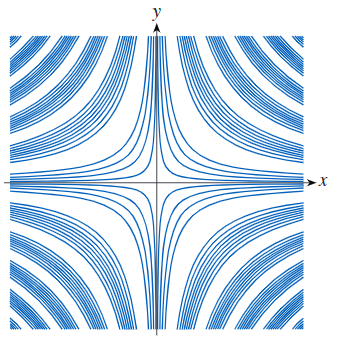
z = sin(xy). This function is periodic in both x and y, and the function is the same when x is interchanged with y, so its graph is symmetric about the plane y = x. In addition, the function is zero along the x- and y-axes.

z = sin(x-y). This function is periodic in both x and y but is constant along the lines y = x + k.

z = sin(x-y). This function is periodic in both x and y but is constant along the lines y = x + k.

z = (1-x²)(1-y²). This function is zero along the lines x = ±1 and y = ±1. Also note that the trace in the xz-plane is the parabola z = 1-x² and the trace in the yz-plane is the parabola z = 1-y².

z = (1-x²)(1-y²). This function is zero along the lines x = ±1 and y = ±1. Also note that the trace in the xz-plane is the parabola z = 1-x² and the trace in the yz-plane is the parabola z = 1-y².
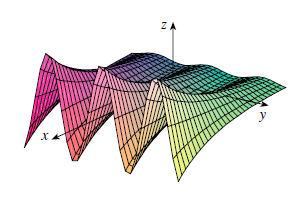
z = excosy. The graph is cyclical, exponential when y = k, and symmetric about the x-axis.

z = excosy. The graph is cyclical, exponential when y = k, and symmetric about the x-axis.
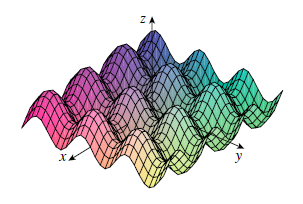
z = sinx - siny. When y=x, there are peaks or valleys. The graph is cyclical.

z = sinx - siny. When y=x, there are peaks or valleys. The graph is cyclical.

z = (x-y) / (1+x2+y2). When y=x, z is constant.

z = (x-y) / (1+x2+y2). When y=x, z is constant.

z = (y-2x)²

z = (y-2x)²

z = yex

z = yex

z = sqrt(y²-x²)
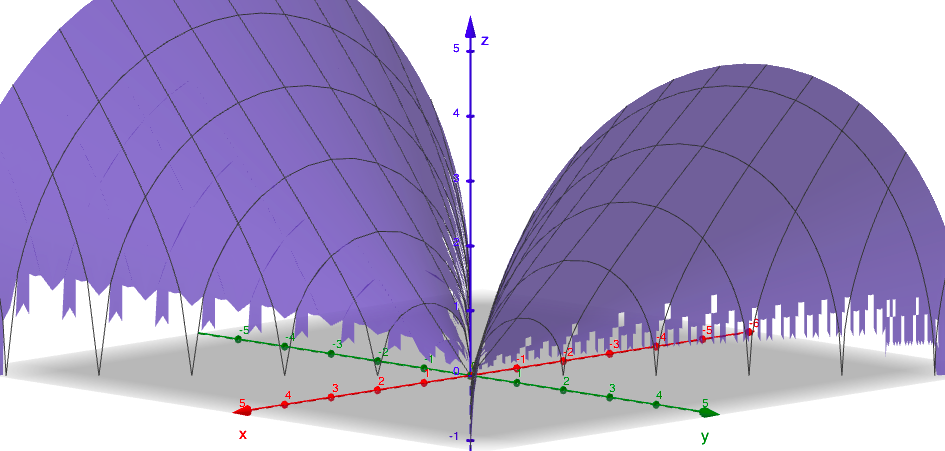
z = sqrt(y²-x²)