Animal Parasitology lecture exam
 Call Kai
 Learn
 Practice Test
 Spaced Repetition
 Match
 Flashcards
 Knowt Play
1/69

There's no tags or description
Looks like no tags are added yet.
Name | Mastery | Learn | Test | Matching | Spaced | Call with Kai | Chat |
|---|
No analytics yet
Send a link to your students to track their progress
70 Terms
What is the definition of parasitology and why is it so hard to agree on a definition?
a close association between 2 organisms, in which a parasite depends on a host that provides some benefit to it
What is intensity dependent pathology? Can you give examples that follow this principle?
intensity dependent pathology is when the severity of a disease in a host increases when parasite burden rises
What are Micro and Macroparasites? What are the similarities and differences? What are some examples of each?

How the terms Disease, Morbidly and Morality related? What is virulence?
§Mortality – “Death” possible consequence of parasite infection
§Morbidity – “Disease” reduction in the host’s fitness as measured in growth or reproductive output Loss of blood Destruction of tissues Competition for resources Costs may be related to defense rather than the pathogen Immune system
§Virulence refers to the likelihood that an infectious agent causes disease or even fatality or The ability of a parasite to reduce its host’s fitness.
How does parasitism represent a consumer-resource interaction? How is it a symbiosis? What does it have in common with Predation and What differs?
parasite acts as the consumer while host is the living resource. it is symbiosis because it is a long term interaction between two organisms. The similarity between both are harmful relationships and there is a predator and a prey. the differences are predation is usually always lethal and a short term interaction. Parasitism is not usually lethal and it is a very long term interaction.
How do micropredators compare to parasites and why do we study them in parasitology?
§Mosquitoes, along with several other blood-feeding arthropods, which are sometimes classified as micropredators, are of course also relevant for parasitology because of the role they play in vectoring other organisms that are unequivocally parasitic.
§Necessary interactions with a “host”
§Continuum from fleeting contact to permanent parasite
§Because organisms such as mosquitoes and bed bugs exhibit specialized behaviors for locating a host and have to overcome the behavioral and chemical defenses of the host if they are to succeed, it is difficult to exclude them from the realm of parasites.
terms for obligatory parasite, permanent parasite, Temporary or Intermittent parasite, facultative parasite, ectoparasite, endoparasite, extracellular parasite, intracellular parasite
OP: must spend at least part of its life-cycle as a parasite
PP: spends all of its life in or on host, except during transfers
Temporary or Intermittent parasite: mostly free living, can be a parasite
FP: Dont need a host
ectoparasite: outside of host
endoparasite: inside host
extracellular: Intestinal dwelling
intracellular: inside of cells
defs for hermaphroditism, Parthenogenesis, asexual reproduction, protolean parasite, phorsey, kleptoparasite, social parasire, nest/brood parasite
Hermaphroditism: 1 individual has fully functioning male and female organs
Parthenogenesis: Females are able to produce offspring without mating
Asexual reproduction: An individual reproduces by budding or spores in which there is no recombination of genes on the chromosomes
Protolean parasite: which refers to an organism that is parasitic when immature but free-living as an adult.
phorsey: organism attaches itself to a host purely for travel
Kleptoparasite steals or scrounges food or other resources obtained by another organism. In all of these associations, an organism customarily identified as a parasite clearly benefits at the expense of a host, and there are often intricate and specialized behaviors or anatomical structures that facilitate the interaction.
Social Parasite: invade or lay their eggs in the nest of a host organism and develop on food provided in that nest Social parasites take advantage of interspecific interactions between members of social animals such as ants, termites, and bumblebees.
nest/brood parasite: Organisms that rely on others to raise their young.
defs for cleaners, hyperparasite, vector, mechanical vector, biological vector, commensal, mutualist
cleaners: infested hosts (clients) are relieved of a portion of their burden of ectoparasites by specialized cleaners, which clearly benefit by securing a novel source of nutrition, cleaners may also feed from the client
hyperparasite: a parasite whos host is also a parasite
vector: any means by which a parasite can be transmitted, whether it is wind, water, or some kind of organism
mech vector: an organism that transports a pathogen passively without pathogen development or reproduction happening in the vector
biological vector: an organism that transports a pathogen after the pathogen develops or multiplies within the vector
commensal: relationship where one organism gains and the other is unaffected
mutualism: both organisms benefit
defs for paratenic host, intermediate host, definitive host, reservoir host
paratenic host: not a necessary host that can harbor a parasite without allowing them to multiply, a transport host
IH: organism that harbors the juvenile stages of a parasite, serving for asexual reproduction
DH: Organism that harbors the adult stage of a parasite, where sexual reproduction occurs
RH: the host in which a parasite normally dwells and where it can be reliably maintained, even when not being actively transmitted, and from which it can then coolonize other hosts.
defs for monoxenous direct life cycle and heteroxenous indirect life cycle
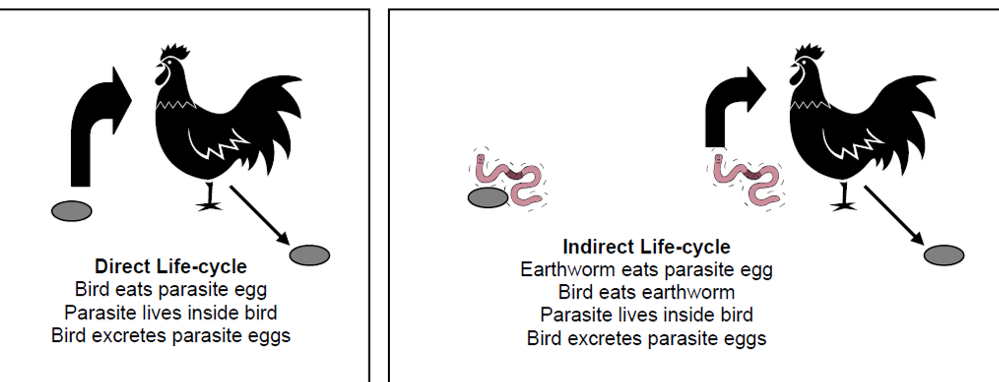
· What is the biological species concept and how can this apply or not to parasites?
BSC: a species is members of populations that can or are currently interbreeding and have viable offspring. This can apply to some parasites that only reproduce sexually, but there are parasites that reproduce asexually that are parasites it does not fully work.
· What is the evolutionary species concept and why is it used in parasitology?
a species is a group of organisms having a single lineage with a shared evolutionary trajectory. It is used in parasitology because it helps with cryptic parasite species and doese’t rely on on inbreeding like the BSC
· What is Taxonomy and how is it related to classification? What is the field of systematics?
Taxonomy: is the classification of organisms based on shared characteristics.
Classification: placing organisms into formally named sets using a hierarchical system, Systematics:
The study of the diversification of life on Earth, including the relationships among organisms over time.
· What are synapomorphies and why are they important to evolutionary biology?
Shared derived traits
Finding these traits is a critical step in discovering true relationships among taxa.
· What are cryptic species? Why is it important to resolve them?
§Closely related organisms that are morphologically similar and are described as a single species
§Individual species involved in cryptic species complexes may have very different modes of transmission or patterns of host use, and geographic distribution.
Branch point, sister taxa, common ancestor, root, polytomy, clade, monophyletic, paraphyletic, polyphyletic.
branch point: most recent common ancestor shared by a lineage
sister taxa: two organisms that share a more recent common ancestor
common ancestor: ancestral species shared by two or more descendant lineages
root: base of the tree that represents the last common ancestor of all organisms in the tree
polytomy: branch point where more than two descent groups emerge, relationships can not be fully solved
clade: a group of organisms and all of their descendants
monophyly: clade
paraphyletic: a group or organisms and some of their descendants
polyphyletic: set of organisms that do not share an immediate common ancestor
platyhelminths structure: o Acoelomate, tegument, types of muscles (and therefore movement), nervous system (which stages have the most well-developed system), digestive tract (incomplete or none), excretory/osmoregulatory system – Protonephridial system, reproductive structures (Hermaphroditism and Parthenogenesis).
acoelomate: lack of a fluid filled body cavity
tegument: Non-ciliated, cytoplasmic syncytium that overlays layers of muscle
muscles: course through the parenchyma. • rarely striated • usually arranged in 1 or 2 longitudinal layers near the body surface • just beneath the syncytial epidermal layer. • circular and dorsoventral fibers also occur.
nervous system: ladder type, with paired ganglia near the anterior end, nerves running anteriad to sensory or holdfast organs, and longitudinal nerve trunks extending posterior subterminal to the body
excretory: Excreta are mainly excess water Therefore considered an osmoregulatory system Excretion of other wastes considered a secondary function. Some species have an excretory bladder just inside the pore
protonephridia system: Excess water, which may contain soluble nitrogenous wastes, is forced into the tubule, which joins with other tubules, eventually to be eliminated through 1 or more excretory pores. Filtration occurs through minute slits formed by rods, or extensions of the cell, collectively called a weir
· Systematics – big-picture relationships of the major groups
Turbellaria: Free-living
Monogenea: Ectoparasitic, single-host worms
Trematoda (subclass Digenea): endoparasitic flukes with 2 or
more hosts and 1 almost always a mollusc
Cestoda: tapeworm
compare and contrast encounter and compatibility filter
The encounter filter is shut if the parasite and host live in different environments or are active during different seasons and thus never come in contact or if behavioral preferences of one or the other organism prevent contact.
The compatibility filter is shut when the parasite is able to gain access to the host but ultimately fails in or on the host
accidental/incidental host, deadend host
accidental/incidental host: when an obligate parasite infects a host which is different
from its normal host
deadend host: a parasite cannot use it to continue its life cycle or transmit infection
propagative transmission vs. Cyclopropagative transmission.
Propagative transmission: involves simple amplification of a parasite within the vector-host. In this case, the same form of the parasite taken up by the vector multiplies within the vector and is then transmitted to a new vertebrate host.
Cyclopropagative transmission, involves asexual and/or sexual multiplication of the parasite, and hence amplification of the parasite within the vector-host. morphologically distinct from the initial form taken up by the vector-host
site specificity and host specificity
Site Specificity – parasites can occupy one or more locations within a particular host
host specificity: specific hosts the parasites needs to be in to grow or reproduce
· Be able to distinguish examples between monoxeneous (simple or direct) and heteroxenous (complex, or in-direct life cycles).
monoxenous: the parasite lives and develops within a single host during its life cycle
heteroxenous where a parasite lives and develops within more than 1 host during its life cycle.
heterogenetic and monogenetic parasites
heterogenetic: Parasites that have alternations of sexual and asexual generations
monogenetic: Parasites that have no alternation of sexual and asexual generations in their life cycles,
defs for myiasis, heterogonic reproduction, protandrous hermaphrodites, polyembryony, parasitic castration, trophic transmission
myiasis: infestation of tissues, wounds, or body cavities of living animal by fly maggots
HR: alternation of free-living and parasitic generations
PH: individuals that are functional males before becoming females
polyembryony: the formation of more than 1 embryo from a single fertilized ovum.
PC: parasites infect reproductive tissues and make reproduction tissues not work properly, increases longevity of host
Trophic Transmission: transmission to the next host in the life cycle through predation
· Geographic distributions, habitat and host associations of the human infecting schistosomes and symptoms
Seen mainly in Africa and some parts of South America and Asia. Seen in developing countries with hot or tropical climates. Found in veins of the blood stream and leads to include anemia, diarrhea, fever, fatigue, ascites and result in organ damage.
pathology and symptoms of schistosomes including causing cancer
pathology: Adults cause no pathology “hide” from immune system Absorb host antigens Pathology due to eggs Eggs must cross tissues between blood vessel and gut lumen Stimulate dramatic immune reaction
symptoms: can cause bladder cancer, and can spread HIV, anemia, diarrhea, fever, fatigue, ascites and result in organ damage.
· Host use and pathology of Swimmer’s Itch
Inflammatory response Pus-filled pimples Itching and pain 4 days Secondary exposure results in more pronounced reactions Can occur in freshwater lakes, marine, and estuarine habitats

· Geographic distribution, host use, and impact of Fascioliasis
§F. hepatica and F. gigantica – can be in cattle and humans widest distribution of any disease transmitted by snails 2.4 – 17 Million Cases Spread Adaptation to new Lymnaeid snails Movement of livestock
· Geographic distribution, host use, and impact of Chinese Liver Flukes in humans
o Mode of transmission (through diet) and pathology in humans
Seen in humans, dogs and cats, mainly just in Asia Transmitted through consumption of raw fish
Impact: Acute and Chronic forms Mechanical Damage Worms get numerous and clog up bile ducts Difficult digestion Build up of bile that kills liver cells Calcium deposits in bile ducts Fibrosis, and lots of scar tissue eventually causing calcification of ducts, making them useless. Cirrhosis of the liver
· Lung flukes (Paragonimus) Pathology, treatment and control
§Rarely morbidity and death. Weakness, Coughing, Shortness of Breath Drug of Choice: Praziqauntel or Triclabendazole Cooking.\Education and change of customs in food preparation
· Ecological Importance of Trematodes – what about their biology makes them useful model species for studying ecology?
Parasites can have pronounced or subtle effects on the behavior, growth, fecundity, and mortality of the host as well as regulate host population dynamics and influence community structure. Digeneans seldom kill their definitive host. Occasionally harm intermediate hosts. Exception is in agriculture or aquaculture
Really good biological indicators such as indicating trophic interactions and can be used to see host migration patterns
· Describe the basic body plan of the Cestodes – the order of structures from anterior to posterior – what are the major components of the body?
Anatomical structures including the nervous system, excretory/osmoregulatory system, muscles, reproductive structures, and tegument
scolex, immature, mature and gravid proglottids nervous system is just nervous cords, more complex in scolex, have flame cells that help remove excess fluid from the tissues. longitudinal bundles of muscle fibers along with scattered dorsoventral groups of muscles Scolex includes many muscles and nerves controlling the movement, hermaphroditic. Tegument & muscles continuous between proglottids. Lack intestines: nutrient absorption through syncytial, microtrich covered tegument
What are calcareous corpuscles?
mineralized cells found in cestodes, possibly used to buffer stomach acid
· Know the general life cycle pattern of the cestodes – how does transmission occur? What are the metacestodes and why are these the most important in disease control?
•Passive Transfer’ Consumption 1-2 Intermediate Hosts Host Specificity at m Order Level. Enormous Number of eggs. Little Pathology to the Definitive Host; More for Intermediate Host(s) Metacestode are the larval stages of cestodes, most important in disease control as the metacestodes tend to cause the most harm to their host
· Diagnosis and distribution of Diphyllobothrium latum pathology (what is pernicious anemia?) and treatment
Species level ID difficult 20 million worldwide ¼ people of Finland. temperate regions. Great Lakes & Alaska
Pathology: Asymptomatic to diarrhea, constipation, fatigue, dizziness, numbness Pernicious anemia due to competition for B12. Easily treated with Praziquantel
o Compare and contrast Taenia saginata and T. solium
Both are infective to humans and have a cystericus, T solium infects pigs while T saginata infects cattle
What is human cysticercosis? Neurocysticercosis?
Being infected with cysterici in the body, up to 50,000 deaths a year. Neuro is that but in the brain, one of the leading causes of epilepsy in developing countries
o Compare and contrast Echinococcus granulosus and E. multilocularis
§ Life cycles (what role to humans play?) what other hosts?
§ Geographic Distribution
both form hydatid cysts, can be found in all continents humans can be a host, deer elk and sheep can also be hosts, multiocularis causes alevolar hydatid disease
§ What is Alveolar Hydatid Disease?
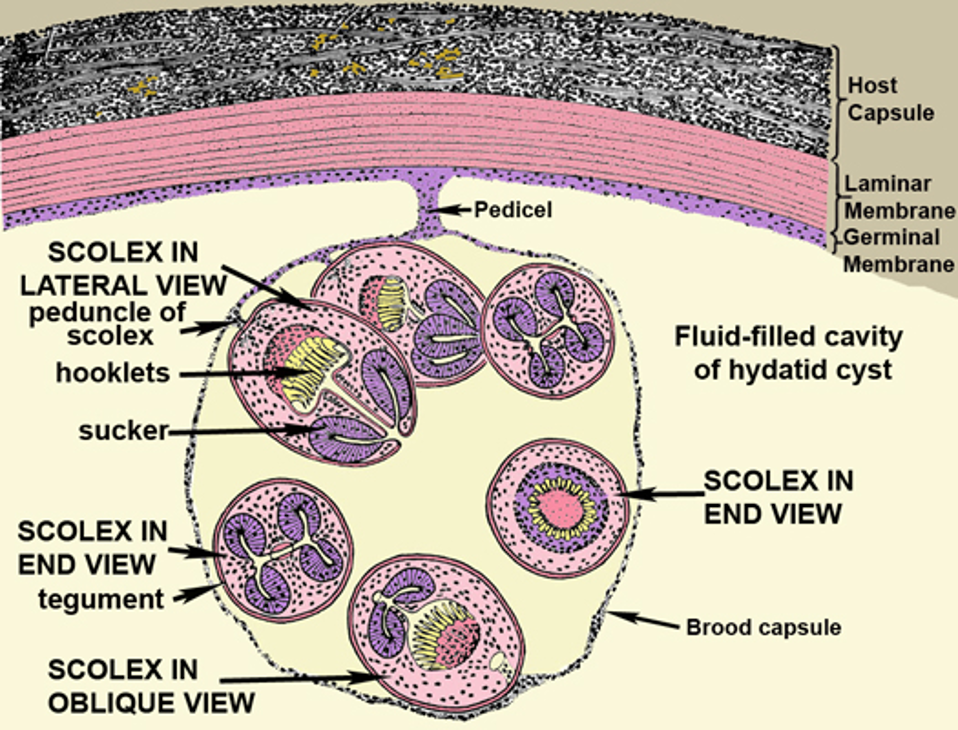
effects the liver as a slow growing destructive tumor
· Why are Cestodes the model system for understanding energetics, metabolism and physiology?
o Examples
they absorb all nutrient through their tegument good for energetics due to the fact their energy gain is entirely dependent on their host. Good for physiology because their simple body plan and continuous regeneration help make studying them a lot easier. Examples include the rate tapeworm and Schistocephalus solidus in sticklebacks
§ Crowding effects in Hymenolepis nana and energetics of adult H. diminuta
crowding effects: Adaptation to adjust the biomass of parasites to the carrying capacity of the host Weight of individual worms is inversely proportional to the number of worms present

§ Energetics of Schistocephalus solidus in Threespine Stickleback

· General nematode morphology, cuticle, body cavity, “skeletal” and muscle system, COMPLETE digestive system, nervous system, sensory structures, osmoregulatory system – Renettte cells, male and female reproductive structures
cuticle: have a cuticle with three layers muscle: movement is accomplished by contraction and relaxation of longitudinal muscles in apposition, or antagonistic to, their hydrostatic skeleton, have a complete digestive system with a mouth and anus Nervous: myo-neural processes that extend from the contractile portion of the muscle cell to the neural junctions of the dorsal or lateral nerve cords
sensory: external structures of parasitic nematodes that enable them to detect their environment include amphids on the anterior end, deirids (also called cervical papillae) near the level of the nerve ring, phasmids near the tail, and various kinds of sensory sensillae:
osmoreg: 'renette glands' excrete salt through a pore on the underside of the animal, close to the pharynx. In most other nematodes, these specialized cells have been replaced by an organ consisting of two parallel ducts connected by a single transverse duct.
male: spicules, vas deferens, seminal vessel, cloaca, testis anus
female: vulva, vagina, oviduct, ovejector, ovary, uterus, seminal receptacle
General structures of the egg – and why is this the evolutionary key to success of the parasitic nematodes
three layers uterine, chintous and lipid layer. This is key to evolutionary success because the eggs are almost indestructible to break so they can be way more likely to be swallowed whole and hatch in a host
· General life cycle – what happens between each stage? Which stage is typically infective?
the stage typically injective is the J3 juvenile stage, the nematode molts to each stage

· Soil Transmitted Helmnth and Filarial Nematodes?
STH: Whip worms, Ascaris, and Hookworms they are gotten via the soil from piercing the skin of the host
Filarial: parasitic roundworms transmitted by arthropod vectors
o Life Cycle, location in the host and pathology of Trichuris trichiura
result

prevented via cooking and freezing. can cause anemia and iron deficiencies
o Life Cycle, location in the host and pathology of Trichinella spiralis
one of the largest intracellular parasites turns a single cell into a host cell. can be prevented via conventional oven cooking and fr

eezing
o Hookworm geographic distributions, life cycle, Pathology (how does intensity dependent pathology apply?) Historical perspective
seen in warmer areas in Asia, Africa and the Americas, Causes anemia impaired mental and physical development more parasites results in more clinical symptoms. people with hookworm were seen as born lazy and to be made fun of

o Ascaris – key to success, host use and Example of how much impact these invisible creatures play.
key: §Prevalence in areas of southeastern USA among school children ranges from 2-21 Eggs can survive up to 15 years Legendary for resistance
uses the host by feeding on blood of the host. total amount of Ascaris currently is equivalent to draining the blood from 600,000 people a day, Worldwide adult Ascaris would fill five Olympic swimming pools
o Know the life cycles, host use and pathology for Wuchereria bancrofti
§ What is Elephantiasis? Physical and mental symptoms
§ Components of control
adults in lymph vessels •Microfilaria enter blood •Mosquitoes serve as vector
Elephantiasis: Gross swelling of the extremities or genitalia Lymphoedema Blockage of lymph accumulates Fibrotic tissue develops Thickening and hardening of the skin Secondary infection Permanent disability can result Disfigured people can be shunned Psychological effects
control: MDA = Mass drug administration (Controversial) Reduce Mosquito exposure
o Onchocerca volvulus River blindness – transmission, pathology – which life stages – type of vector, geographic distributions
found in areas near rivers in Africa, Northern South America, and central America

o Dracunculus medinensis – life cycles, history, work of the Carter Foundation in control.
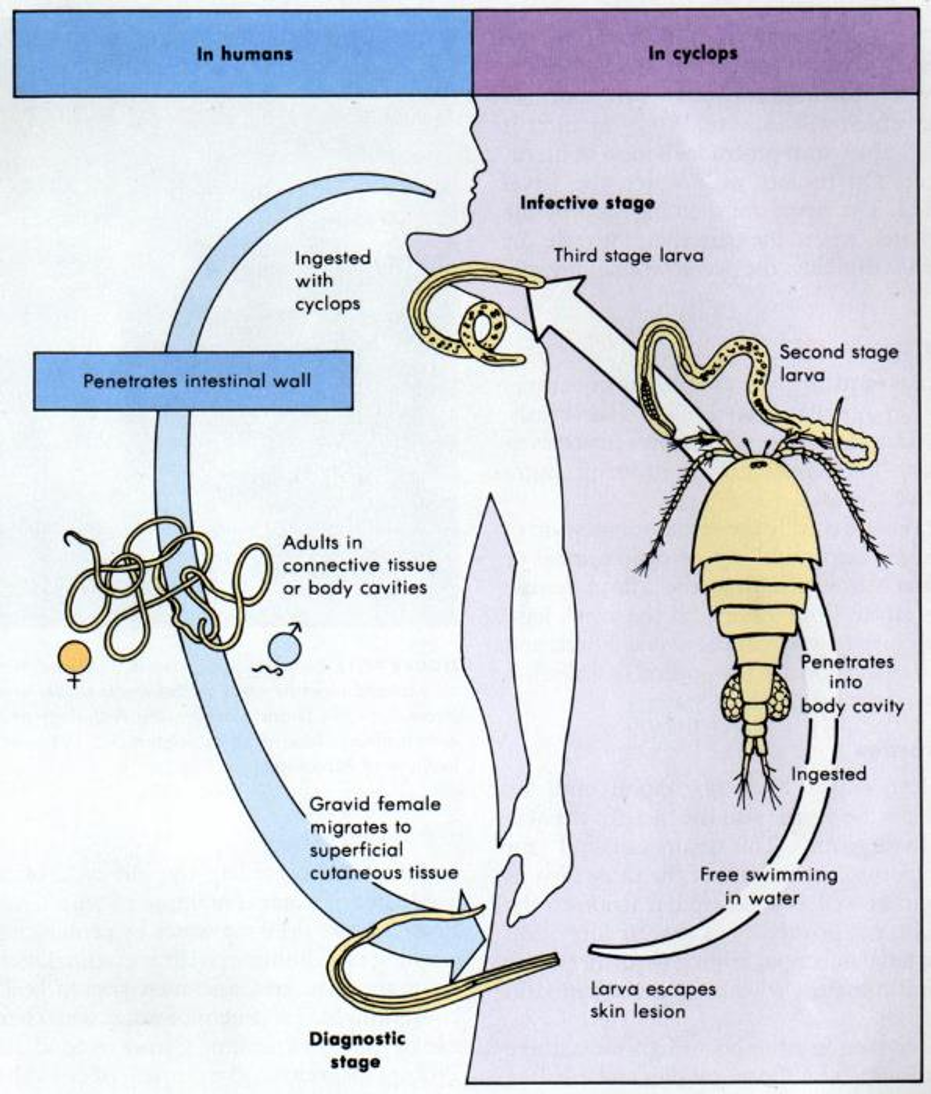
Carter foundation: •Education •improve water supplies •treat infected people
prevalence, intensity, sample mean intensity, abundance
prevalence: proportion of infected individuals
intensity: the number of parasites found in an infected host
Sample mean intensity is the mean number of these values calculated for a sample, with all the 0 values of uninfected hosts excluded.
abundance: defined and treated similarly to intensity, but the 0 values of non infected host individuals are not excluded
infrapopulation
groups of parasite individuals inhabiting the same host individual
· What is an aggregated distribution? Why does this pattern exist?
The majority of hosts harbor 0, or just a very few, parasites, a few hosts harbor more, and only a very few hosts harbor many more of them. exists due to limited dispersal resource distribution, and ecological stability
Constitutive and Inducible mechanisms, Cellular vs. Humoral,
Constitutive: constant and enduring in their expression
Inducible: systems that can lead to structural reinforcements at the site of infection or to specialized responses
Cellular: tells, macrophages, attack intracellular parasites
Humoral: antibodies, attack intercellular parasites
Basics of invertebrate immunity to parasites with trematodes in snails and mosquitos as examples. How does this fit into a parasite control strategy?
Have FREPs that locate parasite antigens, in snails they make hemocytes
What is the basic order of immune defenses for vertebrates? How is adaptive immunity incorporated? How does the immune response differ between acute and chronic infections?
1: block infection barrier defenses like skin and stomach acids
2:destory invaders with components of innate immunity
3:innate response triggers adaptive immune response
in acute infections this is how the immune system responds, in chronic infections the immune response struggles more to find the pathogen due to immune evasion or manipulation.
What are the basics and some specific examples of vertebrate immune responses to protozoa?
natural killer cells and T cells use oxygen and nitrogen to kill parasites via respiratory burst
Why is complete clearance of the parasite rarely achieved?
parasites have co-evolved with their hosts for millions of years and require high amounts of immunopathology, it had led to an evolutionary arms race that has basically plateaued
How does the immune response relate to symptoms and pathology
symptoms of parasite infections are actually from the hosts own immune response,
Why is immunity to Malaria temporary and incomplete? How does this knowledge inform control strategies and vaccine development. What is Premunition?
the immunity developed is not sterilizing, and does eradicate all parasites. the immunity is also very short lived. Premunition is regular and repeated infection to prevent onset, more debilitating disease.
What are the basics and some specific examples of vertebrate immune responses to helminth?
What is the difference between Th-1 and Th-2 immune responses? How are those cells created?
specific examples are Th-1 and Th-2
Th1: for intracellular promote activation and enhanced killing by macrophages
Th2: for extracellular parasites, helps to expel them from the body
How do parasites evade immune defenses? What are some intracellular mechanisms?
have evolved diverse strategies to evade host defenses. some examples include going into a cell and secreting a protein that suppresses the immune system, or have proteins on their surface that binds C9 and inhibits the polymerization that leads to the formation of the membrane attack complex.
How do helminths evade the immune response?
proteins on their surface that binds C9 and inhibits the polymerization that leads to the formation of the membrane attack complex.
What is antigenic variation? What are variant surface glycoproteins? Which parasites are these best studied in?
antigenic variation: periodically altering their surface proteins to help defend against anti bodies. variant surface glycoprotein is the single coat protein of protozoan parasites. Parasites this is bust studied in is trypanosomes
How do parasites suppress or mask themselves from the host immune response?
some code proteins similar to their host, mask themselves with proteins similar to host molecules, adhering to hose erythrocytes also allows them to mask themselves from host immune response