2. Theories of Social Change, Modernity
 Call Kai
 Learn
 Practice Test
 Spaced Repetition
 Match
 Flashcards
 Knowt Play
1/7

There's no tags or description
Looks like no tags are added yet.
8 Terms
What is ‘modern’?
The notion arose during 18th c. - “Age of Reason”
Enlightenment
Early 19th century:
Modernity was no conceived as the opposite of tradition
Modernity and tradition coexisted in a dielaticel relation
Modernity was not perceived as “positive” or “better” than tradition
Questions: problems to resolve rationally
Questions are not isolated
Inquiry as the fundamental mode of solution
Reason, nationalism vs. tradition
Juxtaposed with tradition/backwardness
Rupture and linear temporarily of progress
Turn of 19th/20th century
Modernity was conceived as the complete denial of tradition
Modernity was often regarded as “better” as “overtaking” tradition
Modernity questions/rejects tradition, priories individualism, freedom and formal equality, is the period of the development of nation state, representative democracy, public education (etc.)
Why do we need theories of modernity? — Questions of why, the importance of it, the explanation of it, etc.
Social Science Paradigms of Modernity
Dominant social scientific paradigms (~1950/60s - 2000s) that searches for answers: ‘How and when did modern societies emerge?’
Modernization theories
Developed dominantly in Western economics and sociology
Daniel Lerner: The Passing of Traditional Society: Modernizing the Middle East (1958)
Comparative analysis of Middle Eastern countries
Concerned with modernization on the individual level
Strongly biased from a Western point of view (modernization = diffusion of individualistic values)
Walt W. Rostow, The Stages of Economic Growth: A Non-Communist Manifesto (1960)
A.F.K. Organski, The Stages of Political Development (1965)
Basic characteristics of modernization theories:
Historical concepts are based on a holistic understanding of society: economy, politics, societal relations are determined by general characteristics of society
(Un)Linear conception of historical development
Investigation from a western point of view: modern in opposition with traditional
World/Globalization System theory
Late 15th-16th c.: modern world system (WST, see below) emerged with states
Global network system of economic exchange
Far from being homogeneous in cultural, political, economic terms
→ Fundamental differences in social development, accumulation of political power & capital
Weak & strong states
By 19th c., the world became one complex network of economic exchange relationships
Dominated by a capitalist center in an unequal division of labour, with semi-periphery & periphery
Not geographically fixed; relative to each other
Interdependence system
Almost frozen/strange temporarily
How much is it institutional?
Good institutions create efficient economy → which creates democracy
Why the theory needs semi-periphery?
Modern era is after the world empires?
Theory of multiple modernities
Focuses on the various interplay(s) between cultural & structural processes of change > process of economic development
Radically challenges modernization theories when stating:
Modernity continues to have an undeniable global impact, but this impact is so radically mediated by the historical and cultural backgrounds of each society it encounter, that it makes more sense to speak of the concept in the plural
Multiple modernities (late 1990s):
Denies: - Linearity, universality, uniformity, priority of the Western pattern
How much multiple modernities can be just variations?
Human agency
Institutional variations
Patterns
Depends on how we define modernity
Classic & new social history:
Demographic transitions/classes/urbanization etc.
Western centric and relational like Rostow:
Change is the result of encounter and adaptation
Implications
How did the first modern society arise out of trad. societies?
Are the periods qualitatively the same?
Is it really always the same process from trad. → modern?
It’s a uniform process globally — it is an important theory in itself, relating in a sense that changes towards “reconditions of take off” (stages), simply: the experience of strengths and power of another stage. If there is no relation there, there wouldn’t be any change to society.
A new paradigm:
backward =/= trad.
backwardness is always relative (modernity too)
Development & underdevelopment go hand in hand
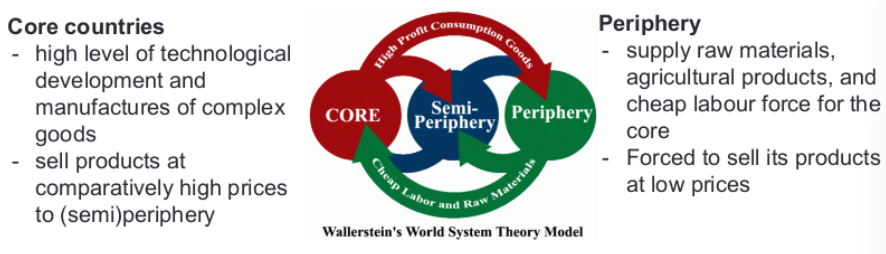
WST “World System Theory” - Immanuel Wallerstein
Contrary to modernization theories: WST states that differences between countries can not and will not be overcame as the system evolves
Developed societies were able to fuel their own development by depriving the backward societies of their resources → exploiting them
Global division of labour — including the existence of independent political units
No political center (e.g. Empire) → the world-system is identified by the global market economy
Development is not homogenous all over the world and not unilinear
Theories of modernity and social history
Classic (C) or New (N):
Rostow:
Economy drives changes
Structural, linear, dynamic presentism (C)
World system theory:
Economic system defines
Structural, rigid, Jongue durée* (C)
Gerschenkron:
contextual, structural, dynamic (C)
Multiple Modernities:
Change is inevitable but human agency and context
Dynamic, cultural (N) but probably just variations (C)