BISC205 Topic 9 (Part 2)

0.0(0)
Studied by 0 people
call kaiCall Kai
learnLearn
examPractice Test
spaced repetitionSpaced Repetition
heart puzzleMatch
flashcardsFlashcards
GameKnowt Play
Card Sorting

1/20

encourage image

There's no tags or description

Looks like no tags are added yet.

21 Terms

1
New cards

four categories of plant tissue

1.) dermal

2.) vascular

3.) ground

4.) meristematic

<p>1.) dermal </p><p>2.) vascular</p><p>3.) ground</p><p>4.) meristematic</p>
2
New cards

5 examples of dermal tissue

1.) epidermis (non-woody plants)

  • single layer of cells that covers and protects the young parts of the plant

2.) cuticle

  • secreted by the epidermal cells

  • minimizes water loss and forms barrier to protect plant from viruses, bacteria, and spores from parasitic fungi

3.) periderm (woody plants)

  • replaces the epidermis in older regions of stems and roots (part of bark)

4.) guard cells (of stomata)

  • regulates CO2 and O2 passage through photosynthetically active tissues

  • regulates water loss

5.) root hairs


<p>1.) epidermis (non-woody plants)</p><ul><li><p>single layer of cells that covers and protects the young parts of the plant</p></li></ul><p>2.) cuticle </p><ul><li><p>secreted by the epidermal cells</p></li><li><p>minimizes water loss and forms barrier to protect plant from viruses, bacteria, and spores from parasitic fungi</p></li></ul><p>3.) periderm (woody plants)</p><ul><li><p>replaces the epidermis in older regions of stems and roots (part of bark)</p></li></ul><p>4.) guard cells (of stomata)</p><ul><li><p>regulates CO2 and O2 passage through photosynthetically active tissues</p></li><li><p>regulates water loss</p></li></ul><p>5.) root hairs</p><p></p>
3
New cards

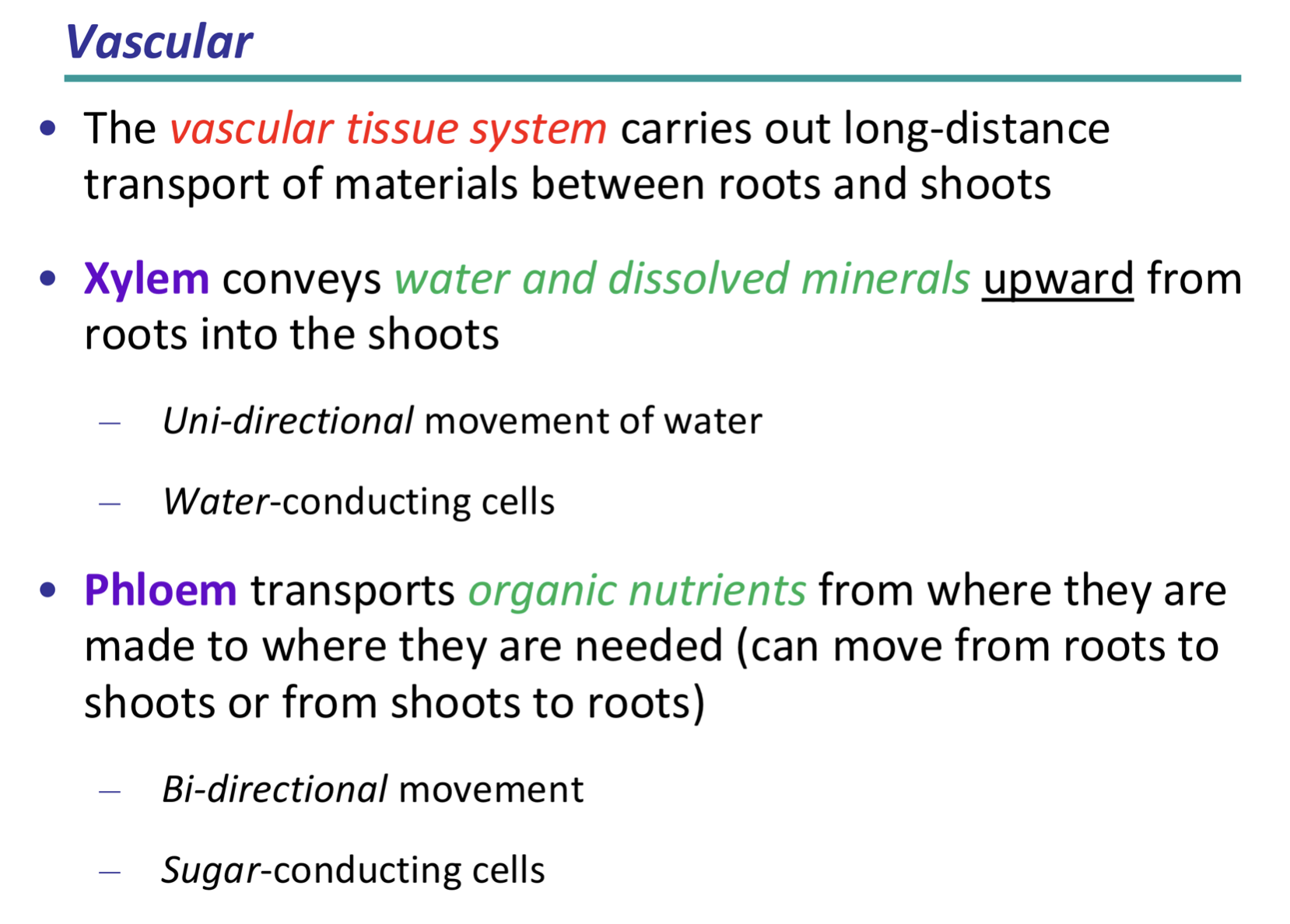
the two types of vascular tissue (xylem vs phloem)

xylem:

  • conveys water and dissolved materials upward from roots into shoot

  • uni-directional movement of water

  • water-conducting cells

phloem

  • transports organic nutrients from where they are made to where they are needed (can move from roots to shoots or from shoots to roots)

  • bi-directional movement

  • sugar-conducting cells


<p>xylem: </p><ul><li><p>conveys water and dissolved materials upward from roots into shoot</p></li></ul><ul><li><p>uni-directional movement of water</p></li><li><p>water-conducting cells</p></li></ul><p>phloem</p><ul><li><p>transports organic nutrients from where they are made to where they are needed (can move from roots to shoots or from shoots to roots)</p></li><li><p>bi-directional movement</p></li><li><p>sugar-conducting cells</p></li></ul><p></p>
4
New cards

two types of xylem (tracheids vs vessel elements)

tracheids

  • long, thin, and tapered

  • water moves from cell to cell mainly through the pits

vessel elements

  • wider, shorter, and thinner walled

  • aligned end to end to form long micropipes

  • end walls of vessel elements have perforation plates that enable water to flow freely through the vessels


<p>tracheids</p><ul><li><p>long, thin, and tapered</p></li><li><p>water moves from cell to cell mainly through the pits</p></li></ul><p>vessel elements</p><ul><li><p>wider, shorter, and thinner walled</p></li><li><p>aligned end to end to form long micropipes</p></li><li><p>end walls of vessel elements have perforation plates that enable water to flow freely through the vessels</p></li></ul><p></p>
5
New cards

similarities between tracheids and vessel elements (xylem)

  1. dead at maturity

  2. interrupted by pits, thinner regions where only primary walls are present. water can migrate laterally between neighbouring cells through pits

  3. hardened with lignin, which prevents collapse under tensions of water transport and provides support


<ol><li><p>dead at maturity</p></li><li><p>interrupted by pits, thinner regions where only primary walls are present. water can migrate laterally between neighbouring cells through pits</p></li><li><p>hardened with lignin, which prevents collapse under tensions of water transport and provides support</p></li></ol><p></p>
6
New cards

two types of phloem (sieve-tube elements vs companion cells)

sieve tube elements

  • alive at functional maturity

  • lack organelles (nucleus, ribosomes, vacuole, cytoskeleton)

  • contains sieve plates (porous end walls that allow fluid to flow between cells along the sieve tube)

companion cells

  • each sieve tube element has a companion cell

  • their nucleus and ribosomes serve both the sieve tube element and companion cell through numerous plasmodesmata


<p>sieve tube elements</p><ul><li><p>alive at functional maturity</p></li><li><p>lack organelles (nucleus, ribosomes, vacuole, cytoskeleton)</p></li><li><p>contains sieve plates (porous end walls that allow fluid to flow between cells along the sieve tube)</p></li></ul><p>companion cells</p><ul><li><p>each sieve tube element has a companion cell</p></li><li><p>their nucleus and ribosomes serve both the sieve tube element and companion cell through numerous plasmodesmata</p></li></ul><p></p>
7
New cards

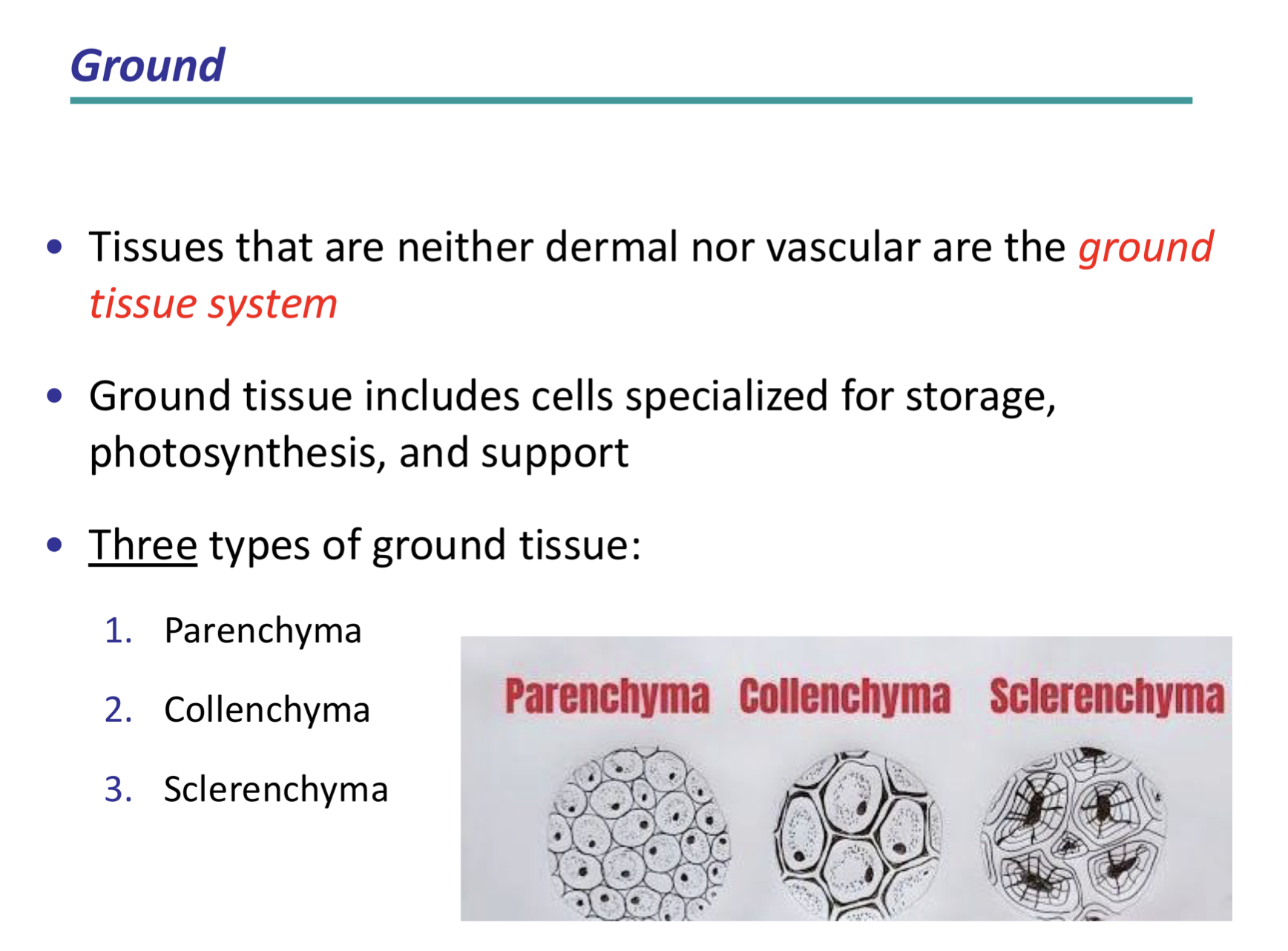
LIST three types of ground tissue

1.) parenchyma

2.) collenchyma

3.) sclerenchyma (2 types)

  • sclereids: short and irregular in shape and have thick lignified secondary walls

  • fibers: long and slender, and arranged in threads

<p>1.) parenchyma</p><p>2.) collenchyma</p><p>3.) sclerenchyma (2 types)</p><ul><li><p>sclereids: short and irregular in shape and have thick lignified secondary walls</p></li><li><p>fibers: long and slender, and arranged in threads</p></li></ul><p></p>
8
New cards
<p>ground tissues: fill in the blank</p>

ground tissues: fill in the blank

knowt flashcard image
9
New cards

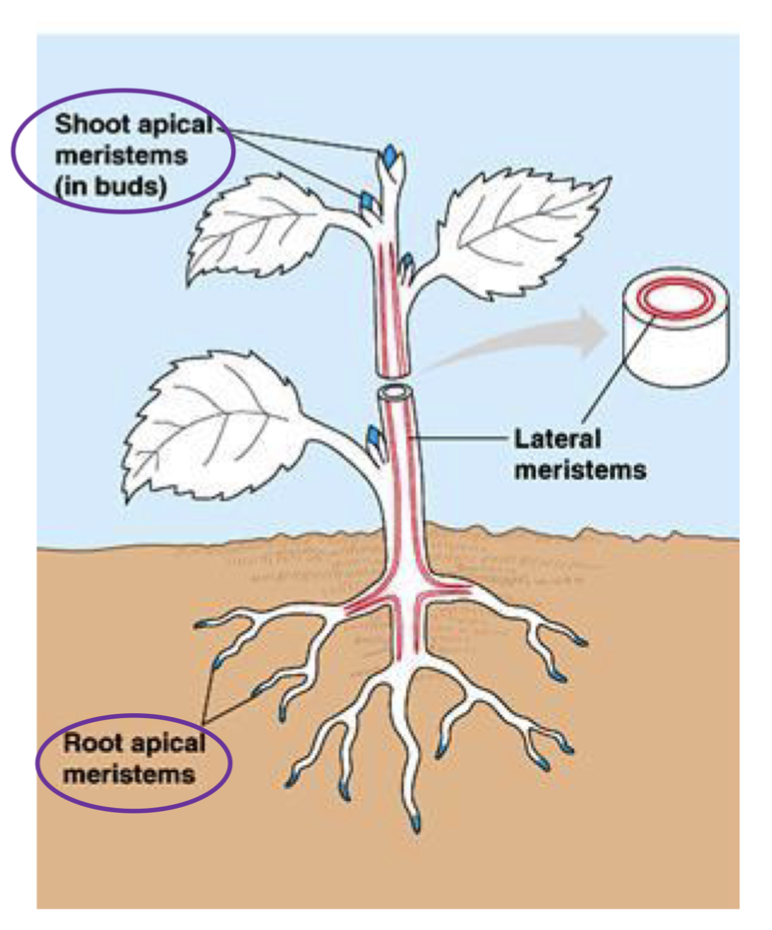
3 types of meristems

1.) shoot apical meristems

2.) lateral meristems

3.) root apical meristems
<p>1.) shoot apical meristems</p><p>2.) lateral meristems</p><p>3.) root apical meristems</p>
10
New cards

meristems vs apical meristems

meristems: active growth regions. plant tissues made of small, undifferentiated cells that are capable of continuous division

apical meristems: located at the tips of roots and shoots and at the axillary buds of shoots


<p>meristems: active growth regions. plant tissues made of small, undifferentiated cells that are capable of continuous division</p><p>apical meristems: located at the tips of roots and shoots and at the axillary buds of shoots</p><p></p>
11
New cards

apical meristems give rise to three types of primary meristems

1.) protoderm = located on the outside, gives rise to dermal tissue

2.) procambium = located typically in the centre, gives rise to primary vascular tissue system

3.) ground meristem = located between protoderm and procambium, gives rise to ground tissue system

<p>1.) protoderm = located on the outside, gives rise to dermal tissue</p><p>2.) procambium = located typically in the centre, gives rise to primary vascular tissue system</p><p>3.) ground meristem = located between protoderm and procambium, gives rise to ground tissue system</p>
12
New cards

two locations for primary growth of shoots

1.) terminal (or apical buds)

  • found at the tip (or apex) of a growing stem

2.) axillary (or lateral) buds

  • found at nodes (points along stem where lateral branches, leaves, or flowers form)


<p>1.) terminal (or apical buds)</p><ul><li><p>found at the tip (or apex) of a growing stem</p></li></ul><p>2.) axillary (or lateral) buds</p><ul><li><p>found at nodes (points along stem where lateral branches, leaves, or flowers form)</p></li></ul><p></p>
13
New cards

2 types of lateral meristems

vascular cambium: adds layers of vascular tissue called secondary xylem (towards centre) and secondary phloem (towards outer side)

cork cambium: replaces epidermis with protective periderm

<p>vascular cambium: adds layers of vascular tissue called secondary xylem (towards centre) and secondary phloem (towards outer side)</p><p>cork cambium: replaces epidermis with protective periderm</p>
14
New cards

meristem for primary growth

apical meristems are responsible for primary growth

primary growth: they elongate shoots and roots


<p>apical meristems are responsible for primary growth</p><p>primary growth: they elongate shoots and roots</p><p></p>
15
New cards

meristems for secondary growth

the two types of lateral meristems are responsible for secondary growth:vascular cambium and cork cambium

secondary growth: involves formation of rings within plant body as stems and roots increase in thickness (found primarily in woody perennials, shrubs, and eudicots)


<p>the two types of lateral meristems are responsible for secondary growth:vascular cambium and cork cambium</p><p>secondary growth: involves formation of rings within plant body as stems and roots increase in thickness (found primarily in woody perennials, shrubs, and eudicots)</p><p></p><p></p>
16
New cards

components of periderm

1.) cork

2.) cork cambium

3.) secondary cortex

4.) lenticels? (ask prof)

17
New cards

why is cork (part of periderm) waterproof?

they contain Suberin to minimize water loss in woody plants

<p>they contain Suberin to minimize water loss in woody plants</p>
18
New cards

components of bark

1) secondary phloem

  • crushed and seeded as part of the outer bark. this is needed to accommodate the increasing girth of the woody stem from continuous accumulation of secondary xylem (wood)

2) layers periderm


<p>1) secondary phloem</p><ul><li><p>crushed and seeded as part of the outer bark. this is needed to accommodate the increasing girth of the woody stem from continuous accumulation of secondary xylem (wood)</p></li></ul><p>2) layers periderm</p><p></p>
19
New cards

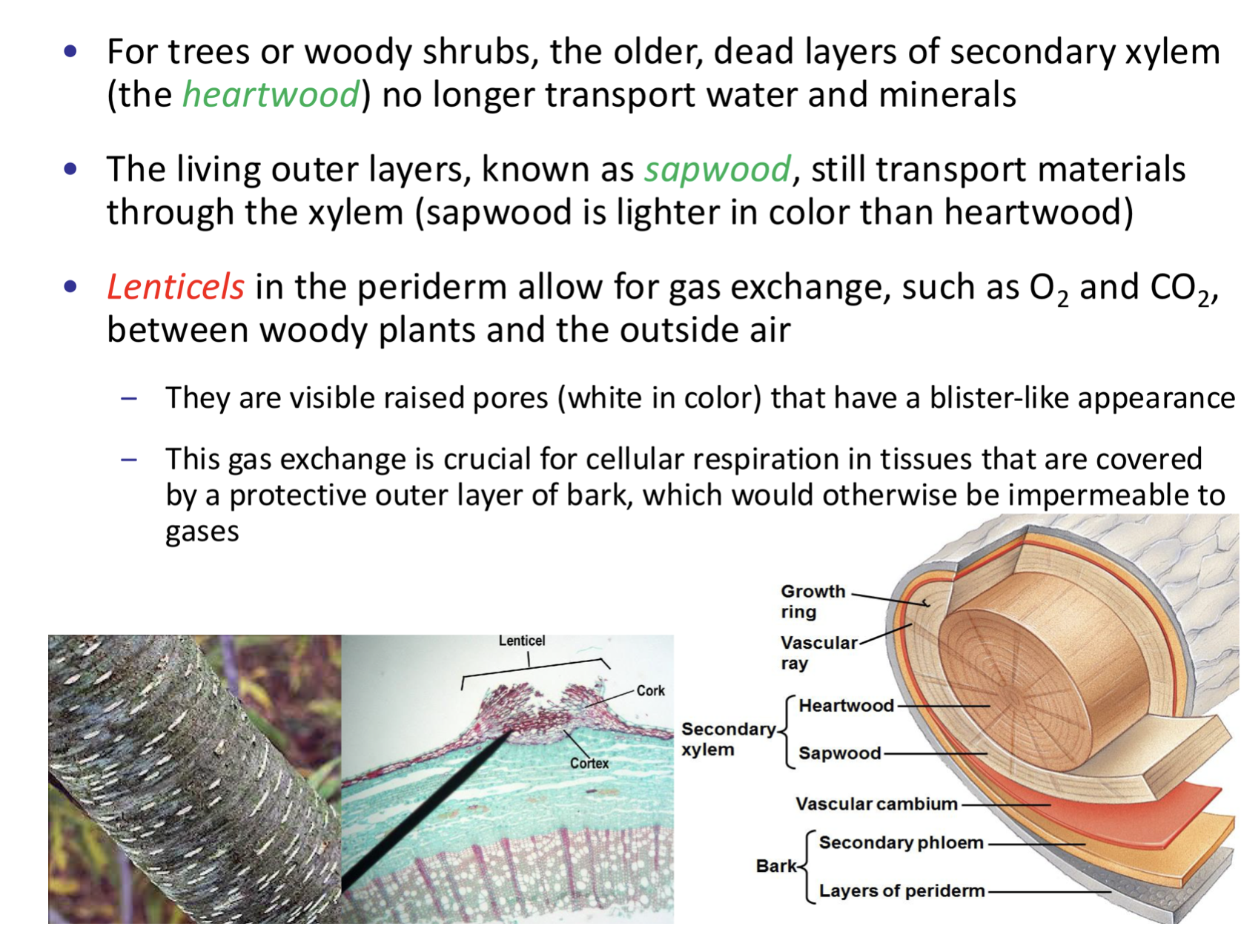
function, structure, and purpose of lenticels

function: allows for gas exchange, such as O2 and CO2 between wood plants and the outside air

structure: visible raised white pores that have a blister-like appearance

purpose: allow for cellular respiration in tissues that are covered by a protective outer layer of bark, which would otherwise be impermeable to gases
<p>function: allows for gas exchange, such as O2 and CO2 between wood plants and the outside air</p><p>structure: visible raised white pores that have a blister-like appearance</p><p>purpose: allow for cellular respiration in tissues that are covered by a protective outer layer of bark, which would otherwise be impermeable to gases</p>
20
New cards

heartwood vs sapwood


<p></p><p></p>
21
New cards

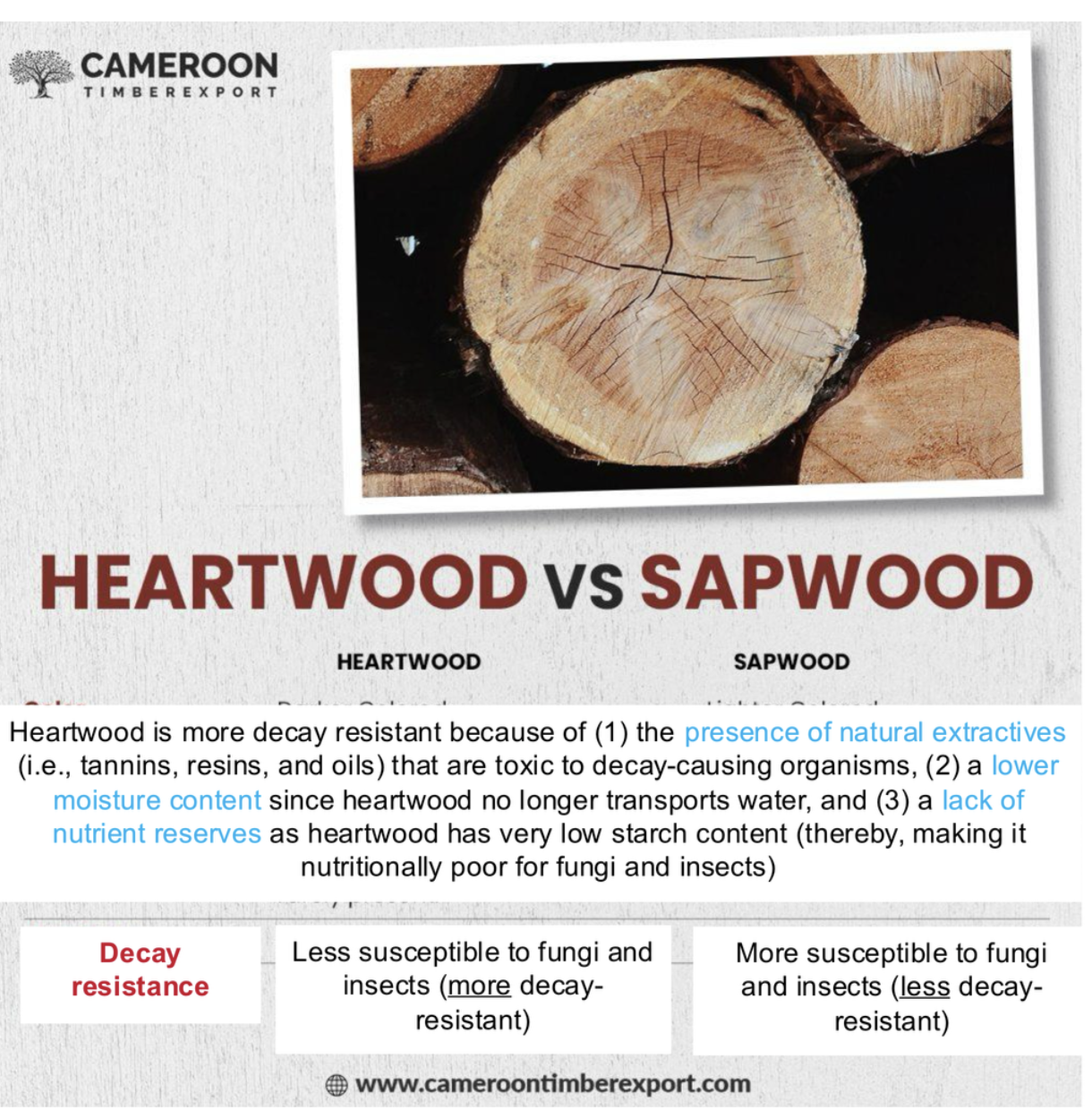
why is heartwood more decay resistant

1.) presence of natural extractives (tannins, resins, oils) that are toxic to decay-causing organisms

2.) a lower moisture content since heartwood no longer transports water

3.) lack of nutrient reserves as heartwood has very low starch content (nutritionally poor for fungi and insects)
<p>1.) presence of natural extractives (tannins, resins, oils) that are toxic to decay-causing organisms</p><p>2.) a lower moisture content since heartwood no longer transports water</p><p>3.) lack of nutrient reserves as heartwood has very low starch content (nutritionally poor for fungi and insects)</p>