Glyoxylate Shunt
 Call Kai
 Learn
 Practice Test
 Spaced Repetition
 Match
 Flashcards
 Knowt Play
1/4

There's no tags or description
Looks like no tags are added yet.
5 Terms
glyoxylate pathway functions and formula
converts acetyl‑CoA into succinate (4 carbons, from 2 acetyl-CoA’s). w/o releasing CO2
bypasses TCA steps 3-5
Efficient biosynthesis of succinate and oxaloacetate
anabolic

what happens after succinate made?
transferred to the citric acid cycle in the mitochondrion, or is converted to oxaloacetate for gluconeogenesis
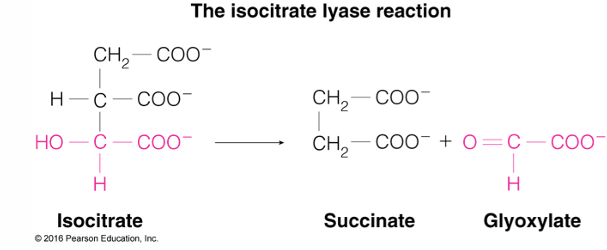
First reaction
Splits isocitrate (6 C’s) into succinate (4 C’s) and glyoxylate (2 C’s)
Second reaction:
adds two more C’s from a second Acetyl-CoA molecule to synthesize malate

Why can plants turn fatty acids into carbohydrates but animals can’t?
animals use pyruvate dehydrogenase to make pyruvate into acetyl-CoA which is irreversible
plants can use the glyoxylate shunt to make succinate which can be converted to oxaloacetate for gluconeogenesis