Theory of Reasoned Action & Planned Behaviour
 Call Kai
 Learn
 Practice Test
 Spaced Repetition
 Match
 Flashcards
 Knowt Play
1/28

There's no tags or description
Looks like no tags are added yet.
29 Terms
What is the Theory of Reasoned Action (TRA)?
TRA says behavioural intention is the most important predictor of behaviour. Intention is influenced by attitudes and subjective norms.
What is the Theory of Planned Behaviour (TPB)?
TPB is an extension of TRA. Behavioural intention is influenced by attitudes, subjective norms, and behavioural control.
What is the main difference between TRA and TPB?
TPB adds behavioural control to the factors that influence intention.
What is classical conditioning?
Learning by creating an association between two stimuli, so a previously neutral stimulus eventually produces a learned response.
What are the 5 components of classical conditioning?
Neutral stimulus
Unconditioned stimulus (US)
Unconditioned response (UR)
Conditioned stimulus (CS)
Conditioned response (CR)
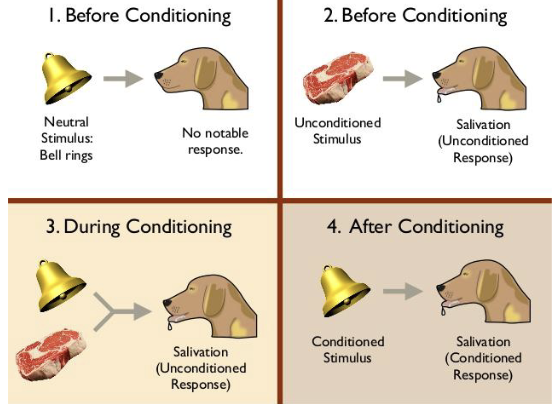
Explain neutral stimulus, US, and UR.
Neutral stimulus: initially does not cause the target response
US: naturally causes a response
UR: natural response to the US
Explain conditioned stimulus and conditioned response.
CS: previously neutral stimulus after conditioning
CR: learned response caused by the CS
What is the basic sequence of classical conditioning?
Neutral stimulus + US → UR. After learning, the neutral stimulus becomes the CS → CR.
What is operant conditioning?
Learning by associating a behaviour with its consequences.
What is the difference between reinforcement and punishment?
Reinforcement: increases behaviour
Punishment: decreases behaviour
What do positive and negative mean in operant conditioning?
Positive: something is added
Negative: something is removed
They do not mean good or bad.
What are positive and negative reinforcement?
Positive reinforcement: add a reward → behaviour increases
Negative reinforcement: remove an aversive stimulus → behaviour increases
What are positive and negative punishment?
Positive punishment: add an aversive stimulus → behaviour decreases
Negative punishment: remove a stimulus → behaviour decreases
How can you quickly identify the type of operant conditioning?
First ask whether the behaviour increased or decreased, then ask whether something was added or removed.
Classical vs. operant conditioning?
Classical: association between two stimuli.
Operant: association between behaviour and consequence.
What is Social Learning Theory?
People learn attitudes and behaviours by observing other people and seeing the outcomes they experience.
What is modeling in Social Learning Theory?
When an individual performs a behaviour and serves as an example for someone else. Modeling may be direct or symbolic.
What is Cognitive Behavioural Therapy (CBT) and what are its 3 targets?
CBT attempts to modify:
Cognitions
Behaviour
Affect
What are the 5 CBT strategies?
Self-monitoring
Cognitive restructuring
Stimulus control
Self-reinforcement
Relaxation training
What is self-monitoring?
Assessing how often a target behaviour occurs while also monitoring its antecedents and consequences.
What is cognitive restructuring?
Also called reframing; replacing negative thoughts with more positive thoughts.
What are stimulus control and self-reinforcement?
Stimulus control: remove stimuli that encourage the target behaviour
Self-reinforcement: reward yourself for successful behaviour change
What is relaxation training?
Reducing stress by replacing the target behaviour with relaxation techniques such as deep breathing or progressive muscle relaxation.
Which CBT strategies belong to each category?
Cognitive: self-monitoring, cognitive restructuring
Behavioural: stimulus control, self-reinforcement
Affective: relaxation training
What is the Transtheoretical Model (TTM)?
It views behaviour change as a gradual, non-linear process involving 6 stages.
What are the 6 TTM stages in order?
Precontemplation → Contemplation → Preparation → Action → Maintenance → Termination
Define the first 3 TTM stages.
Precontemplation: no plans to change
Contemplation: beginning to think about change
Preparation: plans to change within the next 30 days
Define the last 3 TTM stages.
Action: changed behaviour within the past 6 months
Maintenance: maintains change and prevents relapse
Termination: no risk of relapse; uncommon
What are the 4 processes of change in TTM?
Decisional balance: weighing pros and cons
Self-efficacy: confidence in ability to change
Experiential: changing emotions, thoughts, and personal experiences
Behavioural: action-based changes involving behaviour and environment
