Organizational Effectiveness & Development (OED)
 Call Kai
 Learn
 Practice Test
 Spaced Repetition
 Match
 Flashcards
 Knowt Play
 Podcast
1/43

Earn XP
Description and Tags
Vocabulary flashcards covering the core concepts of Organizational Effectiveness and Development (OED), including intervention design, organizational structures, RACI matrices, Tuckman's team development stages, and group dynamics.
44 Terms
Organizational Development
Refers to an organizational management discipline used to maintain and grow organizational effectiveness and efficiency through planned interventions.

Organizational Model
Successful strategy implementation requires alignment of six organizational elements:
Strategy: Organizational goals and direction.
Structure: How work and departments are organized.
Systems: Policies, processes, and technology.
Culture: Shared beliefs and behaviors.
Values: Principles guiding decisions.
Leadership: Behaviors modeled by leaders.
SHRM takeaway: HR assesses alignment among these elements and recommends interventions to improve engagement, performance, motivation, and compliance.
OED Interventions (Organizational Effectiveness & Development)
Actions that interrupt the status quo to examine a situation more closely and implement changes that improve outcomes, classified as either proactive or remedial.
Proactive Interventions
Identify and correct potential problems before they begin affecting performance. They may also prepare the organization to take advantage of anticipated opportunities.
Remedial Interventions
Make changes that bring an organization back on course toward its strategic goals. They are typically intended/designed to resolve a problem or issue that is current or newly discovered and to bring about a long-term positive impact on the organization and its function.
Ex. COVID, Elections
Characteristics of Effective OED Interventions
Effective OED interventions are strategically aligned, collaborative, supported by leadership, and focused on sustainable results and continuous improvement.
They should also be fact- and evidence-based, flexible, and systems-focused, using common tools, clear language, explicit assumptions, and multiple perspectives.
Why Interventions Fail
Common causes include analysis paralysis, insufficient data, unrealistic goals, limited resources, poor change readiness, and failure to involve employees.
Change efforts fail when leadership is uninvolved, messengers are ineffective, or communication is poorly timed, unrealistic, or too narrow. Employees need preparation and opportunities for feedback.
SHRM takeaway: Successful OED interventions require data-driven decisions, realistic goals, leadership support, employee involvement, and effective communication.
Organizational Design
The process of optimizing elements that support an organization's functioning, including mission and vision, strategies, decision-making, communication, processes, and resource alignment systems.
Work Specialization
A structural characteristic in organizational design defined by the degree to which organizational tasks are divided into separate, specific jobs.
Who's doing what in their job? Is there an opportunity to combine jobs so that there's more tasks done within one position? Versus lots of people doing very narrow one or two tasks in their job.
Decision-Making Authority
A structural characteristic in organizational design that determines where authority resides and who has the power to make key decisions.
How long does it take? How many people does it take, in order to make a decision?
Layers of Hierarchy
A structural characteristic in organizational design indicating the number of managerial and reporting levels from the top leadership to frontline staff. There are two important concepts when determining the layers of hierarchy: chain of command and span of control.
Span of Control
Refers to the number of individuals who report to a supervisor. Executives, managers, supervisors, and subordinates are hierarchically connected. Organizations in which many subordinates report to a few supervisors are referred to as “flat.”
Chain of Command
Refers to the line of authority in an organization. Traditionally, a subordinate reported to only one superior.
Formalization
The extent to which rules, policies, and procedures govern the behavior of employees in the organization. The more formal the organization, the greater the written documentation, rules, and regulations. Some organizations are more loosely structured than others.
Formalization may serve an organization well when uniformity is an imperative.
Departmentalization
Refers to the way an organization groups its jobs and aligns effort. Four commonly seen structures are discussed here (functional, product, geographic, and matrix), but you may encounter other, less common types of structures in your work.
New business models may require different structural approaches.

Functional Structure
Departments are separated by function such as marketing and sales, operations, and HR. Traditionally, this has been the most common organizational structure.
Line Unit
Work groups that conduct the major business of an organization, such as the production or marketing functions.
Staff Unit
Work groups that assist line units by providing specialized services, such as HR.

Geographic Structure
Functional departments grouped by geography.
Domestic organization may be structured around regions within the country. Global organizations may be organized by, for example, continents or countries. Each region or country has its own complete and self-sufficient set of functions.

Product or Customer Structure
Functional departments grouped under major product divisions.
Ex. A consumer electronics company may have separate divisions for home appliances, mobile devices, and televisions. Each division will have its own marketing, sales, manufacturing, and finance functions.
Matrix Structure
An organizational structure that combines two or more different forms of departmentalization, typically blending functional and product, project, or geographic dimensions.
Creates a dual rather than single chain of command. As a result, some employees report to two managers rather than one, with neither manager assuming a superior role.
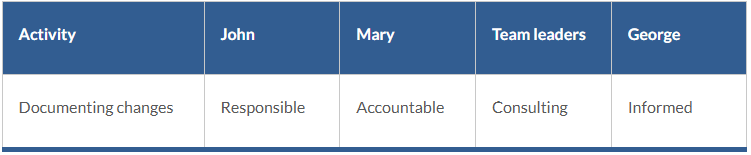
RACI Matrix
A tool that clarifies roles and communication needs around critical activities by classifying participants as Responsible, Accountable, Consult, or Informed.
Responsible (R)
The RACI matrix role assigned to the person or team that performs the work to complete a specific task or deliverable.
Accountable (A)
The RACI matrix role designating the individual with ultimate ownership, veto power, and final answerability for an activity or decision.
Consult (C)
The RACI matrix role involving individuals or subject matter experts who provide input and advice through two-way communication before an action or decision is taken.
Inform (I)
The RACI matrix role involving individuals who are updated on progress and results through one-way communication but do not contribute directly to the work.
Talent Development Intervention Process
HR identifies organizational talent needs, assesses skill gaps, and develops employees through training and development. HR also builds a future talent pipeline using performance management, stretch goals, coaching, mentoring, and succession planning.
SHRM takeaway: Identify talent gaps, develop existing employees, and prepare future leaders.
Organizational Culture Intervention Process
Four steps to align organizational culture with strategy and values:
Assess Current Culture: Examine behaviors, leadership, communication, and values.
Identify Desired Culture: Define the cultural traits the organization wants.
Identify Gaps: Compare current and desired cultures to find conflicts.
Implement Changes: Align leadership behaviors, rewards, policies, and practices with desired values.
SHRM takeaway: Successful cultural change requires leadership commitment, aligned reward systems, and consistent modeling of desired behaviors.
Team or Unit Interventions
Interventions designed to improve team performance, communication, conflict resolution, leadership, and collaboration.
Common targets include:
New teams: Build team identity.
Dysfunctional teams: Resolve conflict.
Existing teams: Improve processes and relationships.
Virtual teams: Build trust and remote collaboration.
SHRM takeaway: Team interventions focus on improving group dynamics, relationships, and processes to increase productivity and support organizational goals.
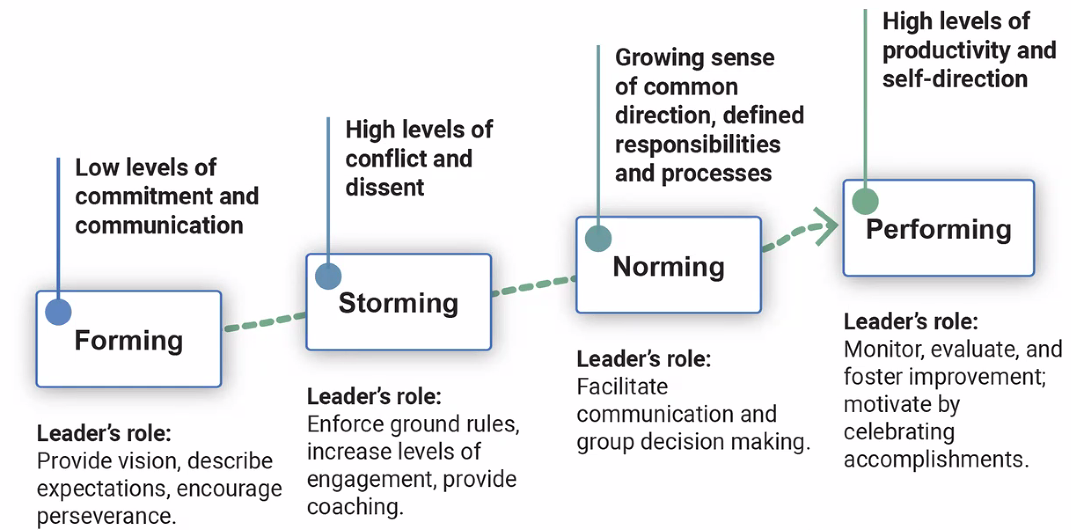
Tuckman’s Four Stages of Team Development
Forming: Team meets; low trust. Leader sets expectations and provides direction.
Storming: Conflict and disagreements emerge. Leader coaches and enforces ground rules.
Norming: Trust, relationships, and shared rules develop. Leader facilitates collaboration.
Performing: Team becomes productive and self-directed. Leader monitors progress and recognizes success.
Forming Stage
The first stage of Bruce Tuckman's team development model, marked by low levels of commitment and communication; the leader's role is to provide vision, describe expectations, and encourage perseverance.
Storming Stage
The second stage of Bruce Tuckman's team development model, characterized by high levels of conflict and dissent; the leader's role is to enforce ground rules, increase engagement, and provide coaching.
Norming Stage
The third stage of Bruce Tuckman's team development model, characterized by a growing sense of common direction, defined responsibilities, and established processes; the leader's role is to facilitate communication and group decision making (leader more hands off).
Performing Stage
The final stage of Bruce Tuckman's team development model, characterized by high levels of productivity and self-direction; the leader's role is to monitor, evaluate, foster improvement, and motivate by celebrating accomplishments.
Skill Diversity
A structural criterion that shapes team design by defining the variety of knowledge, specialized skills, and capabilities present across team members.
Authority Dispersion
A structural criterion that shapes team design based on how widely decision-making power and leadership responsibilities are distributed among team members.
Permanence
A structural criterion that shapes team design based on the intended lifespan and continuity of the team (temporary project-based vs. ongoing).
Group Dynamics
Intergroup - between 2 different groups
Intragroup - between members of a group
Benne and Sheats Group Roles
A framework developed by Kenneth Benne and Paul Sheats that categorizes individual behaviors within a group into task roles, social roles, and dysfunctional roles.
Task Roles
Group roles that focus directly on facilitating and coordinating group efforts to define problems and accomplish specific goals.
Social Roles
Group roles aimed at supporting relationships, managing conflict, and maintaining positive interpersonal dynamics and group cohesion.
Dysfunctional Roles
Individual group roles that satisfy personal needs at the expense of the team, obstructing cohesion and hindering progress.
Team Building
Involves a series of activities designed to help team members examine how they function now and how they could function better.
Focus on:
Goals & Priorities
Role & Responsibility
Processes
Interpersonal Relationships
Talent Development Interventions
Organizational activities directed at identifying talent needs, coordinating selection processes, developing existing staff through workforce initiatives, and building talent pools through mentoring and coaching.