Applied Meteorology HND
 Call Kai
 Learn
 Practice Test
 Spaced Repetition
 Match
 Flashcards
 Knowt Play
1/29

There's no tags or description
Looks like no tags are added yet.
30 Terms
What does ITCZ stand for?
Intertropical Convergence Zone
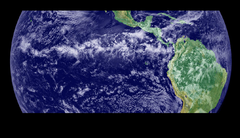
What is the definition of the ITCZ
A low-pressure belt around the Earth.
Where the Northeast and Southeast trade winds meet at the equator

What type of clouds form in the ITCZ?
Cumulus & Cumulonimbus
(Cm/Cb)
Underneath cloud clusters in the ITCZ, what kind of weather is experienced
Stormy
Poor Conditions, rain, wind, thunder, lightning
In between clusters of cloud in the ITCZ, what kind of weather will be experienced?
Fair Clear Weather
How do large amounts of heat energy get transferred into the atmosphere in the ITCZ
Latent heat release during the condensation of water vapour in cumulonimbus alongisde sensible heat flux (high evaporation) from the warm tropical ocean surface
What is sensible heat flux
the turbulent and conductive exchange of heat between the Earth's surface and the atmosphere

Why does the ITCZ move?
It tracks the thermal equator
At what latitudes do the westerlies normally occur?
30-60 N/S

How many observations do you need to obtain a trend?
Minimum 3

Describe the formation and development of the jet stream
With increasing height, atmospheric pressure decreases faster through a cold air mass compared to a warm air mass. This increasing temperature gradient thus increases the pressure gradient force.
Meaning wind speed increases with height.
What is a jet stream?
The jet stream is a fast-flowing river of air found just under the tropopause. They form at the boundaries of adjacent air masses.
What are the connections between the jet stream and frontal depressions?
The jet stream is a major player in the formation of frontal depression, and they are steered by the polar jetstream.

Write a weather report for a position at the cold front of a depression.
Pressure tendency?
Temperature trend?
Clouds/sky?
Weather?
Visbility?
Pressure tendency: Sudden Rise
Temperature trend: Sudden drop
Clouds/Sky: Cumulonimbus with low scud
Weather: Heavy rain, hail, thunder
Visibility: Poor at front, improving later
What will be the weather at the occluded front of a depression.
Pressure Tendency
Clouds
Weather
Visibility
Pressure tendency: steady
Cloud: Nimbostratus and Cumulonimbus
Weather: Heavy rain
Visbility: Poor

Identify and explain the synoptic feature
Trough
an elongated region of relatively low atmospheric pressure that lacks a closed circulation
Where do troughs form?
What weather may you find at a trough?
Troughs form near the surface or high aloft in the jet stream,
They often mark converging, rising air that brings
clouds, wind shifts, and unsettled weather.

What's the expected weather in the warm sector
Clouds/precipitation?
Visibility?
Expected change in pressure?
Expected change in wind?
- Overcast stratus, stratocumulus, drizzle
- Mod to Poor vis (Very foggy)
- Steady, slow drop in pressure
- Steady wind
Explain the different types of anticyclones.
Warm anticyclones (such as subtropical highs) extend deep into the troposphere and bring stable, warm weather. Cold anticyclones (such as polar highs) are shallow systems driven by intense surface cooling.
How do anticyclones form?
Cooling air becomes denser, sinks toward the surface, increases atmospheric pressure, and diverges outward.
What are the general weather conditions in an anticyclone?
Calm or light winds, clear skies, and stable atmospheric conditions.
Why do anticyclones produce clear skies?
Subsidence (sinking air) causes adiabatic warming, which inhibits cloud formation.
What kind of visibility issues occur in anticyclones?
Radiation fog or mist can form overnight under clear skies, causing poor visibility in the morning.
What are winter weather conditions like in an anticyclone?
Cold, frosty nights with surface inversions, sometimes accompanied by persistent low-level fog or stratocumulus.
What are the characteristics of the polar continental air mass?
- Source
- Temperature
- Humidity
- Siberia, Scandinavia, Russia
- Generally cold. Cold in Winter / Mild in Summer
- Low Humidity
What are the characteristics of the polar maritime air mass?
- Source
- Temperature
- Humidity
Greenland, Canada
Cold
High/Medium
What are the characteristics of the Tropical Continental air mass?
- Source
- Temperature
- Humidity
Sahara
Warm
High Humidity
What are the characteristics of the Tropical Maritime air mass?
- Source
- Temperature
- Humidity
Azores/Bahamas
Warm
High Humidity
What are the characteristics of the Arctic air mass?
- Source
- Temperature
- Humidity
Arctic Ocean
V.Cold
Low Humidity(dry)
What are the characteristics of the Returning polar maritime air mass?
- Source
- Temperature
- Humidity
Greenland, North Canada
Cool, warmer in summer
High/Medium Humidity