Ch 6 Cartilage & Bone 🦴
 Call Kai
 Learn
Learn Practice Test
 Spaced Repetition
 Match
Match Flashcards
 Knowt Play
1/15

There's no tags or description
Looks like no tags are added yet.
Name | Mastery | Learn | Test | Matching | Spaced | Call with Kai | Chat |
|---|
No analytics yet
Send a link to your students to track their progress
16 Terms
Cartilage
Semirigid connective tissue that is weaker than bone, but flexible and resilient.
What are the function of cartilage?
Supporting tissues
Providing a gliding surface at articulations (joints), where two bones meet.
Providing a model for the formation of most of the bones in the body.
What are the three types of cartilage?
Hyaline cartilage
Elastic cartilage
Fibrocartilage
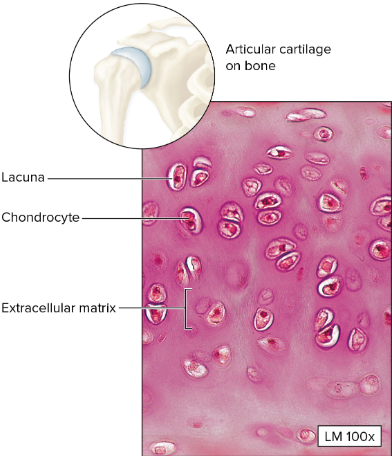
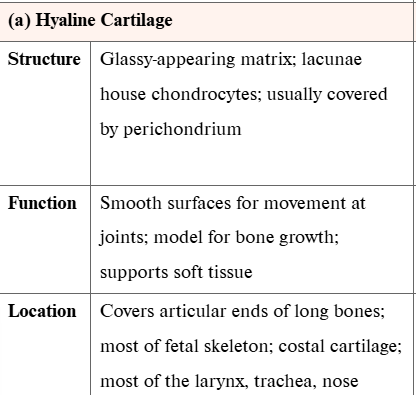
Hyaline Cartilage

Fibrocartilage


Elastic Cartilage

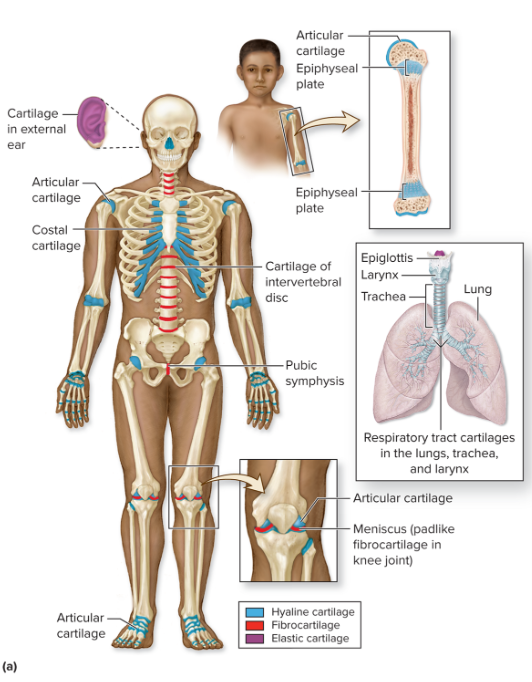
Distribution of cartilage
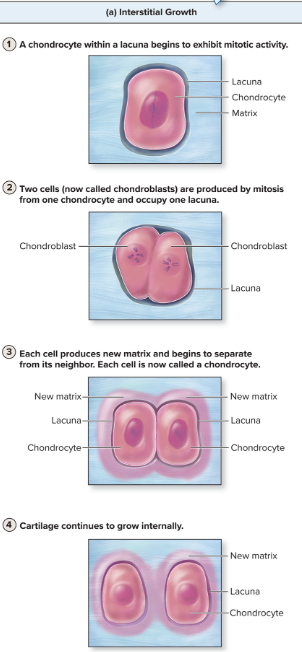
Interstitial growth
Occurs within the internal regions of cartilage through a series of four steps
Chondrocytes housed within lacunae are stimulated to undergo mitotic cell division.
Following cell division, two cells occupy a single lacuna; they are now called chondroblast.
As chondroblasts begin to synthesize and secrete new cartilage matrix, they are pushed apart. These cells now reside in their own lacuna and are called chondrocytes.
The cartilage continues to grow in the internal region as chondrocytes continue to produce more matrix.
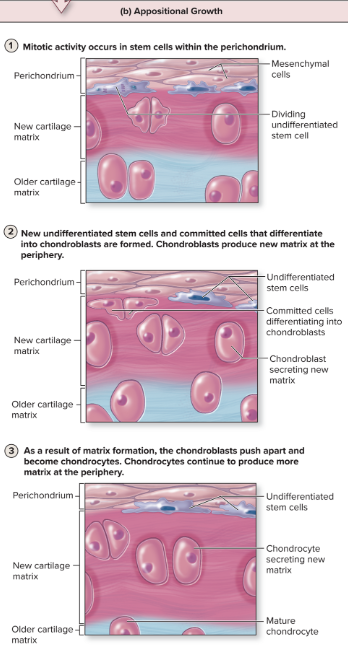
Appositional growth
An expansion along the outside edge, or periphery of the cartilage, usually under the perichondrium.
Undifferentiated stems cells deep to the perichondrium begin to divide. (Notes: The perichondrium contains mesenchymal calls as well as these stem cells.)
The dividing cells results in new undifferentiated stem cells and cells that differentiate into chondroblasts. These chondroblasts are located at the periphery of the old cartilage, where they begin to produce and secrete new cartilage matrix.
As a result of matrix formation, the chondroblast push apart and become chondrocytes, with each occupying its own lacuna. The cartilage continues to grow at the periphery as chondrocytes continue to produce more matrix.
What are the functions of bone and bone connective tissue?
Support and protection
Movement
Hematopoiesis: The process production of formed elements in the blood.
Storage of mineral and energy reserves
Classification of bone by shape


Long bones
Greater length than width
Most common shape
Have elongated, cylindrical shaft (diaphysis)
Upper limb: Arm, forearm, palm, and fingers
Lower Limb: Thigh, leg, sole of the foot, and toes.

Short bones
Length nearly equal to their width
External surfaces are covered by compact bone
Interior is composed of spongy bone
Carpals and tarsals
Sesamoid bones
Patella
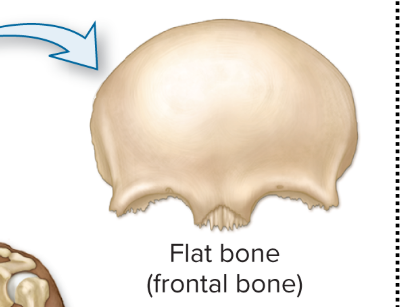
Flat bones
Flat and thin surface
Composed of roughly parallel surfaces of compact bone with a layer of internally placed spongy bone
Provide extensive surfaces for muscle attachment
Protect underlying soft tissue
Roof of the skull
Scapulae
Sternum
Ribs

Irregular bones
Elaborate, complex shapes
Do not fit into any of the preceding categories
Compact bone covering internal spongy bone
Vertebrae, hip bones, ethmoid, sphenoid bones.
Skeletal system
