Chapter 8 : Analysis of a Tariff
 Call Kai
 Learn
 Practice Test
 Spaced Repetition
 Match
 Flashcards
 Knowt Play
1/14

There's no tags or description
Looks like no tags are added yet.
15 Terms
Describe what a tariff is
A tax on imported goods
Why on two different countries, a tariff can have different effects ? what are the effects on world price ?
Because it depends on the size of the importing country
Small → No effect on world prices, just an effect on domestic prices
Big → Impact the world price
For a small importing countries what are the effects on : Price of imported goods ; price of domestic goods ; quantity demanded ; quantity supplied domestically ; The imports ?
Price of imported goods rise (here from 300 to 330), therefore the market price follows (and domestic goods also)
Demand reduce (From D0 to D1 in the example)
Quantity supplied rise from S0 to S1 (as prices rise)
Imports reduce (from M0 to M1)
Other question : What’s the area a on the picture ? The gain of producers from the tariffs
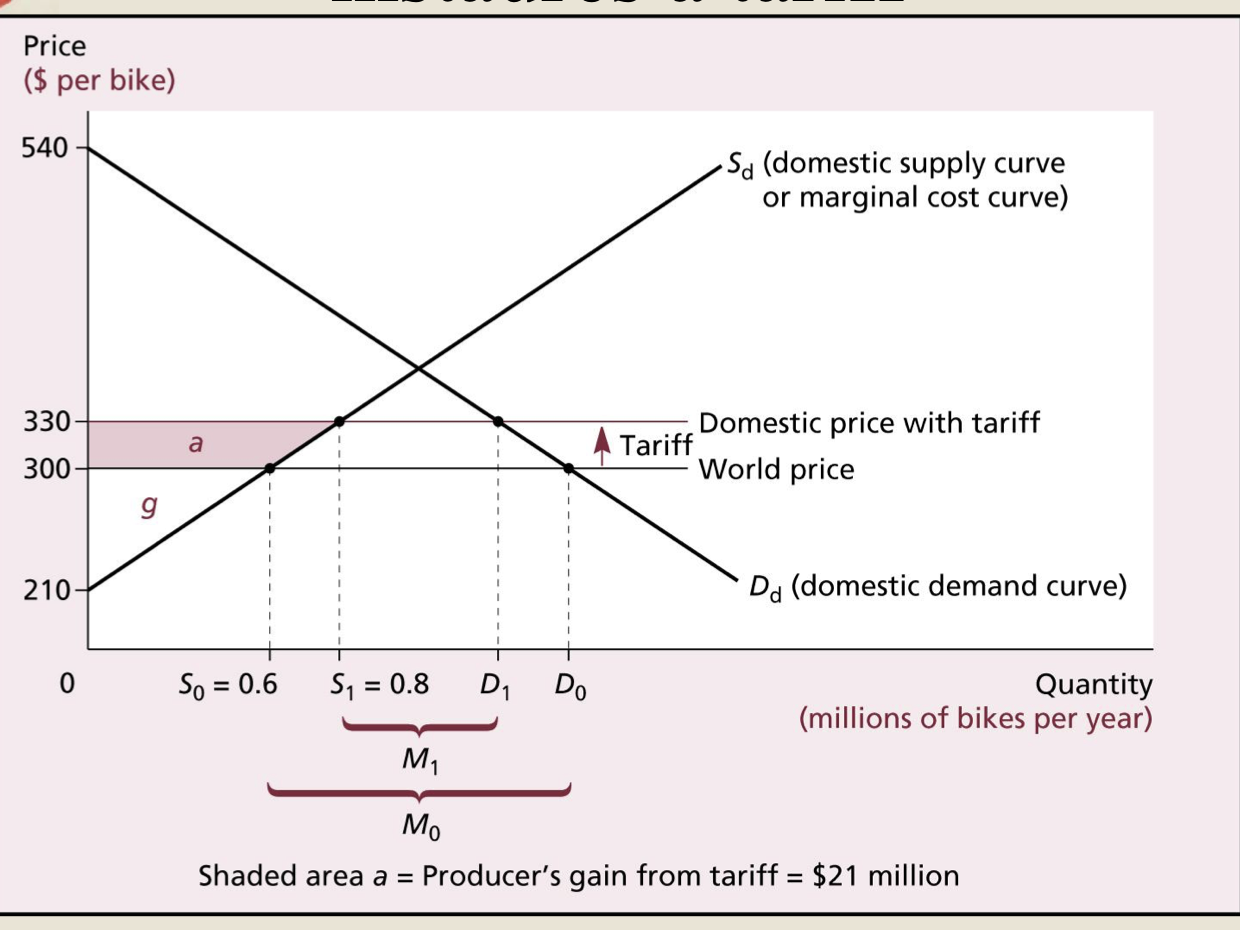
What are the changes in consumer surplus ? and in producer surplus ? What does government gains and how to calculate the value ? Therefore what’s the change in total surplus ?
Interprete each result
CS reduce (-a-b-c-d) → Consumers lose by paying a higher price for both imported and domestic goods (so they consume less)
Producer surplus increase by a → Producers win as they get a higher price and so are able to produce a larger quantity (S1)
→ Note : Could be more complicated if other tariffs impact the cost of intermediate materials
Government gains c (so here 30*M1) <=> The tariff times the new imports → Government obviously gains thanks to the tariffs
So total surplus is : -a-b-c-d+a+c = -b-d → Overall its a loss for the small country to set a tariff
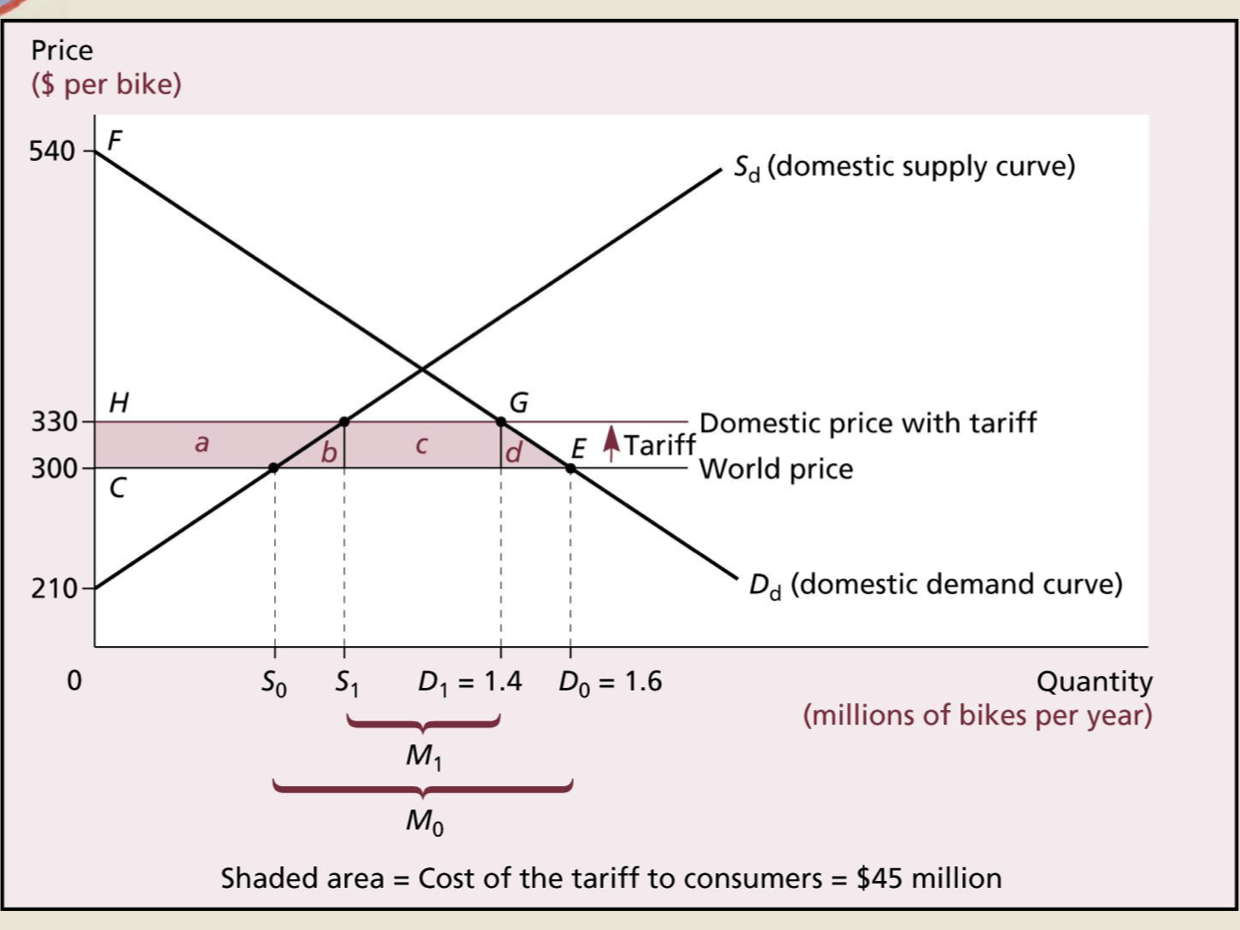
What are the effects on consumption and on supply ?
Consumption reduce (-d) and production from (-b) because of the high cost domestic production caused by the tariff
Which explain the total surplus variation : -b-d
Now for a large country : what’s the main difference with setting up a tariff ? Explain how this can happen
The tariff impacts the world price
→ By putting tariffs on imports, exporters have to lower their prices to keep the same competitivity on the country (and as its a large country it has a lot of exporters so the whole world price changes)
So with tariffs what happen for exporter, importing price, consumer and government ?
exporters gains less ; importing price falls (as exporters lower their prices) ; consumers pay more ; and government gains

What can we know about the variation of price when we only know the value of the tariff ?
We know that price will not have a variation higher than the tariff value because exporters prefer to lower their exporting prices rather than losing their exports revenue and competitivity.
So what are the changes in CS ; PS ; government ; and TS in this large country ?
No changes for PS and CS :
PS : producers still gain from the higher price, they gain a again
CS : Consumers lose from the higher price of imported goods and domestic goods
→ So they lose a+b+c+d (-a-b-c-d)
Government : government still gains c but also gains e (c+e)
→ with e = the new difference between world price and export price because tariffs made exporters lower their prices
So TS = a-a-b-c-d+c+e = -b-d+e

Therefore, overall, does the large country win or lose from the tariffs ?
We can’t know without further information :
TS is -b-d+e so :
Gains if : -b-d+c > 0
Loses if : -b-d+c < 0
We say that the country shows a national loss but also a national gain
In the country who will anyway lose from the tariff in any situation ?
So if we have a small tariff and -b-d+e > 0, what happens in the country ?
Consumer
There’s a net gain, consumer lose but are more than compensated by domestic producers gains and government gains
And what’s the direct negative effect on the foreign exporter and the risk ?
The loss for the exporter is greater than the net gain of the big country, therefore there’s a risk that the exporter stop exporting to the big country or set up conter tariffs for exemple as he’s too hurted by the tariffs
When there’s a tariff, why domestic producers increase their prices instead of keeping it as they have no tariffs on their goods ?
Because with perfect competitivity that is assumed, they are price takers.
To sum up, give me really quickly the effect of a tariff on a small and on a big country (like is it positive or not, or we don’t know or jsp j’ai plus d’inspi)
Tariffs always hurt a small importing country for sure
But tariffs in theory may not hurt a big importing country, though the exporter will probably in practice retaliate and you’ll lose because of your own tariff
→ So in general its in any case a loss BUT sometimes it can be great for a big country
What’s the CAP ? What’s his goal ? How has he been protected ?
CAP = Common agricultural policy (in Europe)
→ The goal is to ensure European farmers that they will get high prices for their production, and if the market prices fall below the agreed market price level, the EU buy the farmers production
→ In order to protect the market price and farmers production, tariffs have been set up, so that the market price in the EU stays higher than the agreed level