Chapters 6,7
 Call Kai
 Learn
 Practice Test
 Spaced Repetition
 Match
 Flashcards
 Knowt Play
1/33

There's no tags or description
Looks like no tags are added yet.
34 Terms
membrane potential
the difference in electrical potential between the interior and the exterior of a cell
threshold potential
the membrane potential to which a membrane must be depolarized to initiate an action potential (-40 - -55 mV)

voltage/electric potential difference
potential difference between two points
current
the flow of electric charge through a medium; carried by moving ions to neurons
resting potential
the membrane potential of quiescent cellls (-70 - -90mV)
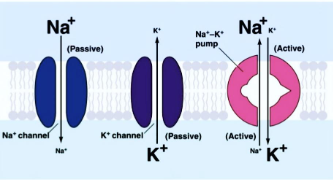
3 Na+ OUT 2 K+ IN
K+ and Na+ channels have passive ion leakage down concentration gradients
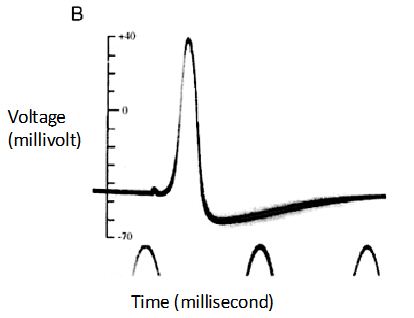
Hodgkin and Huxley
the first two researchers to record an action potential with the use of a squid giant axon
Axon was dissected from a squid and an electrode was inserted within it and connected to an amplifier
Trace shows change in voltage during an action potential
Cell voltage is measured in milivolts; resting potential of a squid axon is -76 mV
Equilibrium Potential
the potential at which the electrostatic force in the cell is exactly equal to the force of diffusion for an ionic species; the forces of K+ and Na+ channels are atractive at 102mV
Nersnt Equation
equilibrium potential for an individual ion
Ek = 61.5 log10 (3 mM/135mM) = -
102mV
Goldman equation
equilibrum potential across a cell’s membrane for all permanent ions

voltage clamp
measures the ion currents across the membrane and holds the voltage at a set level; researchers can inject current into the cell to maintain a certain voltage

Ohm’s Law
V = IR

physiological changes at single-channel levels
voltage: ~100mV
resistant: drops ~100x as channels open
current: ~10 nanoamperes caused by Na+ influx and K+ efflux
concentration: ~0.1 picomoles of Na+ enter and ~0.1 picomoles of K+ leave
capacitance: low


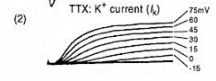
scorpion toxin (ScTX) and puffer fish/terodotoxin (TTX)
block Na+ channels, revealing K+ currents
voltage-gated sodium channels
S4 subdomain of the alpha subunit detects voltage changes via positively charged arginine residues

tetraethylamonium (TEA)
blocks K+ channels, revealing Na+ currents

epilepsy
millions of neurons release K+ simultaneously, causing a positive shift in the K+ equilibrium and resting potential
causes hightened neuron sensitivity
spreading depolarization waves inducing seizures
interictal epileptiform discharges (IEDs) are hypersynchronous patterns of brain activity

electroencephalogram (EEG)
transcranial measurement using 64 silver electrodes to record millions of postsynaptic electrical currents in mV over time

Neurotransmitter Criteria
Synthesized by and released from neurons
Released from nerve terminals in chemically identifiable forms
A reproducible response at the postsynaptic cell
Effect blocked if appropriate receptor antagonist is used
Mechanisms of termination present

glutamate
receptor: AMPA
location: hippocampus
function: memory
GABA
receptor: GABA-A
location: cerebellum
function: inhibition
acetylcholine
receptor: nicotinic
location: cortex
function: attention
dopamine
receptor: D1
location: striatum
function: movement
noradrenaline
receptor: alpha-2
location: cortex
function: attention
adrenaline
receptor: beta
location: brainstem
function: arousal
serotonin
receptor: 5-HT1A
location: hippocampus
function: mood
endorphin
receptor: micro-opiod
location: hypothalamus
function: analgesia (pain relief)
Neurotransmitter life cycle
1-3. Amino acid precursor accumulates in neuron, is metabolizd, and packaged in vesicles
4-5. transmitter is released into synaptic cleft, interacting with autoreceptors or regulating post-synaptic receptors
high-affinity transporters terminate neurotransmitter action
transmitter diffuses away from the synaptic cleft
glia and auto-transporters take in transmitter through membrane-bound transporters

GABA transmitter life cycle
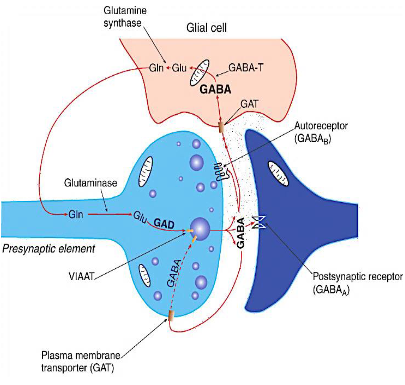
GABA is converted into glutamate by GABA transaminase (GABA-T); glutamine synthase then produces glutamine
glutamine enters neuron and is transformed by glutaminase into glutamate; GABA is formed from glutamate by glutamic acid decarboxylase (GAD)
released GABA is accumulated by GABA transporters (GAT) in astrocyte glia
Caffeine inhibits GABA release; alcohol and xanax increase GABA activity
GABA
dervied from glucose metabolism; major inhibitory transmitter of the brain, opening channels to hyperpolarize neurons
transmitter life cycle in catecholamine neurons
tyrosine is accumulated by the neuron
it is later metabolized to L-DOPA by tyrosine hydroxylase (TH) and L-aromatic amino acid decarboxylase (L-AADC) to dopamine (DA)
Dopamine is taken into vesicles (final step in dopaminergic neurons)
in norepinephrin (NE) neurons, dopamine is converted to norepinephrine by dopamine-beta-hydroxylase (DBH) inside vesicles
accumulation by NE transporter (NET) facilitates its breakdown to inactive dihydroxyphenylglycine (DHPG) by monoamine oxidase (MAO)

welbutrin
inhibits dopamine and norepinephrin reuptake
prozac
inhibits the serotonin transporter SERT); selective serotonin reuptake inhibitor (SSRI)
functional magnetic resonance imaging (fMRI)
directs blood oxygenation changes occurring in response to neural activity
depression effects
decreased global neural activity
decreased hippocampal size
reduced dendritic branching and spinal density
