exam 3 practice questions
 Call Kai
 Learn
 Practice Test
 Spaced Repetition
 Match
 Flashcards
 Knowt Play
1/24

There's no tags or description
Looks like no tags are added yet.
25 Terms
B₂O₃ + 3 C + 3 Cl₂ → 3 CO + 2 BCl₃ This reaction is an acid-base reaction
False.
B₂O₃ + 3 C + 3 Cl₂ → 3 CO + 2 BCl₃ This reaction is a redox reaction
True.
B₂O₃ + 3 C + 3 Cl₂ → 3 CO + 2 BCl₃ This reaction is a disproportionation reaction
False.
AlF₃ + 3 KF → K₃[AlF₆] This reaction is an acid-base reaction
True.
AlF₃ + 3 KF → K₃[AlF₆] This reaction is a redox reaction
False.
The reaction of silicon tetrachloride and water to generate silicic acid and hydrochloric acid This reaction is a hydrolysis reaction
True.
The reaction of silicon tetrachloride and water to generate silicic acid and hydrochloric acid This reaction is a redox reaction
False.
The reaction of silicon tetrachloride and water to generate silicic acid and hydrochloric acid This reaction is a calcination reaction
False.
The reaction of silicon tetrachloride and water to generate silicic acid and hydrochloric acid This reaction is a hydrolysis reaction / This reaction is a redox reaction / This reaction is a calcination reaction / None of the above
Hydrolysis
The structure and properties of cubic BN are analogues to those of diamond (the cubic allotrope of carbon)
True.
Diamond, carbon nanotubes, graphite, Buckminster-fullerenes, and graphene are all allotropes of carbon
True.
SiO₂ contains four oxygen-silicon single bonds
True: each Si is bonded to four O atoms in the network.
Tin forms a covalent hydride
True: SnH₄.
It is most likely that BiI₅ is much less stable, if existing at all, than BiI₃
True.
PbO₂ is an oxidant but SiO₂ is not
True (under the ordinary conditions intended).
PH₃ can be expected to be a Lewis base
True.
SbCl₅ can be expected to be a Lewis acid
True.
P₄O₆ contains double bonds
False: its cage contains P–O single bonds.
SbCl₄ is the likely product between Sb and elemental Cl₂
False: the usual chlorides are SbCl₃ and SbCl₅, depending on conditions.
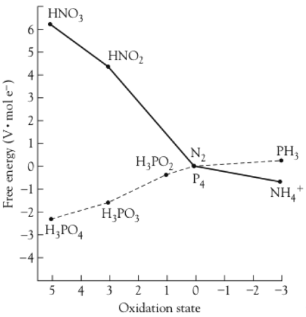
Considering the Frost diagram for N₂ and P₄ in acidic solutions shown: H₃PO₄ is a better oxidant than HNO₃.
False.

Considering the Frost diagram for N₂ and P₄ in acidic solutions shown: PH₃ is a reductant.
True.
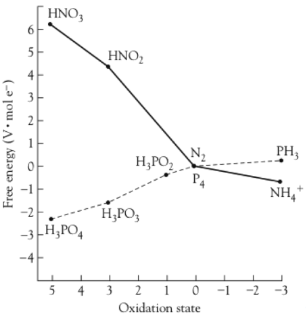
Considering the Frost diagram for N₂ and P₄ in acidic solutions shown: The reaction H₃PO₂ → H₃PO₃ is an oxidation.
True: P changes from +1 to +3.
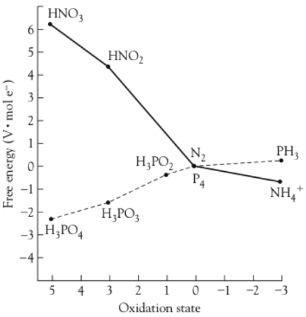
Considering the Frost diagram for N₂ and P₄ in acidic solutions shown: The formation of P₄ from H₃PO₃ is exothermic.
Cannot tell from a Frost diagram alone. It gives Gibbs free-energy information, not the enthalpy needed to identify an exothermic reaction.
Explain with very few words why CCl₄ is not a Lewis acid but SiCl₄ is:
SiCl₄ accepts electron pairs to form higher-coordinate adducts; larger Si can accommodate five or six ligands. CCl₄ does not readily form analogous stable adducts.
Explain very few words why the boiling point of SnCl₂ is 652°C but that of SnCl₄ is 114°C:
SnCl₂ has an extended, chloride-bridged structure with strong interactions; SnCl₄ consists of discrete molecules with weaker intermolecular attractions.